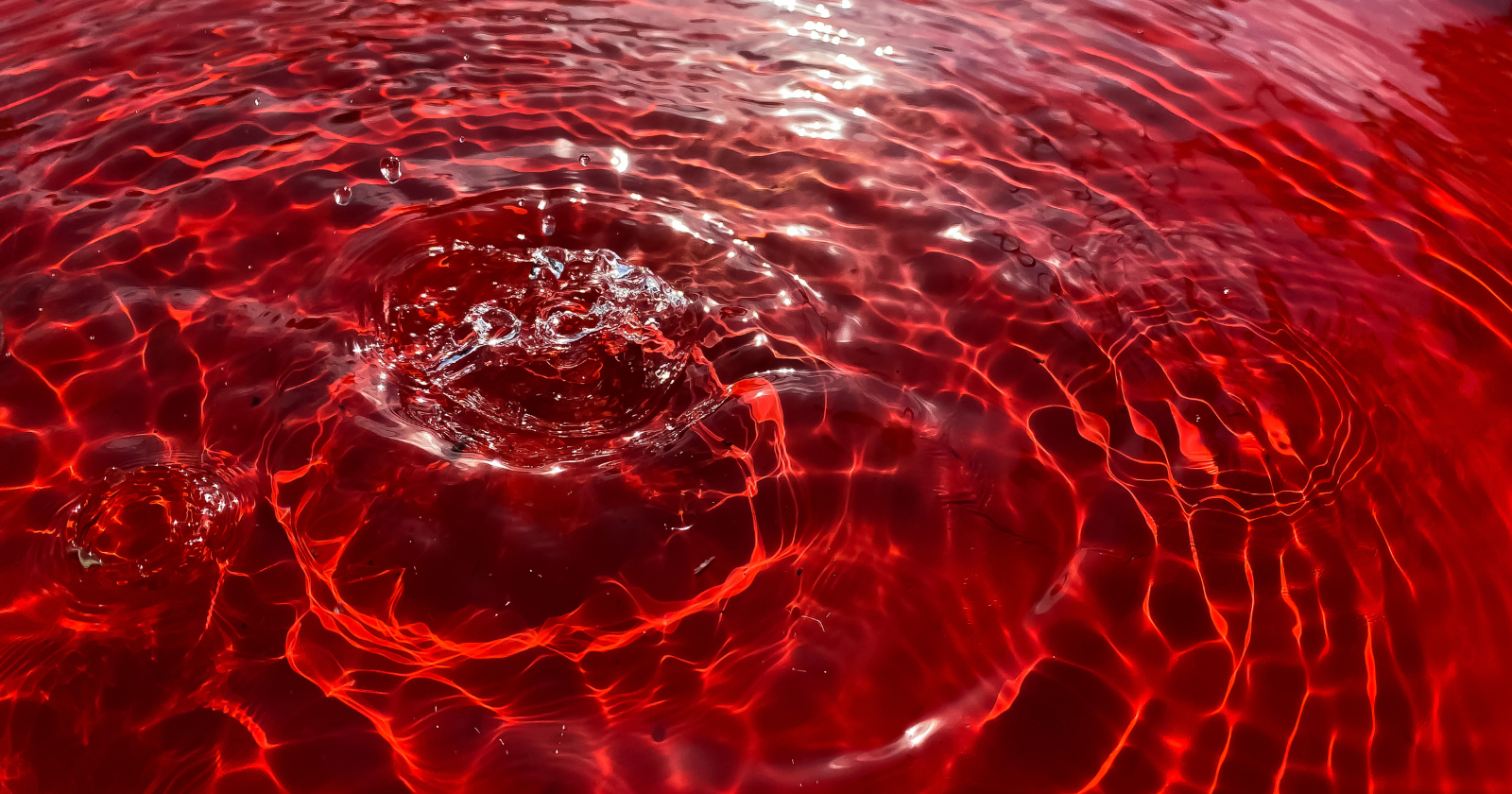
Brine leaving the base of Taylor Glacier comes out clear. The red builds afterwards, as iron precipitates out and the deposit concentrates while the ice around it ablates. What has been harder to establish is what makes an outflow start, and what the glacier is doing while it happens.
A short note published online on 13 January and carried in the April issue of Antarctic Science, by Peter Doran of Louisiana State University with Matthew Siegfried, Hilary Dugan, Kayla Hubbard and Jade Lawrence, sets three simultaneous instrument records against a single outflow event. The glacier sank slightly, and it slowed down.
What three instruments happened to record
In September 2018, three monitoring systems were running near the terminus at once: a GPS station on the ice, a time-lapse camera photographing the outflow daily, and a thermistor string recording temperature at ten depths in the west lobe of Lake Bonney, about 150 metres from the centre of the glacier front. None was installed to capture a release.
The authors call the overlap serendipitous, not designed.
The camera shows flow beginning on 10 September, new discharge visible daily from 19 September to the end of that month, then intermittent discharge into mid-October, with the stained area expanding through the sequence. Over the same window the GPS station dropped roughly 15 millimetres and ice velocity fell from 5.0 to 4.6 metres per year, close to a 10 per cent reduction. The lake recorded negative temperature anomalies of up to 1.5 degrees Celsius below the seasonal median at the 17.89 metre thermistor, the largest on 23 September and 16 October.
Context matters for reading the 15 millimetres. Across the three-year record the station gained about 60 millimetres in elevation, so the lowering runs against the background trend and not within it.
The pressure signal is the useful part
Taylor Glacier is a cold glacier with very little surface melt, so liquid water travelling upward through it needs explaining. The 2017 Journal of Glaciology paper led by Jessica Badgeley, with Erin Pettit, Christina Carr, Slawek Tulaczyk, Jill Mikucki and Berry Lyons, used radio echo sounding to map brine held inside the ice upstream of the falls. Their reading is that pressurised brine gets injected through basal crevasses, then stays liquid through a combination of salt concentration and the latent heat released as part of it freezes.
That model needs pressure to do the driving, and the pressure was inferred. These observations put a measured consequence on the other side of it.
What the note does not settle
The trigger remains open.
The authors note that surface elevation rose faster before the event than after, and suggest transient pressure buildup may periodically open flow pathways. They put that forward as a potential indication rather than a demonstrated mechanism.
They are also explicit about the limits: one GPS station, one camera, one thermistor string, and therefore very little spatial resolution. The lake anomalies sit at the depth where subglacial brine and lake water are of equal density, consistent with earlier work showing brine enters the west lobe along the whole glacier front, so the authors relate the signal to both surface and subsurface drainage rather than to the visible vent alone. A hint that velocity after the event may have settled about 0.2 metres per year slower than before is flagged as needing a longer series.
Some of the February coverage presented this as a century-old question closed. The paper argues for expanded high-frequency monitoring instead.
Why the plumbing question matters
Two things about the outflow sit behind the plumbing question. The brine is anoxic, sulfate-rich and marine in origin, and it supports a microbial community that Mikucki’s group described in Science in 2009 as cycling sulfur with ferric iron in place of oxygen, with no contemporary photosynthesis. And the red is not ordinary rust: the 2022 analysis in Frontiers in Astronomy and Space Sciences led by Elizabeth Sklute found amorphous iron-rich nanospheres carrying chlorine, silicon, calcium and magnesium rather than crystalline iron oxides.
A cold, briny, oxygen-poor system that vents to the surface on its own schedule is a working example of something people expect to find under ice elsewhere. If it exists on an icy moon, when and why it discharges is not a secondary question.
The work was supported by National Science Foundation grants OPP-2224760 and 2145407, with processing code and data archived on Zenodo. What to watch is whether the wider sensor coverage the authors are asking for gets funded and installed, and whether a longer record shows any change in how often or how forcefully the brine escapes.