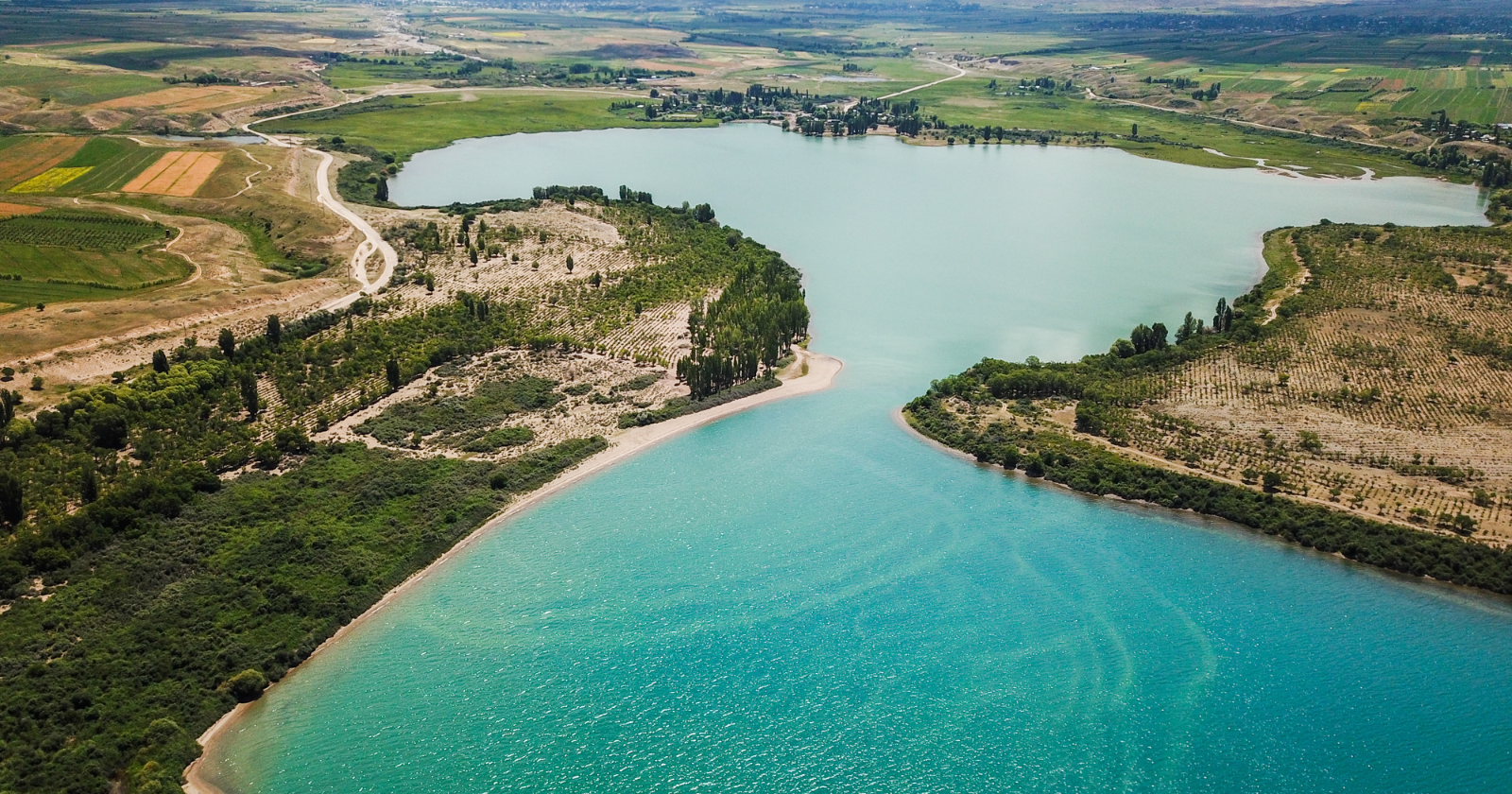
Wade out from the north-western shore of Lake Issyk-Kul, keep walking until the water reaches your chest, and there is a fair chance you are standing on a mosque.
In the autumn of 2025, an international dive team surveyed four patches of lakebed off that shore in Kyrgyzstan, working in water between one and four metres deep. What they mapped, the Russian Geographical Society announced, was a medieval city: fired-brick buildings, a stone millstone, big ceramic jars and a Muslim cemetery, all of it sitting in cold mountain water roughly six centuries after the place went under.
What the divers found
Start with the millstone: half of a pair, the kind used to grind grain into flour or coarse meal for a town with real mouths to feed. Nearby lay a carved architectural fragment, exterior decoration of the kind reserved for a building that mattered, and the expedition offers three candidates: a mosque, a bathhouse or a madrasa. Divers also recorded ruins of stone and timber nearby, and the wood has gone off for tree-ring dating and radiocarbon analysis.
A second zone held the burial ground, an expanse of graves 300 metres by 200, which Live Science works out to about 14 acres, or eleven football fields of dead. Skeletons lie with their faces turned towards the qibla, the direction of the Kaaba in Mecca. Two sets of remains, one man and one woman, were lifted for study.
A third zone gave up a khum, a storage vessel so deeply embedded in the sediment that divers abandoned it for next season. In the fourth, as documented by HeritageDaily, mudbrick structures turned up alongside layers of buried soil that should eventually reveal how the settlement grew.
How a city ends up under a lake
“The city went under the waters of the lake,” says Valery Kolchenko of the National Academy of Sciences of the Kyrgyz Republic, who led the host country’s contingent. He is describing an earthquake at the start of the 15th century. He calls the site a city or a large commercial agglomeration on an important stretch of the Silk Road, reckons its residents had already cleared out before the disaster, and compares what followed to Pompeii. Settled medieval life in the region stopped. Nomads moved in where the city had been.
Geologically speaking, Issyk-Kul had it coming. It sits in a tectonically restless basin in the Tian Shan. No river carries its water away to the sea, and its surface has never held still. Writing in Climate of the Past, Andrea Catalina Gebhardt and colleagues read 84 seismic profiles across the lake’s deltas. They found at least four cycles of stepwise rise and fall of 400 metres or more, driven mainly by shifting air masses over Central Asia. That is one team’s reconstruction across geological time, not a verdict on a single night in the 1400s. It does establish the habit.
Why the lake keeps turning up in world history
Maksim Menshikov of the Institute of Archaeology of the Russian Academy of Sciences, who led the expedition, describes a settlement founded before the 13th century as a genuine mix of faiths: Tengrian, Buddhist, Nestorian Christian. Islam spread later and partly for commercial reasons, per Menshikov, because merchants preferred to strike bargains with people who swore the same oaths.
This is not the lake’s first appearance in a story with global consequences. In cemeteries at Kara-Djigach and Burana, over the mountains in the Chüy Valley, 19th-century excavators recovered tombstones dated 1338 and 1339 that named a pestilence as the cause of death. Historians spent a century arguing over whether that pestilence was really plague. A 2022 paper published in Nature settled it by pulling ancient DNA from seven of those bodies and finding Yersinia pestis in a strain that sits close to the ancestor of the Black Death. Johannes Krause, a senior author on the paper, told the Max Planck Society that the modern strains most closely related to it still live in rodent populations around the Tian Shan.
Merchants who stopped at Issyk-Kul were on the road that carried it west.
The water is taking it back
Waves are chewing through the cemetery right now. That is why two skeletons came up this season, and why underwater drones were used to fix the position of every wall and beam. What has been recorded is a baseline, something to measure the coming losses against.
Shallow water is not the mercy it sounds like. Down at 300 metres a site is dark, cold and undisturbed. At two metres it is in the surf zone, and every storm shifts sediment across brick that has not been touched since the Karakhanids.
Toru-Aygyr lasted six hundred years because nobody could get to it. Now that anyone with a wetsuit can, the lake has started handing it over faster than anyone can write it down.