
Somewhere above the South Australian desert in 2031, a capsule the size of a beach ball will hit the atmosphere at interplanetary speed, glow like a meteor, and drift down under parachute carrying about a tablespoon of a moon nobody has ever touched.
Getting it there starts next month. JAXA has scheduled the launch of its Martian Moons eXploration spacecraft for 20 October at 4.41am Japan time, riding an H3 rocket out of Tanegashima, with backup dates running through to 7 November. The round trip takes about five years: Mars orbit in 2027, a long survey, sampling, then a capsule dropping over Woomera in 2031.
A moon that barely qualifies as one
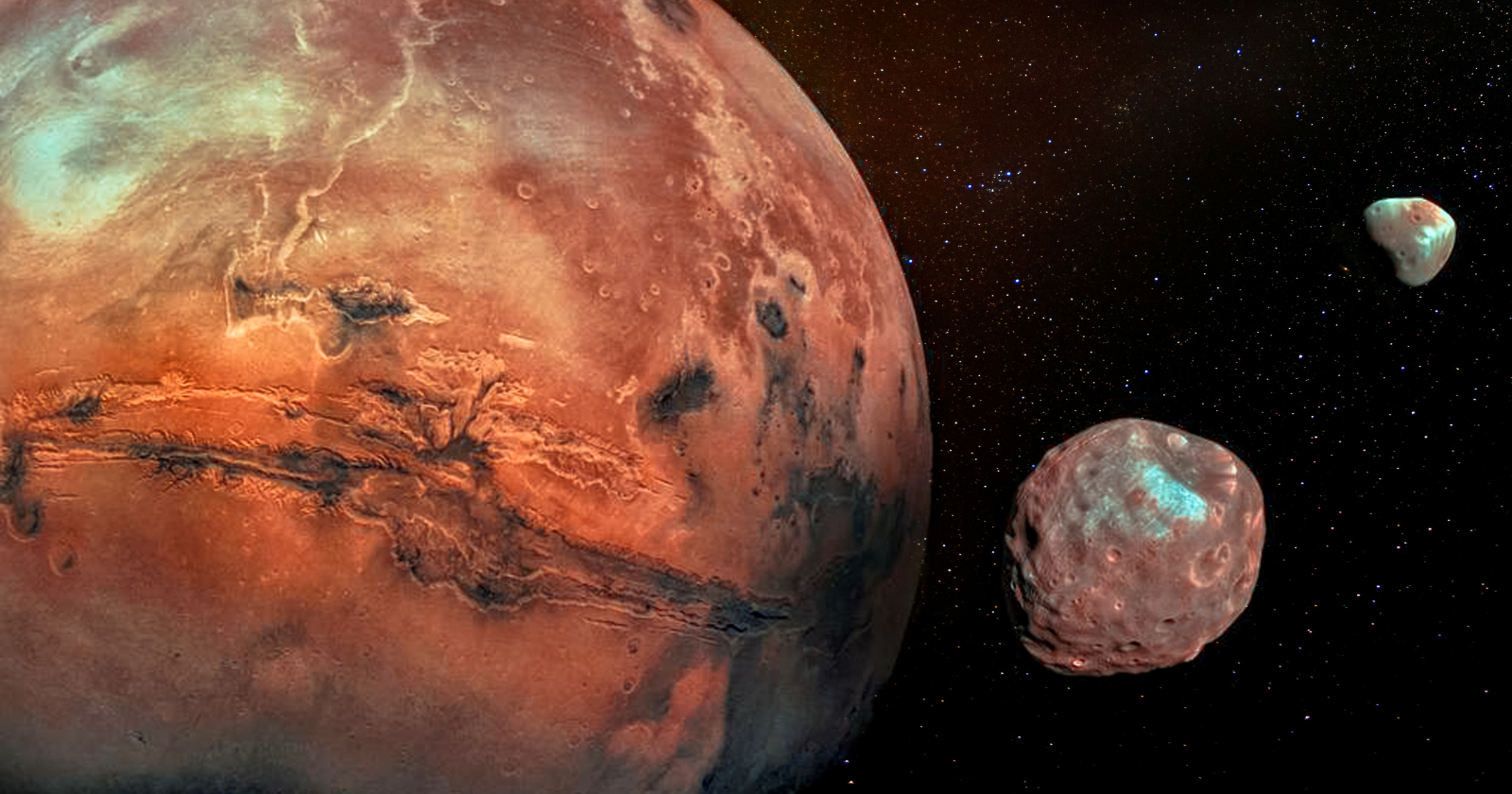
Phobos is a lumpy grey object roughly 22 kilometres across, closer in scale to a large asteroid than to anything most people picture when they hear the word moon. It orbits just 6,000 kilometres above the Martian surface, more than sixty times nearer than our own Moon sits to Earth, as the Planetary Society lays out in its mission rundown. Gravity there is nearly theoretical. ESA’s mission factsheet notes that Idefix, the 25 kilogram French and German rover riding along, will weigh the equivalent of about 15 grams once it is down.
That creates an engineering headache. MMX cannot simply orbit Phobos, because Phobos has nowhere near enough gravity to hold a spacecraft in place. Instead it will fly what mission planners call a quasi-satellite orbit, circling Mars on a path tuned so finely that it appears to shadow the little moon through a year of mapping.
Landing, when it finally comes, will be less a descent than a very slow and extremely deliberate bump.
Two ways to grab a handful
What the surface is like underfoot is anyone’s guess. Rock, gravel, or something closer to talcum powder all remain live options, so the spacecraft carries two sampling systems. The C-Sampler is a corer on a robotic arm that pushes a couple of centimetres down and stores a tube of material. The P-Sampler is NASA’s contribution, built by Honeybee Robotics, and it fires a pulse of pressurised gas that kicks loose grains up a tube and into a container in a fraction of a second.
Idefix goes first. The rover will be dropped from tens of metres up rather than lowered on a cable, then left to crawl across the regolith and report back on how the ground behaves under wheels.
Mission target: more than 10 grams, gathered over two touchdowns.
That sounds thin until you consider that modern laboratory instruments work comfortably with milligrams, leaving most of the haul sealed away for techniques that do not exist yet.
The argument all of this is meant to settle
Two origin stories have been circling each other for decades, and each holds evidence the other struggles to explain. Planetary scientist Kiyoshi Kuramoto set them out in a review of the field. Both moons sit in near-circular orbits almost exactly above the Martian equator, precisely what you would expect from debris that accreted into a disc after something enormous struck the planet. Their surfaces tell a different story. Dark, reddish and barely reflective, they resemble the primitive carbon-rich asteroids of the outer solar system, the sort of body Mars could plausibly have caught and kept.
Spectroscopy has not broken the tie. A 2025 comparison published in Astronomy & Astrophysics searched for matches among asteroids, Martian terrains and laboratory samples, and the shortlist stayed stubbornly mixed. Others have floated middle routes, including a 2024 Icarus paper proposing that an asteroid was torn apart passing inside the Martian Roche limit, leaving a ring of its own wreckage behind. That is one modelling study, not a settled answer.
Even the moon’s biggest scar is disputed. Work presented at this year’s European Geosciences Union meeting in Vienna, summarised by Universe Today, suggests a giant-impact origin would date Stickney Crater to roughly 4.2 billion years, while a capture origin allows something nearer 2.6 billion.
MEGANE, the NASA gamma-ray and neutron spectrometer on board, will take the first swing at the question from orbit, measuring what the surface is made of long before anything is packed for the journey home.
The bit of Mars that comes free
Phobos comes with a bonus. Every large asteroid strike on Mars throws debris upward, and Phobos ploughs straight through the plume. Brown University’s Ken Ramsley and James Head calculated that Martian material should sit in the Phobos regolith at around 250 parts per million, concentrated in the uppermost half metre. A later model led by Ryuki Hyodo, published in Scientific Reports, pushed the figure higher still.
That matters more now than it would have a year ago. Congress stripped funding from NASA’s Mars Sample Return program in January, leaving the tubes Perseverance has spent five years filling parked on the surface with no ride home. Whatever JAXA brings back may be the only Martian material in a laboratory this decade, arriving by accident, mixed into somebody else’s moon.
Phobos has tens of millions of years left before Martian tides pull it apart. The grams scraped off its surface will outlive the moon they came from.
