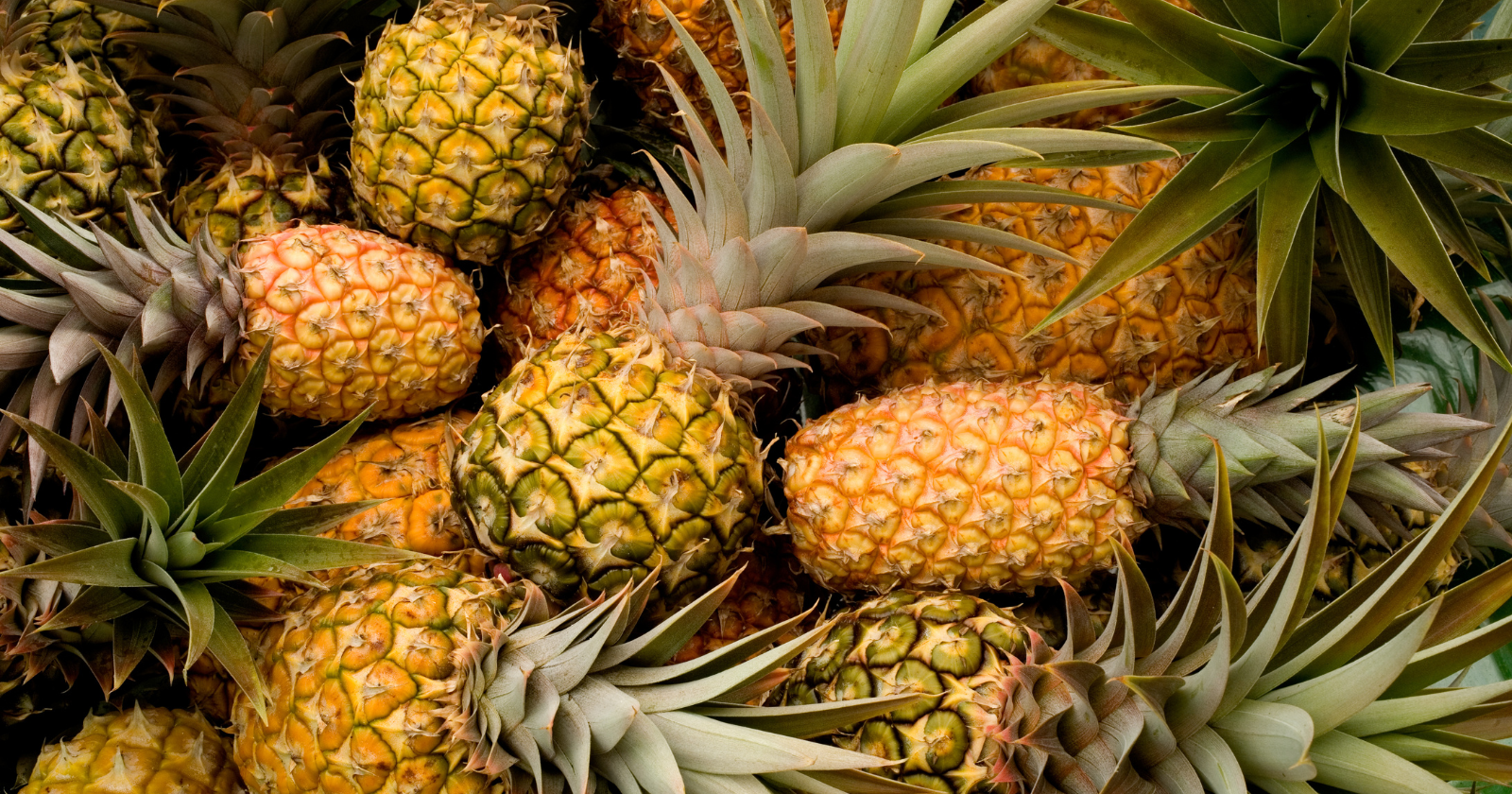
By the early eighteenth century, an English-grown pineapple was considered too valuable to eat. Households displayed it as a table centrepiece instead, and the same fruit was often carried from party to party until it began to rot.
That convention took hold after the fruit’s first documented appearance in Britain, and it did not apply from the start. Lauren Alex O’Hagan, then at Cardiff University, dates the earliest fame to 1668, when Charles II had a pineapple imported from Barbados and set it at the top of a fruit pyramid at dinner with the French ambassador, while England and France argued over rights to St Kitts. Writing in The Conversation in January 2020, she notes that the king cut his open and ate it. The display-only habit belongs to the households that came after him, once home cultivation made the fruit an English project rather than an import.
Distance was only part of the expense that followed. Growing a pineapple on English soil meant holding a glasshouse at tropical temperature for several years, and the buildings that did this, known as pineries, were both costly and dangerous.
What sixty pounds actually bought
In a 2020 BBC News report on the fruit’s rise and fall, the horticulturalist Joanna Lausen-Higgins describes mid-seventeenth-century glasshouses heated by internal furnaces whose fumes frequently killed the plants, and the later system of fire walls warmed by hot air from stoves that needed constant stoking with coal. Many pineries burned down. In her history The Pineapple: King of Fruits, Fran Beauman puts the cost of bringing a single fruit to ripeness in early eighteenth-century England at roughly the price of a new coach.
The figure that recurs across the accounts is £60 for one fruit.
A home-grown pineapple was more valuable than an imported one, and buyers looked for shoots and leaves still attached as proof it had been raised rather than shipped. The value sat in the evidence of what had been spent, not in the eating.
Why the modern price tags do not agree
Convert that £60 and the numbers scatter. O’Hagan gives roughly £5,000. The BBC report gives roughly £11,000 for the same historical figure. American write-ups variously offer $8,000 and $14,400. These are not competing discoveries. They are different inflation baselines applied to the same number, and none is wrong so much as unstated. The £60 is the traceable part. The rest is estimation, and it is more useful to say so than to settle on the largest figure.
The rental trade is well attested in the popular histories. Nina-Sophia Miralles, writing in The Paris Review in 2018, describes hire shops serving those who could not fund a pinery, and maids carrying the fruit between houses at genuine risk from thieves. What sits on firmer documentary ground is the surrounding hardware: ceramics firms manufactured dedicated pineapple stands with a central hole to hold the fruit upright, ringed with cheaper fruit that guests were actually permitted to eat. A 2018 study in the journal Eighteenth-Century Fiction traces how the motif migrated onto Staffordshire creamware, and reads the object as a piece of imperial signalling rather than simple hospitality.
The painting that gets cited more than it gets read
Almost every version of this story reproduces the same image: a kneeling gardener presenting a pineapple to Charles II, conventionally titled as the first pineapple grown in England. The Royal Collection Trust catalogue entry for its version, dated to about 1675 to 1680, notes that the kneeling figure is only possibly the royal gardener John Rose, and that at that date the fruit was more likely imported than grown. Beauman has raised the same doubt, suggesting the claim to have “raised” it may have meant ripening an import rather than cultivating one from the start.
The founding image of British pineapple mania, in other words, is itself a status claim rather than a settled record of what actually happened in that garden.
A building shaped like the argument
The most literal surviving artefact stands near Airth in Stirlingshire. The pavilion beneath it carries the date 1761 and was built for John Murray, 4th Earl of Dunmore. The Landmark Trust’s account places the pineapple cupola later, after Dunmore’s forced return from the governorship of Virginia in 1777. The National Trust for Scotland, which was given the site in 1974, records the walled garden’s hollow walls circulating hot air for growing fruit, with the chimneys disguised as stone vases along the top.
A man who had just lost his American governorship in the upheaval of revolution came home and built a forty-foot stone fruit.
What ended it
Steamships did, along with regular colonial supply from the 1840s and then canning. Once the fruit was affordable it stopped carrying any information about the person serving it, and the upper classes went looking for something else that was slow and expensive to produce. O’Hagan’s answer, the better half of her article, is celery: trench-grown, labour-intensive, priced in Victorian Britain at around 33 shillings, and displayed in purpose-made glass vases with the same early reluctance to actually eat it. Cultivation methods improved, and celery followed the pineapple down to the everyday shelf.