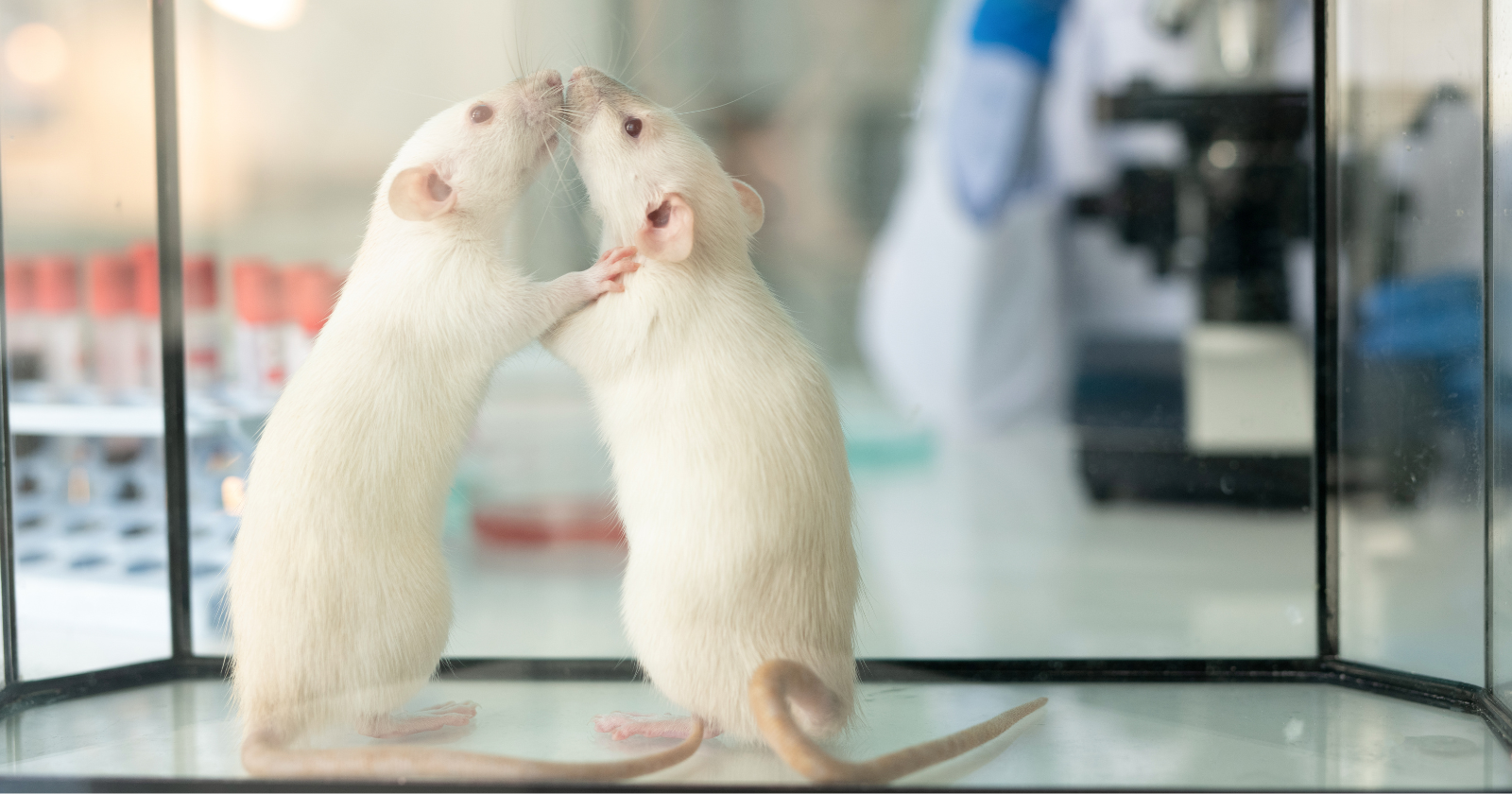
In December 2011, Inbal Ben-Ami Bartal, Jean Decety and Peggy Mason published a short report in Science describing what happened when they put one rat in an arena with a second rat shut inside a clear plastic restrainer. The tube was cut with slits along its body and a larger one at the back, so the two animals could smell and touch each other through it. The free rat could tip the door open from outside, though it took real force to shift.
Most of the rats worked it out. Twenty-three of the thirty tested with a trapped cagemate became reliable door-openers, taking an average of 6.9 days to learn it. Across the control conditions, where the restrainer was empty, held a toy rat, or sat beside a second rat already loose behind a perforated divide, five of forty rats ever opened anything.
The team then ran a version with two restrainers, one holding a cagemate and one holding five chocolate chips. By days six to twelve, the free rats were opening the two at statistically indistinguishable latencies, and chips were left behind in about half the trials.
That last detail is the one that travels, and fifteen years of retelling have rounded it into something warmer than the paper supports. The finding is worth taking seriously, but it should not be read as the final word. A separate group of researchers has spent the past decade arguing that the helping interpretation is the wrong one, and the argument is not settled.
The chocolate result, in the numbers
The paper calls the outcome sharing. We would describe it as chips left uneaten, since that is what the procedure measured, and the distinction matters for how the result gets used.
Free rats in the chocolate-plus-cagemate condition ate an average of 3.5 chips out of five, against 4.8 in the control where the second restrainer was empty. That left 1.5 chips for the trapped rat. Chips remained in 52 per cent of all trials and 61 per cent on days six to twelve.
Nothing in the published data records which restrainer a given rat opened first, so the popular version in which the animal frees its companion before touching the chocolate is not something the paper shows. It shows two converged latencies, and a free rat eating less than it would have eaten alone.
That difference is real, and the authors report it as significant. It is also a good deal narrower than an act of deliberate provision.
One detail usually gets dropped. Every one of the six females became an opener, against seventeen of twenty-four males, and the females opened faster from day seven onwards. However the behaviour is explained, it was not evenly distributed across the animals.
Where the paper hedges
The report is more careful than its reception. Bartal, Decety and Mason set out three alternative accounts and argue against each: that the rats acted to stop the trapped animal’s alarm calls, that they were drawn by curiosity, and that door-opening was an accident of general agitation. Alarm calls were infrequent, the behaviour persisted for over a month when the freed rat exited into a separate arena, and opening required a consistent learned technique.
Their concluding sentence has the rats acting to end distress, and then comes the clause that almost never survives retelling: either their own distress or that of the trapped rat. The authors do not claim to have separated the two.
The objection from another laboratory
In 2014, Alan Silberberg and colleagues at American University published a paper in Animal Cognition titled Desire for social contact, not empathy, may explain “rescue” behavior in rats. Three results cut against the original account. A free rat would not learn the door-touching response when the separated setup came first rather than second. Trapped rats, over time, often walked back into the restrainer of their own accord, which complicates the assumption that the tube was aversive. And a trained rat kept performing the response after it no longer released anyone.
Four years later, the same group published an E-maze study in the Journal of the Experimental Analysis of Behavior. Six rats preferred a goal box that released a trapped rat to an empty one, but showed no preference between a trapped rat and one already loose, and preferred a rat whose tube was already open to an empty box. On that reading, the animals were pursuing company, and the tube was incidental.
The designs built to settle it
The obvious next step was to take the company out of the equation. N. Sato and colleagues reported in Animal Cognition in 2015 that rats would open a door to release a cagemate from a soaked compartment, faster if they had been soaked themselves. In a 2020 Neuropsychopharmacology paper, posted online the previous November, Stewart Cox and Carmela Reichel had an observer pull a chain that released a second rat from a pool of water into a dry chamber the observer could not enter. The rats learned it anyway.
The following year, Kelsey Heslin and Michael Brown gave nineteen rats three concurrent options: a restrained rat, an unrestrained one, or an empty chamber. Across the first twelve sessions they chose the unrestrained rat 48 per cent of the time and the restrained rat 30 per cent, a significant preference for the animal that needed nothing. Three of the nineteen favoured the restrained rat in the first block. None did in the second. Entering the chamber released the restrained rat automatically, so the effort that carried much of the weight in 2011 was absent by design.
Three apparatus designs, three answers, and a 2021 commentary in Biology Letters by M. H. Blystad arguing that the studies failing to support the model go uncited.
Familiarity does more work than kindness
The most interesting follow-up came from the original team. Their 2014 eLife paper, Pro-social behavior in rats is modulated by social experience, is harder to sentimentalise.
Albino Sprague-Dawley rats released trapped strangers of their own strain as readily as cagemates: ten of twelve became openers, against six of eight. Strangers of the unfamiliar black-caped Long-Evans strain got nothing, with only a quarter of the free rats opening. Two weeks of pair-housing with a single Long-Evans rat shifted that, and two-thirds then opened for Long-Evans strangers they had never met.
Then the fostering experiment, usually described more cleanly than it ran. Two albino pups went into each Long-Evans litter at birth and one was removed at around six days, so most spent roughly their first week alongside an albino littermate before losing all contact with their own strain. Average exposure came to 7.2 days. As adults, one of eight opened for an albino stranger, and it was the animal with the longest exposure at eleven days, the only one whose eyes had been open while an albino littermate was still present.
A single opener is thin ground, and that coincidence is either the mechanism showing through or a sample of one. The condition rules out a strong innate preference for one’s own kind.
If the door-opening is helping, it is helping bounded by who the animal has previously lived alongside, and the boundary can be moved by a fortnight of cohabitation.
What is left standing
Anyone borrowing this study as evidence about human generosity should be careful which claim they take. The arena test leaves open whether rats understand another animal’s situation, and it cannot tell relieving another’s distress apart from relieving one’s own discomfort at the sight of it. On that last point the authors agree.
Something narrower survives. A rat will learn an effortful, non-obvious motor task, keep performing it for weeks, and eat about a chip and a half less chocolate than it otherwise would, in a setup whose only consistent outcome is another rat getting out of a tube.
Russell Church reported in 1959 that rats trained to press a lever for food stopped pressing when a rat in the adjacent compartment was shocked. Pressing did not cause the shock, and stopping made no difference to it, so the suppression helped nobody. Naive rats showed it once and adapted out within a few exposures. It returned durably in animals that had themselves been shocked immediately after watching another rat be shocked, and weakly in those shocked without that pairing, which Church put down to self-conditioning rather than sympathy.
Church deflated his own result. Six decades on, the shape of the exchange has not changed much: a demonstration, then a simpler account of it, then a new apparatus built to rule the simpler account out. The restrainer test is the current round rather than the resolution of it.