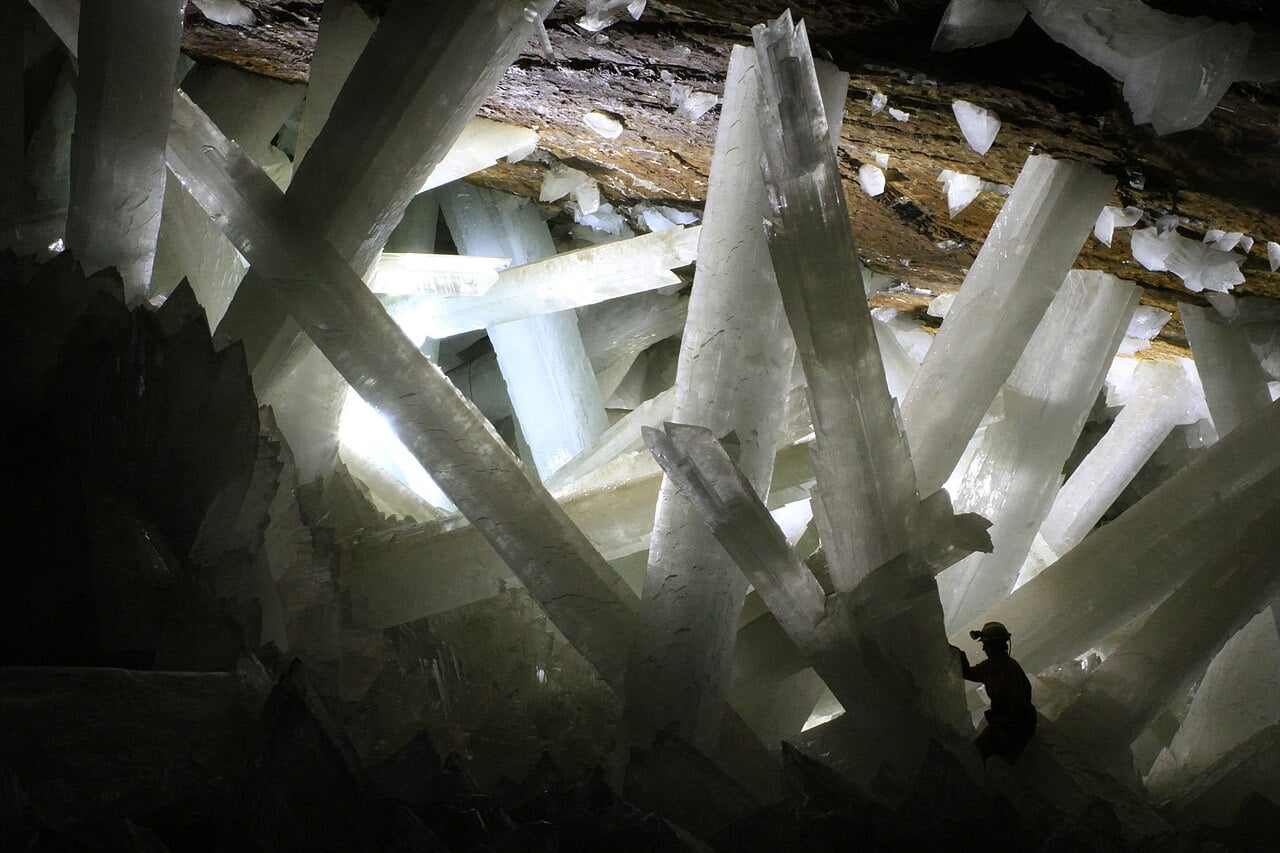
In April 2000, two miners cutting an exploration tunnel roughly 300 metres beneath the Sierra de Naica in Chihuahua drilled into a void. They put a light through the gap and found a chamber crossed at every angle by translucent beams of gypsum, several of them longer than a telephone pole is tall. They were working for Industrias Peñoles, drilling through the Naica fault as ordinary mine engineering.
Twenty-six years on, the Cueva de los Cristales remains one of the few places on Earth where the limit on human presence was measured in minutes.
What is in the chamber
The cave is a horseshoe-shaped cavity in limestone, 109 metres long, with a surveyed volume of 5,000 to 6,000 cubic metres. Survey data puts the longest beam of selenite, the transparent form of gypsum, at 11.40 metres and an estimated 12 tonnes. A weight of 55 tons has circulated since National Geographic’s 2007 coverage, though it rests on repetition, with no published measurement behind it.
Why the working windows were so short
Air temperature in the main chamber reached 58 degrees Celsius, with relative humidity between 90 and 99 per cent. Death Valley has recorded comparable air temperatures in dry air, and people survive them.
The hazard at Naica is the water already in the air. With humidity that close to saturation, sweat has nowhere to go, the body loses its main route for shedding heat, and moisture condenses on any surface cooler than the air, including the airway.
The Naica Project, which studied the caves from 2006 under an agreement with Peñoles, was run by the Italian exploration group La Venta with Speleoresearch & Films of Mexico City. La Venta designed the cooling gear with the outdoor manufacturer Ferrino: an overall lined with refrigerating tubes fed from a backpack holding 20 kilograms of iced water, dubbed the Tolomea suit, paired with a respirator delivering cooled air.
Four endurance figures circulate for the cave, and they measure four different things. Unprotected exposure was usually held to ten minutes. A backpack of melting ice gave thirty minutes of autonomy, and National Geographic reported that the suits worn on the 2008 and 2009 expeditions could stretch a light task toward a full hour. Penelope Boston, then director of the NASA Astrobiology Institute, put her own sampling stints at 20 minutes, the practical span for careful work at the crystal face. After that came the 38-degree room, which counted, in context, as cool.
The narrow temperature window that built them
The best supported account of how the crystals formed came from Juan Manuel García-Ruiz and colleagues in a 2007 paper in the journal Geology, Formation of natural gypsum megacrystals in Naica, Mexico. From fluid inclusions trapped inside the crystals, they put the growth temperature at 54 degrees, just below the point where the solubility of anhydrite equals that of gypsum. Below the crossover, anhydrite in the surrounding rock dissolves slowly and feeds gypsum growth. Water heated by a magma chamber three to five kilometres down held the system there.
That balance only holds within a narrow band of temperature. Move outside it and nucleation accelerates, producing many small crystals where Naica produced a handful of enormous ones. The Cueva de las Espadas, found higher in the mine in 1910, is the shorter version of the same process.
In 2011, A. E. S. Van Driessche, García-Ruiz and co-authors published Ultraslow growth rates of giant gypsum crystals in the Proceedings of the National Academy of Sciences, using purpose-built interferometry to detect surface advance at fractions of a nanometre. At 55 degrees the rate came out at 1.4 by 10 to the power of minus 5 nanometres per second, which Van Driessche put to Chemical & Engineering News in human terms: the thickness of a sheet of paper every two centuries. Extrapolating from it, the authors calculated the time needed to grow a crystal one metre thick at that temperature, in water matching the present-day mine: 0.99 million years, give or take 0.27.
Set that beside the dating result and the two pull apart. Uranium-thorium dating by Stein-Erik Lauritzen of the University of Bergen gave a maximum age for the giant crystals of 500,000 years, half of what the growth rates imply. Both have soft edges. Crystals that pure hold very little uranium, so the isotopic age is coarse by construction. Van Driessche has acknowledged the limitation. The extrapolation assumes today’s mine water stands in for the water of half a million years ago, and that temperature held near 55 degrees throughout. A degree of drift moves the answer a long way. Together they bracket the age of the beams without fixing it.
The microbe result remains a conference report
At the American Association for the Advancement of Science meeting in February 2017, Boston reported that her team had revived dormant microbes from fluid pockets inside the crystals, sampled in 2008 and 2009 under New Mexico Tech. She gave a figure of around 40 strains plus some viruses, possibly dormant for tens of thousands of years, living on iron and sulfur rather than sunlight.
The work had not been through peer review when it was announced, and NASA declined to release the material for outside comment beforehand.
Purificación López-García of the French National Centre for Scientific Research had reported microbial life in Naica’s hot springs in 2013. She told National Geographic that microbes in fluid inclusions were possible in principle. Contamination during drilling was a serious risk, in her assessment, and she would stay sceptical until the work appeared. Nine years later, a peer-reviewed paper establishing the revival result still does not appear to have followed. The claim may well hold up. What stands behind it in the meantime is repetition.
Organisms living off minerals in sealed, hot pockets are the closest terrestrial analogue for the subsurface environments now of interest on Mars and the icy moons. That is why a lead and zinc mine turns up repeatedly in space coverage, and why NASA’s Jet Propulsion Laboratory holds a Terra satellite image of the site in its archive.
The cave was dry only because the pumps were running
These chambers sit well below the natural water table. Everything anyone saw between 2000 and 2015 was visible because Peñoles kept pumping hot groundwater out of the mountain, at a rate Van Driessche described to C&EN as comparable to emptying an Olympic swimming pool every 40 minutes.
That ended in 2015. A flood hit part of the mine in January, and according to Peñoles’ account of the unit, nine months of effort to bring levels down failed. Indefinite suspension was communicated on 13 October, the pumps stopped, and the water came back up.
Submersion is, on balance, good for the crystals, since exposure to air degrades their surfaces. A 2018 paper in Crystal Growth & Design found bassanite, the dehydrated form of calcium sulfate, forming on crystal faces. Removing a beam for display was never a serious option for the same reason.
How far the water has risen is less clear than most accounts suggest. The usual telling has the main chamber under within months, though not every report agrees, and nobody has been in to check.
Access now depends on the mine rather than on science funding. Reporting from 2019 raised the possibility of researchers returning if Peñoles opens another entrance. Until then, the measurements taken in those short windows are the whole record.