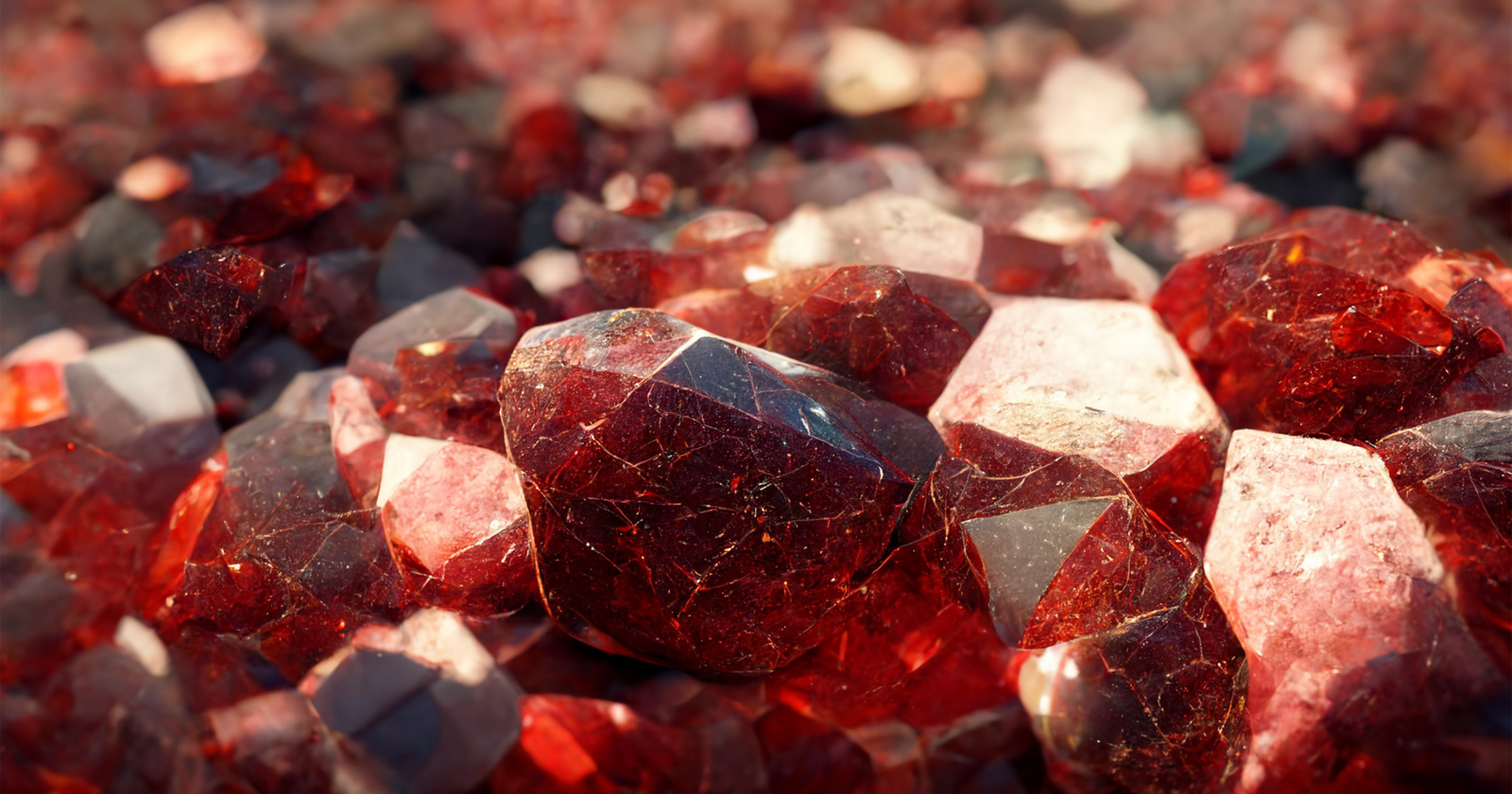
Arthur Charles Davy Pain thought he had bought a ruby. He had actually bought a mineral so scarce that decades later the entire known global supply still fitted in a single museum drawer.
Pain was a British gem dealer and collector working the Mogok gem tract in Upper Burma, the valley that has been feeding rubies and sapphires into the world market for centuries. In 1952 he sent a deep garnet-red crystal weighing 1.7 grams, recovered from one of the small ruby mines near Ohngaing village, off to London. The colour was roughly right, the hardness roughly right. It matched nothing in the catalogue.
Five years later, G. F. Claringbull, Max Hey and C. J. Payne published a description of the new species in Mineralogical Magazine. They logged a hardness of about 8, a density more than four times that of water, and a colour that swung from ruby red to pale brownish orange depending on how the light went through it. Painite, they called it, after the man who had noticed.
Boron and zirconium rarely share a crystal
The chemistry is what made mineralogists sit up. Painite holds calcium, zirconium, aluminium, boron and oxygen together in one structure, given in the Handbook of Mineralogy as CaZrAl9O15(BO3). Boron is light and mobile, and usually ends up in pegmatites or dried-out lake beds. Zirconium is heavy and stubborn, and it tends to lock itself inside zircon and stay put. Persuading both into the same lattice takes a narrow set of conditions, which is most of the reason painite is scarce. Earth never ran short of the ingredients. It just rarely combines them this way.
Those conditions turn out to be a skarn, the scorched contact zone where hot granite shoulders into marble and rearranges it. Working out that detail took another fifty years.
Three crystals in fifty years
“This is painite! And these are the only two pieces ever found.” That was Peter Embrey, curator of minerals at the British Museum of Natural History, showing off the Pain collection to a visiting American dealer named Bill Larson in the early 1970s. Larson later wrote up the encounter: two small reddish-brown crystals, 1.7 and 2.1 grams, sitting in a drawer as the entire confirmed world supply.
A third turned up in 1979, spotted at the Gemological Institute of America inside a parcel of Burmese gem rough that somebody had bought for something else entirely.
Three crystals in nearly thirty years of looking.
Guinness duly listed painite as the rarest gem mineral going, and the Natural History Museum in London reckons that even by 2005 the worldwide count had reached only about twenty-five specimens.
A bag of gravel from northern Myanmar
Larson spent two decades asking around. He carried photographs of painite to mineral dealers across the Mogok district in 1995, pointed them at Ohn Gaing and urged them to look harder. More than twenty trips produced nothing at all. Then in 2001 somebody showed him a fragment weighing 55 carats, about 11 grams. A slice went to George Rossman at Caltech, and the calcium, zirconium and boron came back as expected.
The real break arrived the following year, and it was almost comically undramatic. Rossman bought a bag of low-grade gem gravel at Namya in northern Myanmar, carried it home, and found two painites sitting in it. His running record of the specimens logs a second locality hundreds of kilometres from the first. Word of it reached geologists inside Myanmar by 2004.
They went looking properly.
In mid 2005 the source rock finally gave itself up at the Wetloo mine, near the base of Hinthar Hill west of Mogok. Within a week another deposit surfaced east of town at Thurein-taung, where, as Rossman documented at the time, nearly every house in the quarter had painite for sale.
The point where counting stopped
How do you tell when a mineral has stopped being rare? For painite the answer was administrative. Rossman had been numbering specimens as each one was confirmed, painite #1 through to painite #25, and somewhere past that he abandoned the practice on the grounds that individual numbering no longer made any sense. Several thousand crystals and fragments emerged from the Mogok deposits. Before mid 2005 exactly two faceted painites had been reported anywhere; by May 2006 the Gem Research Swiss Lab was reporting a 633 gram crystal, hauled out of mine tailings and crusted with small rubies.
Then the tap shut off. Wetloo had been worked out by 2013 and was reverting to creek bed. Rossman’s most recent notes from Myanmar describe informal digging aimed squarely at rubies, sapphires and spinel, with gem-quality painite hard to come by once again.
So the world’s rarest gemstone was, for half a century, largely a filing problem. Nobody knew what to look for, so nobody looked. The moment a few people did, it came out of the ground by the kilogram, in villages that had been standing on top of it the whole time.