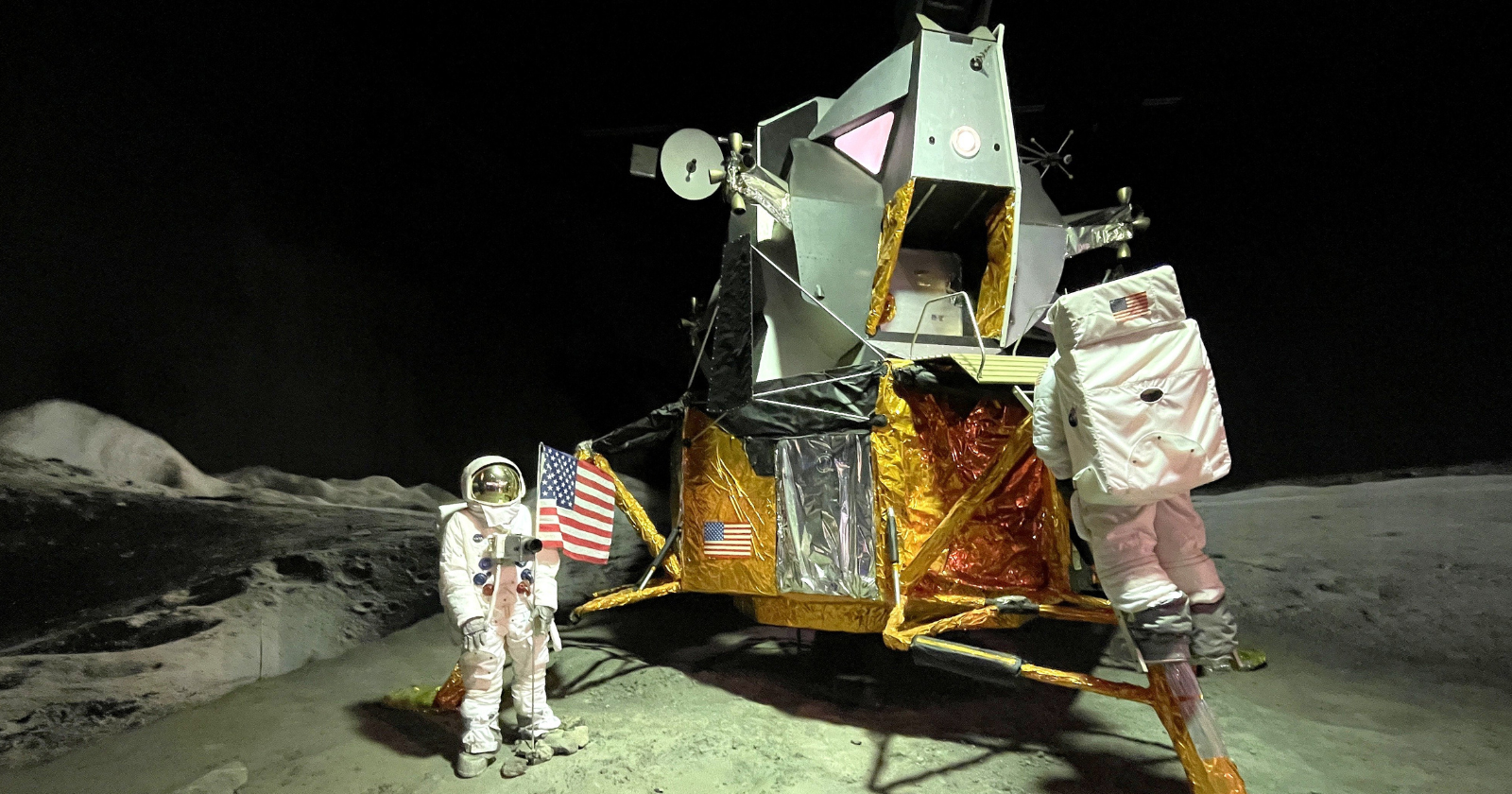
I want to write about something slightly embarrassing, partly because it is true, and partly because the path out of the belief was, in my case, a particular piece of evidence that I have not, in the years since, ever heard a conspiracy debunker bring up. The piece of evidence is, on examination, the most useful thing I learned about how to evaluate this kind of claim, and I want to set it down here in case it is useful to anyone currently in the position I was in for most of my twenties.
The position I was in, for about fifteen years, was that I believed, with varying degrees of conviction, that the moon landings had been faked. I want to be clear that I was not, in any obvious sense, a conspiracy theorist. I did not believe in lizard people. I did not believe in flat earth. I did not, by the standards of internet conspiracy culture, qualify as a serious member of the community. I was, more accurately, a person who had absorbed, somewhere in my late teens, the specific moon-landing claim, and who had, in the years since, found the standard counterarguments insufficient to dislodge it.
This sounds, in retrospect, slightly insane. It was not, at the time, particularly visible to me as insane. I was just, in my internal accounting, holding open a question that the wider culture seemed to me to be closing too easily. I would, when the topic came up at dinner parties, push back gently on the assumption that the landings had occurred. I would mention some of the standard suspicious features: the flag waving, the apparent lack of stars in the photographs, the various technical objections that have, since the late 1960s, been the standard furniture of the conspiracy claim. The dinner parties usually moved on quickly. I was, in those moments, not making myself popular. I was also, I now recognize, slightly enjoying not making myself popular. The not-being-popular was, in some real way, part of the appeal of holding the position.
What the standard counterarguments did not do
For most of those fifteen years, the standard counterarguments to the moon-landing claim did not, on close examination, move me. I want to be honest about why, because the reasons are themselves interesting.
The standard counterarguments tend to take the form of debunking the specific technical objections raised by the conspiracy claim. The flag was not waving in a vacuum; it was disturbed by the astronaut planting it and the lack of atmosphere meant the disturbance did not dissipate. The stars do not appear in the photographs because the cameras were calibrated for the bright lunar surface and the dim stars would not register. The Van Allen radiation belts were traversed quickly enough that the astronauts did not receive a fatal dose. And so on, through a long list of specific technical answers to specific technical claims.
The trouble with these counterarguments, in my experience of being on the receiving end of them, was that they required me to evaluate technical claims about a domain I knew nothing about. The conspiracy claim said the flag was suspicious. The debunking said the flag was not suspicious because of a particular feature of vacuum physics. I had no independent way of evaluating which of these two technical claims was correct. I had to trust someone. The conspiracy theorist had told me one thing. The debunker had told me another. The decision about which to trust was, in some real way, prior to the technical evaluation, and the technical evaluation was, accordingly, not actually the basis on which I would make the decision.
This is, on close examination, the structural problem with how most conspiracy debunking is conducted. The debunking treats the conspiracy claim as if it were a technical disagreement, when the disagreement is, in fact, almost entirely a disagreement about whose authority to accept on technical matters one does not personally have the equipment to evaluate. Producing more technical evidence does not solve this. It just adds to the pile of technical claims that the person holding the conspiracy belief has, by the structure of their position, decided not to accept from the relevant authorities.
The piece of evidence that did work
What changed my mind, somewhere in my early thirties, was not a technical argument. It was a particular observation about the structure of the conspiracy claim itself, that I encountered in an offhand way in a book I was reading on something else entirely, and that I have not, since, ever heard repeated by anyone in the standard debunking community.
The observation was this. The Soviet Union, in 1969, was the principal geopolitical adversary of the United States. The space race was, by the late 1960s, one of the most public competitive theaters of the Cold War. The Soviets had been ahead, for most of the previous decade, on various measurable space-program metrics. The Americans, in landing on the moon, were claiming a definitive victory in this competition. The claim was, geopolitically, enormous. It was used, by the Americans, as a piece of soft-power propaganda for the rest of the Cold War.
The Soviets had every conceivable incentive to expose the landing as a fake, if it had been a fake. They had the technical expertise to evaluate the claim. They had the intelligence apparatus to investigate it. They had the geopolitical motivation, larger than any other actor’s motivation, to undermine the American victory. They had, on top of all this, a state-controlled media that could have, at any point in the subsequent decades, broadcast their findings to the world.
The Soviets did not, at any point in the subsequent decades, claim the landings were faked. They accepted, from the moment the landings occurred, that the landings had occurred. They congratulated the Americans publicly. Their own scientific establishment, including the scientists who had been most directly competing with the American program, accepted the result. This acceptance continued through the dissolution of the Soviet Union and the opening of its archives. The post-Soviet Russian space program, in cooperation with NASA on later projects, has never, to my knowledge, suggested any doubt about the original landings.
When I encountered this observation, sometime in my early thirties, I found that I could not, in any honest way, account for it within the conspiracy framework. The conspiracy framework requires the cooperation, in the deception, of an enormous number of people, but it also requires the silent acceptance of the deception by the one actor on earth who had every reason to expose it. The silent acceptance is, on examination, the structural feature of the historical record that the conspiracy claim cannot, without contortion, explain.
The technical objections about the flag and the stars and the radiation belts could, in principle, be the result of various confusing technical features I did not understand. The geopolitical objection could not be the result of a technical feature. It was, in some real way, a structural fact about the world. The Soviets accepted the landings. The Soviets had every incentive not to. The acceptance was, in its quiet way, the most powerful piece of evidence in favor of the landings that I had, in fifteen years of holding the contrary position, ever encountered.
Why this kind of evidence is so rarely deployed
I want to think about why this piece of evidence is so rarely brought up in the standard moon-landing debates, because the rarity is, itself, instructive.
The rarity, I think, is partly because debunkers tend to come from technical backgrounds, and they accordingly approach conspiracy claims as technical disagreements. They want to refute the technical objections on technical grounds. They are good at this. They produce, in response to the conspiracy claims, a great deal of accurate technical material.
What they less often produce is the structural argument, which is the argument that does not engage with the technical claims at all but instead asks what kind of world we would have to be living in for the conspiracy claim to be true, and whether that world is plausible given the other things we know about how the actors in it behave. The structural argument, in the moon-landing case, is that we would have to be living in a world in which the Soviet Union, with all its motivation and capability, declined to expose the most damaging possible piece of American Cold War propaganda. This world is, on close examination, not plausible. The Soviets would have exposed the deception. They did not. The not-exposing is, by itself, more or less decisive.
This kind of argument has the advantage of not requiring the listener to evaluate technical claims they cannot independently verify. It requires, more modestly, the listener to think about geopolitical incentives, which most adults are reasonably well-equipped to do. The listener does not need to know anything about vacuum physics. The listener needs to know, in some basic sense, how the Cold War worked. Most listeners do.
I think the reason this kind of argument is so rarely deployed is that it does not feel, to the debunker, like the kind of evidence that should be needed. The debunker, who knows the technical claims are wrong, wants to demonstrate that they are wrong. The structural argument concedes, in some sense, that the technical claims do not need to be addressed, which feels, to the debunker, like a kind of cheating. But the structural argument is, on examination, often the more effective one, because it does not require the listener to do the kind of technical evaluation that the listener is, by the structure of the conspiracy framework, already predisposed to distrust.
The broader lesson, for me
The broader lesson I took from this, that I have, in the years since, found applicable to a wide range of similar questions, is that when I am holding a contrarian belief about a matter of historical or scientific fact, the most useful question I can ask myself is not whether the technical objections to the mainstream view are valid. The most useful question is what the world would have to look like for the contrarian view to be true, and whether the actual world looks like that.
In the moon-landing case, the actual world contains a Soviet Union that accepted the landings. The contrarian view requires a world in which the Soviet Union did not have the motivation or capacity to expose the deception, or in which the Soviets were, for some reason, in on it. Neither of these worlds matches the world we have. The mismatch is, on close examination, the decisive evidence.
I have used this approach, since, on a few other questions where I have been tempted by contrarian positions. It has, in most cases, produced the same result. The contrarian position requires the world to be a particular way that, on close examination, it is not. The mainstream position does not require the world to be any particular way that it is not. The mainstream position is, accordingly, the more probable one.
This is not a glamorous epistemic principle. It is, on examination, just a particular form of the same Bayesian reasoning that everyone is supposed to be doing all the time. What it has produced, in my own case, is the slow retirement of a number of contrarian beliefs that I had been holding for years without good reason. The moon landing was the first one. There have been a few since. The retirements have, in each case, made me slightly more boring at dinner parties. I am, in middle age, finding that I do not mind being slightly more boring at dinner parties. The being-right is, in my honest accounting, more important than the being-interesting. The being-right is, more often than not, the boring position. The boring position is, in most cases, the one I now hold.
The moon landings happened. The Soviets would have told us if they had not. They did not tell us. That is, in the end, the entire argument. I should have figured this out fifteen years earlier than I did. The figuring-out, when it finally arrived, was a small but real improvement in how I conduct the rest of my thinking. The improvement is, in some real way, what the rest of this article has been about.