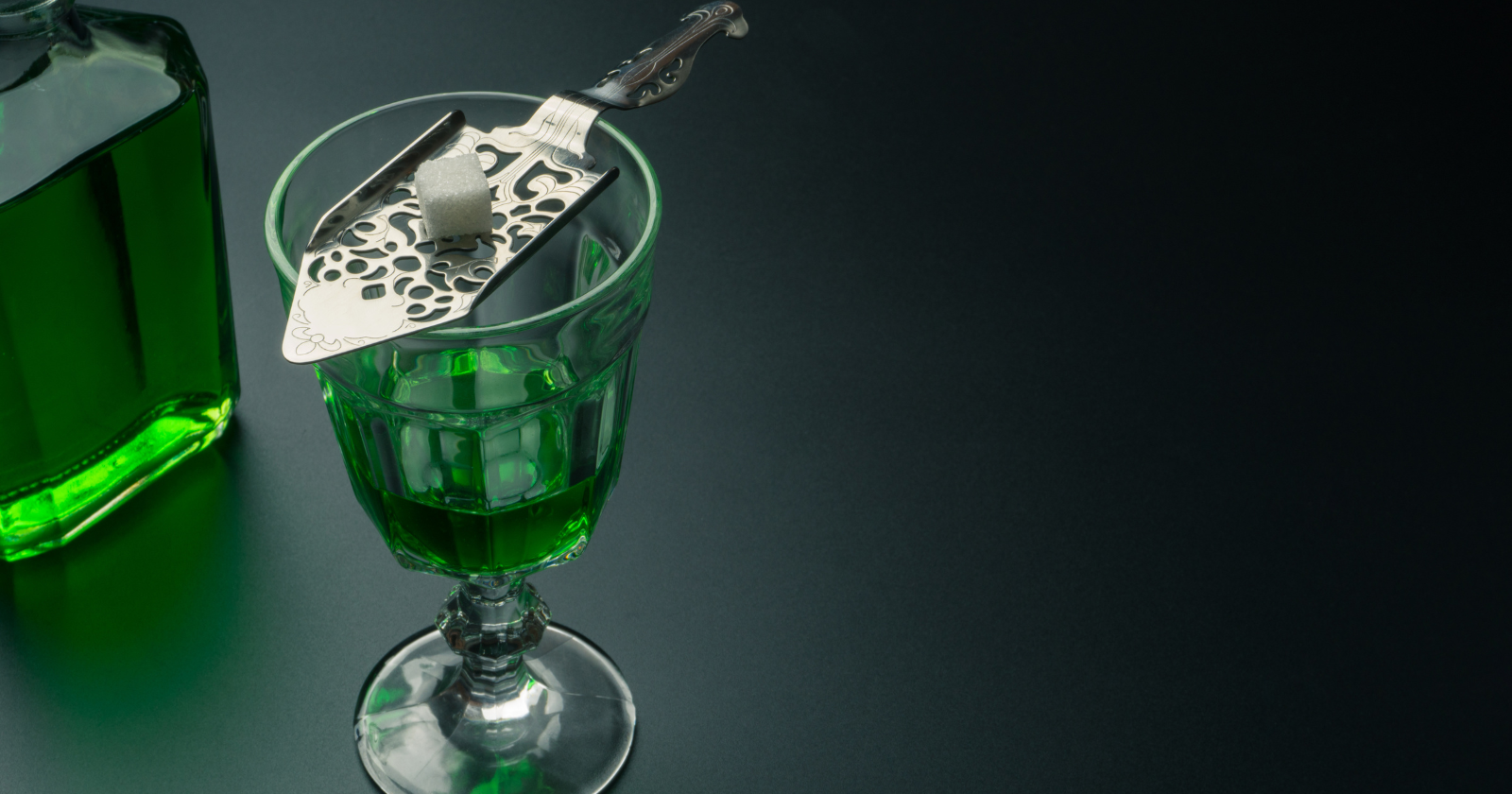
Thirteen sealed bottles outlived the panic that banned them.
In 2008, a team led by Dirk Lachenmeier at the Chemical and Veterinary Investigation Laboratory in Karlsruhe opened thirteen bottles of absinthe distilled before 1915 and put them through gas chromatography. They were looking for whatever it was that had persuaded most of the Western world to outlaw a drink. The results, published in the Journal of Agricultural and Food Chemistry, were flat. Total thujone, the wormwood compound blamed for a century of ruined painters and poets, ranged from 0.5 to 48.3 mg/L, averaging 25.4. That sits comfortably inside the 35 mg/kg ceiling the European Union permits in bitter spirits today.
This account leans on the published papers and the reporting that followed them.
What was actually in the bottles
Copper salts were a known trick for faking absinthe’s colour, and nineteenth-century absinthe was cheap and widely adulterated, so the samples were tested for the other usual suspects too: methanol, higher alcohols, fenchone, pinocamphone, copper, antimony. None appeared at concentrations that would explain anything. The paper’s conclusion is unusually blunt for a chemistry journal: of everything tested, only the alcohol content stood out as capable of producing what nineteenth-century doctors labelled absinthism.
Ethanol was present in quantity. The preban samples ran at roughly 70 percent alcohol by volume, close to double a modern whisky, and it was drunk by the glass in cafés for hours at a stretch.
The obvious objection is that thujone might simply have degraded over a hundred years in the bottle. The same group tested that too, in a follow-up paper the next year, exposing absinthe in traditional green glass to ultraviolet light for up to 200 hours. Composition held. Clear glass lost about 18 percent of its beta-thujone and visibly faded, but the vintage bottles had kept their colour, which suggests they had not seen much light either.
Thirteen bottles is a small sample. It represents a handful of distilleries and vintages drawn from a period that spanned decades and a continent’s worth of production.
The experiments that started it
The scientific case against absinthe was built in the 1860s and 1870s by the French psychiatrist Valentin Magnan, who dosed animals with wormwood oil, produced convulsions, and argued that absinthism was a distinct condition rather than ordinary alcoholism. The step that never held up is the one between wormwood oil and the drink. A 2006 review by Stephan Padosch, Lachenmeier and Lars Kröner in Substance Abuse Treatment, Prevention, and Policy went back through those experiments and found the only conclusion they consistently support is that concentrated wormwood oil causes seizures. Absinthe is a diluted distillate, and the oil used in Magnan’s experiments bears little resemblance to what anyone was actually drinking.
Who wanted the ban
Phylloxera had wrecked French vineyards from the 1860s onward, wine became scarce and expensive, and absinthe took the market. When the vines recovered, the wine trade found itself with a competitor it had not had before, and an ally in the temperance movement.
Then came Commugny. On 28 August 1905 a Swiss labourer named Jean Lanfray shot his pregnant wife and two daughters. He had drunk seven glasses of wine, six of cognac, two coffees laced with brandy, two crème de menthes, and two glasses of absinthe. The prosecutor pointed out that the absinthe was a minor part of the day, but the newspapers fixed on it anyway. A petition in Vaud drew 82,000 signatures, a federal referendum on 5 July 1908 wrote prohibition into the Swiss constitution, and the ban took effect in 1910. Belgium had already moved in 1905, the Netherlands followed in 1909, the United States in 1912, France in 1915.
What the chemistry does not settle
The chemistry does not make absinthe benign. The symptoms Magnan catalogued, the tremors, the seizures, the hallucinations, the deterioration, describe what sustained heavy drinking looks like. Removing the exotic explanation does not shrink the harm. It relocates it.
Which is probably why the myth lasted so long. A cursed bottle is a more manageable story than a widespread drinking problem, because it can be legislated away in a single afternoon. Europe banned one spirit and left the rest of the shelf alone. As the Science History Institute notes in its account of the affair, the most likely culprit was also the most ordinary one.
Anyone weighing up their own drinking will get further with a doctor than with a history of nineteenth-century food chemistry.
Where the law landed
The bans came apart quietly. Switzerland revised its food legislation in 2004 and 2005, clearing the way for legal distilling to return to the Val-de-Travers. The United States adopted a 10 ppm threshold for what counts as thujone-free at the end of 2006, and on 5 March 2007 the Alcohol and Tobacco Tax and Trade Bureau approved a label for Lucid Absinthe Supérieure, the first absinthe cleared for sale there since 1912.
So the drink returned under rules written to police a compound the chemistry had already cleared. Every bottle on an American shelf is screened for thujone before it can be sold. The alcohol content, which is the part the analysis actually implicated, is simply printed on the label.