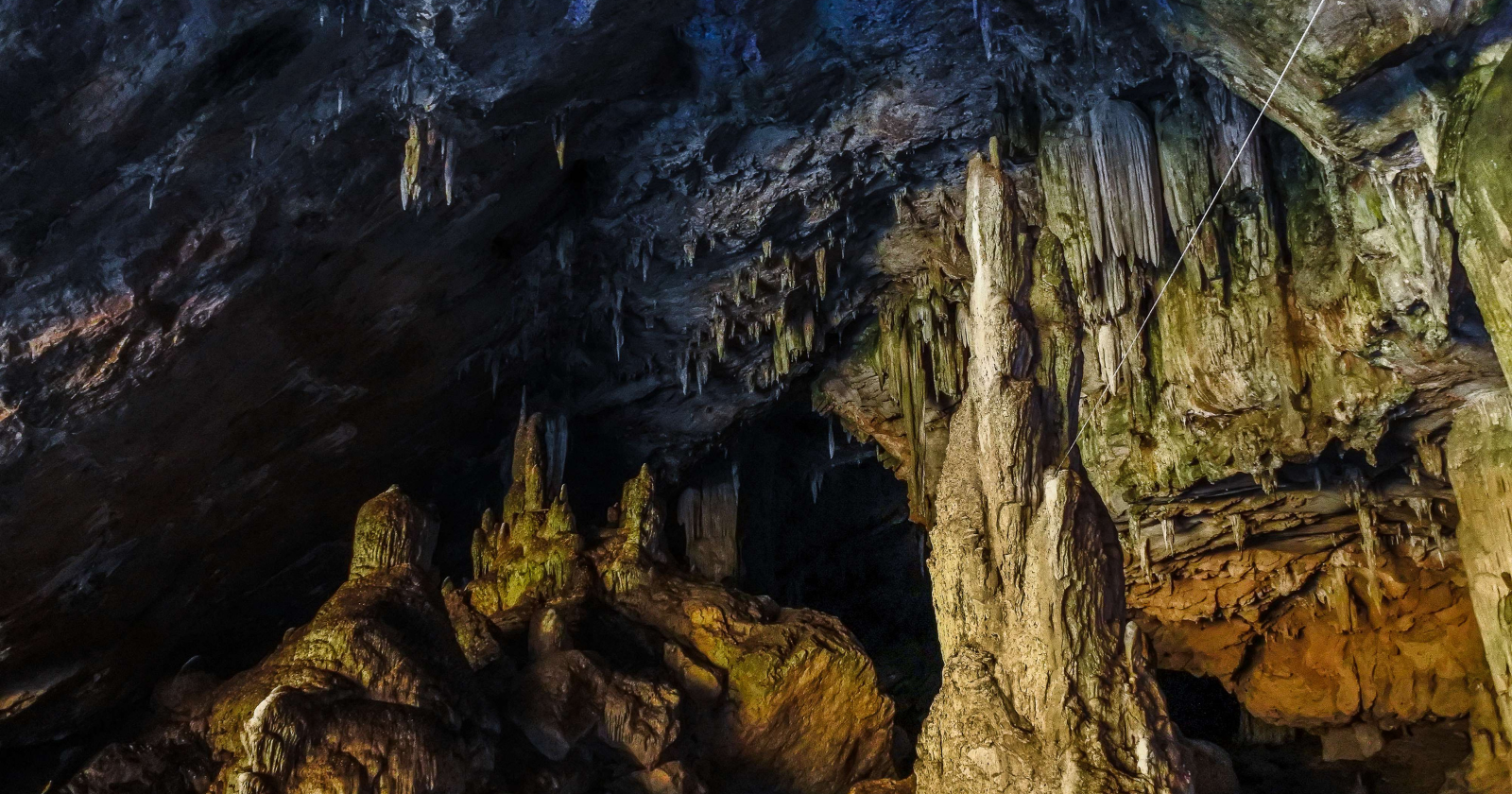
Eighteen metres below a field on the outskirts of Mangalia in south-eastern Romania, two kilometres from the Black Sea shore, there is a limestone maze 240 metres long that has no natural opening to the surface. A geological survey shaft cut into it in June 1986. Nobody had been inside it before, and on the available evidence nothing from the surface had washed into it for a very long time either.
Conditions vary sharply by depth, and the distinction matters. In the dry upper level the air sits at 21 degrees Celsius with 19 per cent oxygen and 1 per cent carbon dioxide, which is breathable. The lower level is 40 metres long and partly flooded, and in the three air pockets known as the Air-Bells the oxygen falls to 7 per cent while carbon dioxide climbs to 3.5 per cent. That is where the air becomes a problem. Researchers reach those chambers by diving, and, according to the 2021 review in Diversity by Traian Brad, Sanda Iepure and Serban Sarbu, they keep breathing through a regulator while they work in there.
Accounts of the water column differ. That review dates the transition to anoxic water to below one millimetre of depth, citing Riess and colleagues (1999). Serban Sarbu’s own 2000 chapter puts measurable dissolved oxygen in roughly the first five centimetres. A 2023 study led by Joost Aerts describes oxygen declining rapidly below the surface to microaerobic or anoxic conditions rather than cutting off at a fixed line, which is the more careful phrasing.
What the 1996 paper established
The finding that made the cave scientifically significant was published in Science on 28 June 1996 by Serban Sarbu, Thomas Kane and Brian Kinkle. Using stable carbon and nitrogen isotope analysis, they showed that the animals in the cave were feeding on carbon fixed in place by bacteria oxidising hydrogen sulphide, not on anything washed in from above. Their paper counted 48 invertebrate species, 33 of them found nowhere else, and described the system as the only terrestrial community then known to run on chemoautotrophic production.
The picture has since become more crowded. Work led by Yin Chen and J. Colin Murrell, published in the ISME Journal in 2009, used stable isotope probing with labelled bicarbonate and found Thiobacillus species most active in assimilating carbon dioxide. Those incubations implied that ammonia and nitrite oxidisers were also active, which led the authors to suggest that this may be another major primary production route. They present it as a possibility raised by the incubations rather than an established second pathway.
The sealing date is not settled
Two figures circulate for the same event, and they are roughly a factor of two apart. The 2023 study states that impermeable layers of clay and loess have prevented significant input of surface water and organic matter for the last 5.5 million years. The Diversity review, citing Lascu, Popa and Sarbu in Revue Roumaine de Géographie (1994), dates the covering of the Sarmatian limestone by those Quaternary clays and loess to approximately 2.5 million years ago.
Both statements describe the same clay and loess cover, and they cannot both be right.
A third number sits alongside them from a different kind of evidence. Andrzej Falniowski and colleagues, writing in Molluscan Research in 2008, used mitochondrial COI sequences to estimate that the cave snail Heleobia dobrogica diverged from its nearest surface relative about 2.17 million years ago, give or take 170,000 years. That estimate covers one species and does not date the seal. The 5.5 million year figure is the one that has stuck in the literature, and the 2020 description of the cave’s largest predator carries “Five million years in the darkness” in its title. Its shorter rival rarely gets quoted.
The species list is still being added to
The 2021 species list from Brad, Iepure and Sarbu runs to 52 invertebrate species, 21 aquatic and 31 terrestrial, of which 37 are endemic. The top terrestrial predator, Cryptops speleorex, is a centipede 8 to 10 centimetres long, described only in 2020 by Varpu Vahtera, Pavel Stoev and Nesrine Akkari. Below it sit blind water scorpions, a blind leech, flatworms, springtails in very large numbers, and the isopod Armadillidium tabacarui, which the review records at densities of up to 200 individuals per square metre in the Air-Bells.
One detail tends to get lost when the cave is described as a sealed world. Several of its endemic species also turn up in old hand-dug wells and in sulphidic springs along the shore, one to three kilometres away.
Movile is an access point to a sulphurous aquifer estimated at 50 to 100 square kilometres, and the cave functions as a window onto it.
Why a space research programme paid for cave sampling
In October 2023, Aerts and his co-authors published three years of sampling from the cave in the journal Life, along with a microcosm experiment in which minerals were left in the cave water for a year and then sequenced. Different zones held distinct microbial communities, and the incubated minerals had been colonised by their own specific communities within twelve months. The paper was supported in part by the Netherlands Organisation for Scientific Research’s User Support Programme Space Research, and its co-authors include Pascale Ehrenfreund of Leiden Observatory and the Space Policy Institute at George Washington University.
Behind that funding line is a straightforward piece of reasoning. If you want a working example of a biosphere powered by chemistry instead of sunlight, in the dark, under rock, this one can be reached by car. Whether comparable ecosystems exist beneath the ice of Europa or Enceladus is a separate question, and Movile has nothing to say about it. What the cave offers is a constraint on what such a search would need to look for, and a demonstration that a system of this kind can persist over geological time.
The cave is inside a Natura 2000 site and entry requires a permit. What is worth watching is the water. Brad, Iepure and Sarbu flag agricultural runoff into the Dobrogea aquifer and residential expansion around Mangalia as the plausible threats, and every organism in the system depends on the continued inflow of sulphide-rich water from 180 to 200 metres down.