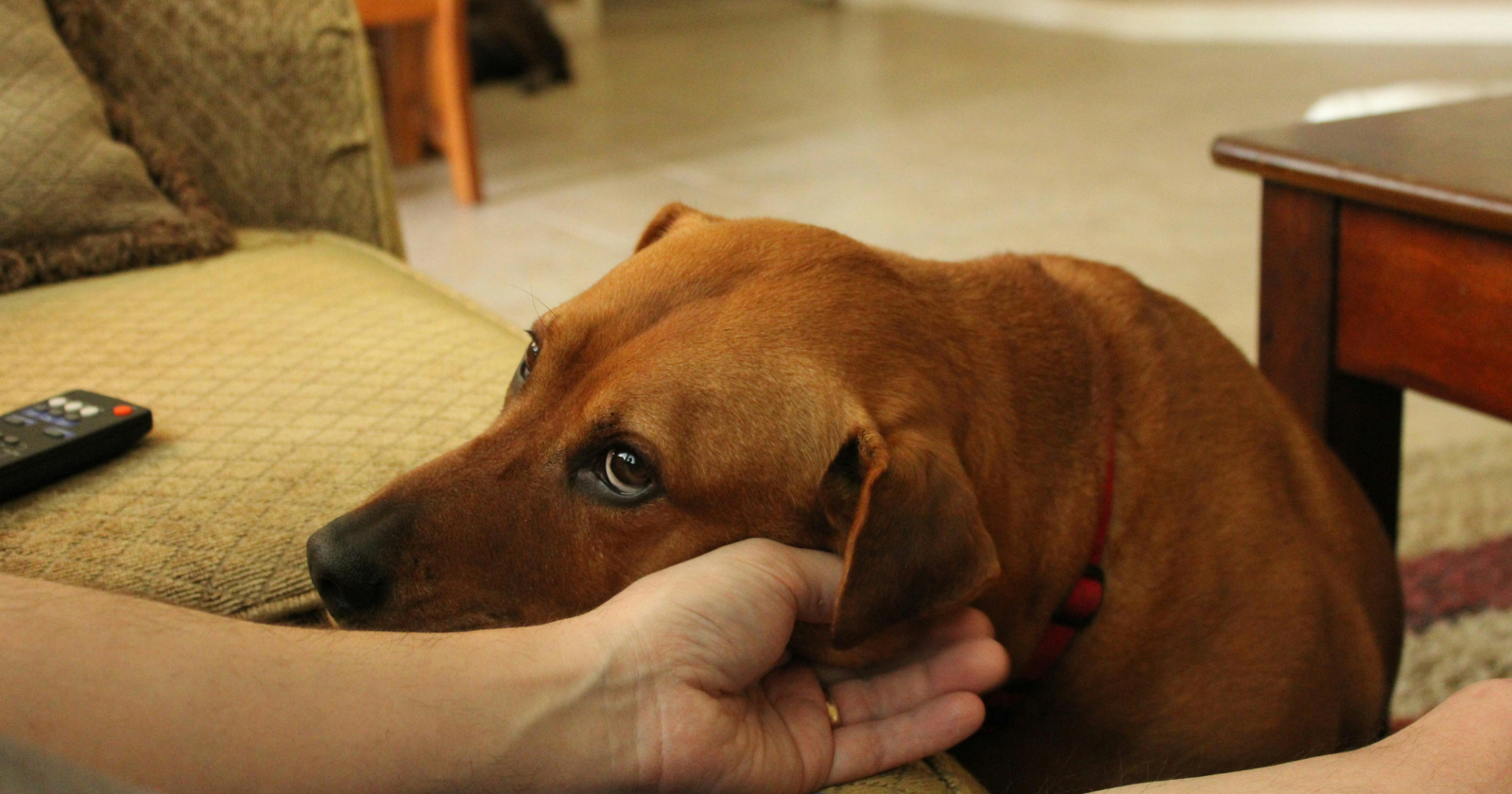
Hugo worked it out before I did.
My beagle is thirteen kilos of noise and bad decisions, and on a Tuesday afternoon he was doing what he always does at that hour, which is aggressively nothing. Then an email landed. I read two lines, felt my chest tighten, and kept reading without saying a word or moving from the chair. By the time I reached the bottom of the message Hugo had left his spot by the door, crossed the room and parked his chin on my foot.
I filed it under coincidence for about a year. Then I started reading the canine olfaction research, and coincidence stopped being the best available explanation.
What four dogs in Belfast could smell
Researchers at Queen’s University Belfast ran the cleanest version of this experiment anyone has managed. Clara Wilson and her colleagues collected combined breath and sweat samples from 36 people, once at rest and once immediately after a fast, unpleasant mental arithmetic task, then confirmed the stress was real using heart rate, blood pressure and self-report. Four trained dogs were asked to pick the stressed sample out of a line-up under double-blind conditions. In the paper published in PLOS ONE, the dogs were correct 93.75 per cent of the time across 720 trials, in a task where chance alone would have got them one in three.
Same person, same day, four minutes apart, with stress as the only variable.
If you enjoy weird animal facts, check out this video we made on something unusual only elephants can see:
Why the signal turns up in breath
Your body constantly sheds volatile organic compounds, which are small carbon-based molecules light enough to evaporate off skin and drift out of lungs. Under pressure, two hormone systems fire on different clocks. One dumps adrenaline and noradrenaline within milliseconds. The other takes minutes or hours to release cortisol. Both alter what your metabolism is producing, and some of that production simply walks out through your breath.
A proof-of-concept study at Dalhousie University pushed the idea further. Laura Kiiroja and her team, writing in Frontiers in Allergy, collected breath from 26 people with trauma histories, first while calm and again during exposure to personalised reminders of what they had been through. Two dogs, a golden retriever named Ivy and a shepherd cross named Callie, hit roughly 90 per cent accuracy telling the two states apart when both samples were laid out side by side for comparison. The strange detail is what their errors revealed. Ivy’s accuracy tracked how anxious the donors said they felt, while Callie’s tracked how ashamed they felt, which suggests the two animals had locked onto different molecules entirely.
The team then tried something closer to real life: one sample at a time, no direct comparison to lean on. Accuracy dropped to 74 per cent for Ivy and 81 per cent for Callie. Still well clear of chance, but that gap between the two versions of the task is the honest headline. Two dogs is two dogs, and the authors call this a proof of concept rather than a settled finding.
A nose wired into the eyes
Dogs are not simply running our sense of smell at higher volume. A Cornell team including Erica Andrews and Philippa Johnson scanned 23 dogs with diffusion tensor imaging, confirmed the results by dissection, and mapped five substantial white matter tracts leading out of the olfactory bulb. One of them terminates in the occipital lobe, the visual cortex. No direct link between the nose and the visual brain had been documented in any species before, and Johnson has described the tracts as dramatic in size next to anything in the human olfactory system.
That reframes the whole business. Hugo is not sniffing me and then working out what it means. Smell arrives in his head already fused with everything else he knows about the room.
Smelling stress changes what dogs do next
A University of Bristol team tested 18 dogs on a cognitive bias task, the standard method for measuring optimism and pessimism in animals. Each dog learned that food appeared at one location and never at a second, then met bowls placed in ambiguous spots in between while a jar of human odour sat in the room. The odour on its own did not make dogs cautious at every ambiguous spot. The effect showed up at exactly one location, the one nearest the no-food end of the line, and only by the third test session. There, dogs given the smell of a stressed stranger became roughly half as likely to approach that spot compared to no odour at all. Zoe Parr-Cortes and Nicola Rooney reported in Scientific Reports that this happened on smell alone, with no face, no voice and no familiar person present.
Earlier work at the University of Naples Federico II pointed the same way, finding that dogs given sweat collected from frightened men showed more stress behaviour and stayed closer to their owners than when given happy or neutral samples.
What I actually changed
I stopped assuming Hugo was reading my face.
On rough days he now gets his walk earlier, because the pacing and the whining at nothing, which I used to treat as his problem, read to me now as a reasonable response to a flatmate quietly leaking adrenaline into the air. None of this is locked down. It is a small stack of studies with small samples, and the specific compounds have not been identified.
Still, he is mostly nose, and I am the largest chemical event in his day.