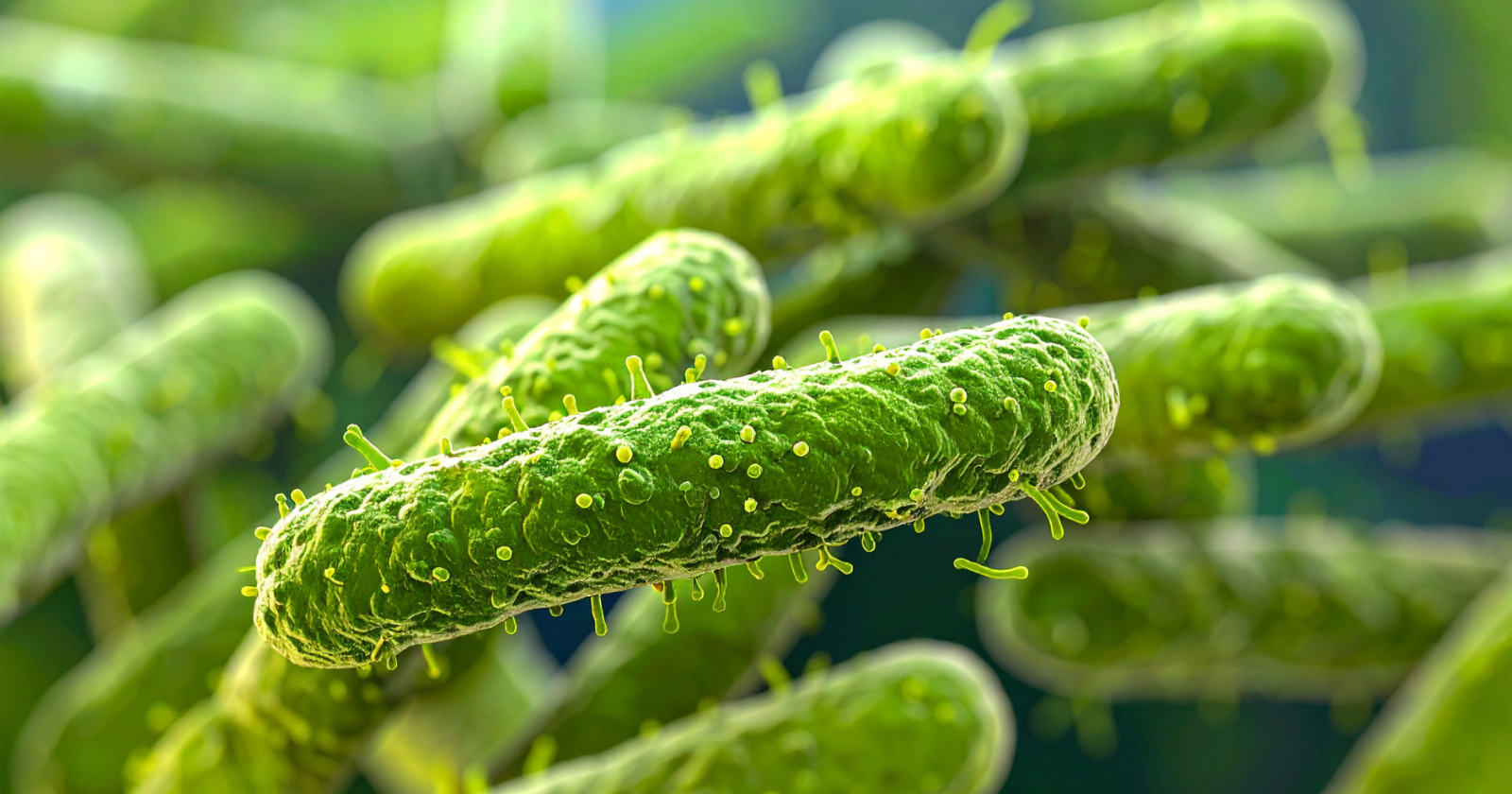
Somewhere under a flooded paddy, bacteria are being paid in sugar to hand over their electrons, and nobody has told the farmer.
Rice roots leak: as a plant photosynthesises, a share of what it makes gets pushed out through the roots as sugars, acids and other simple carbon compounds. Waterlogged soil holds almost no oxygen, so bacteria feeding on those leftovers have nowhere convenient to put the electrons that a meal releases. Offer them a conductive surface and they’ll hand the electrons off there instead. Wire that surface to a second electrode floating in the water above, where oxygen is abundant, and current moves along the wire between the two.
That is a battery made of mud, roots and appetite.
First tests in a Japanese paddy
Back in 2008, a group led by Kazuya Watanabe buried graphite felt in the root zone of a working Japanese rice field and floated a matching electrode in the flooded water above it. Writing in Applied Microbiology and Biotechnology, they clocked output as high as 6 milliwatts per square metre of electrode. It rose and fell on a daily cycle with the sun, and it collapsed when the plants were deliberately shaded during daylight hours. They described the arrangement as an ecological solar cell, with photosynthesis at one end and bacterial metabolism at the other.
What the Bangladesh trial measured
“Not yet viable for large-scale application” was how one Bangladeshi team framed the problem, right before setting out to improve on it. In 2020, that team, led by Mostofa Mujtahid Al Hussain, tested the same architecture on farmland soil, growing rice in pots inside a greenhouse rather than a working field, and swapped in a much cheaper anode: activated biochar, charcoal further processed to open up far more surface area for bacteria to colonise. Their results, published in Energy Conversion and Management four years later with funding from the country’s University Grants Commission, put peak power at 106.67 milliwatts per square metre of anode, roughly triple the 38.28 milliwatts managed by the sediment-only version of the same rig. Methane emissions fell 38 per cent against untreated rice in one configuration and 27.1 per cent in another. Grain yield showed no significant change.
One paper, one site, one growing season.
For calibration, a review of paddy field systems by Atsushi Kouzuma, Nobuo Kaku and Watanabe put earlier demonstrated peaks at close to 80 milliwatts on the same basis, so the Bangladeshi figure is a step up rather than a leap into another category. The Bangladeshi work also presents itself as the first of its kind in that country, and that’s exactly why the numbers want repeating in other soils before anyone treats them as typical.
How little power that actually is
How much is a tenth of a watt, in practical terms? That’s roughly what a hundred milliwatts across a square metre works out to, close to the best the Bangladeshi trial recorded. At that peak output, matching a typical phone charger’s draw of 5 to 20 watts would need something like a hundred square metres of electrode, before accounting for losses in the electronics, which is a faintly ridiculous way to think about the technology.
Small and constant is a different product from large and occasional. Yu Lu and colleagues, reporting in AMB Express, wired three paddy soil cells in series and ran an electronic timer off them. In West Kalimantan, Emilius Sudirjo and co-workers from Wageningen University installed tubular cells in a working paddy for four growing seasons. Across that run, they logged a maximum daily average of 9.6 milliwatts per square metre of plant growth area and used LoRa radio to relay the cells’ performance data out of the field.
Rice kept growing regardless.
Methane is where it gets interesting
Every flooded paddy is quietly fermenting all season, whether anyone taps it for power or not. Around 8 per cent of human-caused methane comes from growing rice, per the Food and Agriculture Organization, sitting inside an agricultural share of about 40 per cent. Flooded soil is excellent real estate for methanogens, the archaea that make methane when nothing better is on offer to accept electrons. An electrode is something better. Give the microbial community a wire, and some of the carbon that would otherwise vent as methane leaves instead as current.
Kouzuma and his co-authors flagged that where the root zone is loaded with organic matter, the methane-suppressing effect of electricity generation falls away sharply, and they called for more work before paddy cells are counted as a mitigation tool. A couple of trials showing lower emissions is a promising signal. Establishing a reliable effect across soil types, water regimes and climates is a much longer job.
What has to happen before a farmer cares
Cost is the entire conversation. Graphite felt and platinum catalysts are unremarkable in a research plot and preposterous across a smallholding, which is why replacing them with biochar matters more than the headline milliwatt count. Installation in most designs happens hill by hill across a paddy, which adds up to serious labour, and the Indonesian tubular design was developed partly to avoid excavating topsoil at all.
None of that is exotic engineering. Whether paddies end up quietly running their own moisture sensors will come down to the price of a buried electrode and the patience of whoever pushes it into the mud, season after season, while the bacteria go on eating for free.