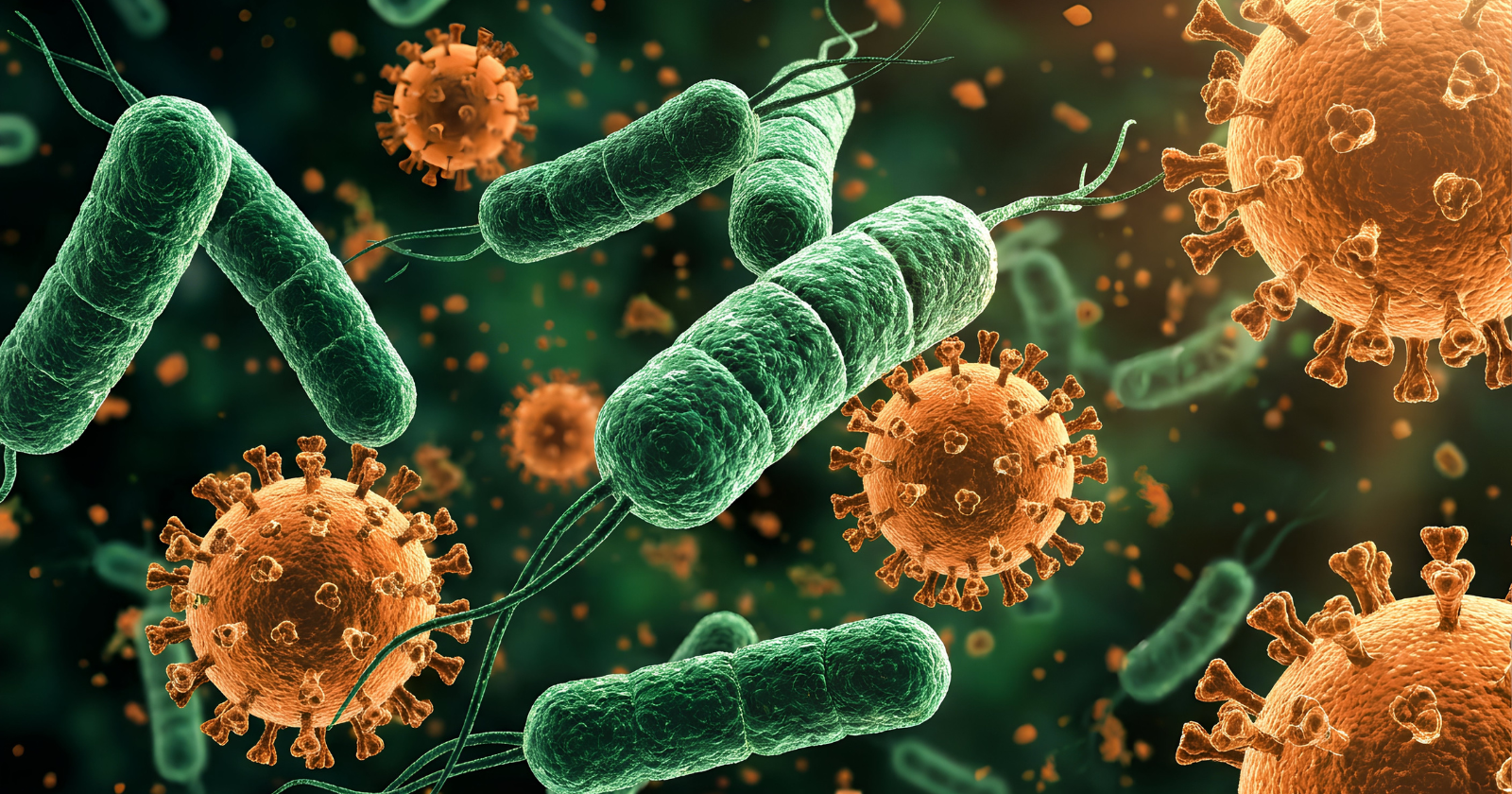
Scrape up a teaspoon of garden soil and you are holding several billion bacteria, and a fair few of them are quietly running on nothing but air.
Hydrogen makes up roughly 0.00005 per cent of the atmosphere, a rounding error sitting on top of another rounding error, and a surprising number of soil bacteria have worked out how to live on it. Microbiologists have known this for years. What nobody could explain was the trick itself, because pulling energy out of a gas so scarce, in an atmosphere full of oxygen, should not be chemically worth the bother.
A team at the Monash University Biomedicine Discovery Institute in Melbourne, led by Rhys Grinter, Ashleigh Kropp and Chris Greening, took the machinery apart and found the answer. They isolated the enzyme responsible from Mycobacterium smegmatis, a harmless soil-dwelling relative of the tuberculosis bacterium, and showed in a paper published in Nature that it converts atmospheric hydrogen directly into an electrical current. They named it Huc.
The habit is widespread and consequential. Soil microbes strip roughly 70 million tonnes of hydrogen out of the air annually, a figure the researchers set out in their own account of the discovery. Traffic on that scale helps set the composition of the atmosphere, and it sustains life where there is almost nothing else on the menu, from Antarctic ground to volcanic craters.
What the enzyme is doing
A hydrogen molecule is two protons glued together by two electrons. Huc prises them apart and sends the electrons off down the bacterium’s respiratory chain, which is where its energy comes from. That flow of electrons is a current, so the enzyme is effectively a very small battery that never needs plugging in.
Grinter told Cosmos it took close to five years and a pile of failed attempts to get hold of it, largely because there was no established method for growing the bacteria, cracking them open and fishing out one component. The structure they eventually resolved by cryo-electron microscopy turned out to be a large molecular complex mounted on a stalk, ferrying an electron carrier out from the membrane to where the reaction happens.
Oxygen is normally the dealbreaker
“Huc is extraordinarily efficient,” Grinter said when the Nature paper came out. Almost every other hydrogenase, the class of enzyme that oxidises hydrogen, is oxygen-sensitive: exposure to air deactivates it, one reason hydrogen fuel cells built on them stay expensive and finicky. Huc simply ignores that constraint.
Computer simulations run by Syma Khalid’s group at Oxford explained why: the channels leading into the active site are wide enough to admit hydrogen and too narrow for oxygen to squeeze through. Greening told Physics World that the enzyme’s appetite for the gas is high enough to strip hydrogen straight out of ambient air, something no known chemical catalyst manages.
It also survives things enzymes do not survive
Can you freeze an enzyme, bake it, and still get power out the other side? Purified proteins are usually delicate, short-lived and expensive to keep stable, but Huc is none of those. Kropp reported that the isolated enzyme can be frozen solid or heated to 80°C and still generate power afterwards.
For anything that might one day sit inside a device on a shelf, that matters more than the headline chemistry.
How much electricity is actually on offer
Not much, yet. The 2023 work was structural biology rather than an engineering demonstration, and a small quantity of enzyme produces a proportionally modest current. Grinter’s stated goal at the time was scaling up production, on the grounds that the bacteria are cheap and easy to grow in bulk, with a wristwatch floated as a plausible proof of concept.
A second use needs no scaling at all. As reported by eeNews Europe, the same current also makes Huc a sensitive hydrogen detector, useful for spotting leaks in pipelines and storage tanks.
One paper describing how a protein works is not the same thing as a power source, and the team was careful to say so.
Where it has gone since
By 2025, a separate Monash engineering group had wired Huc onto a mesh of carbon nanotubes to see what it could actually do in a circuit. The work was led by Kaiqiang He, alongside Kropp, Grinter and Greening. The resulting cell put out 1.72 milliwatts per square centimetre running on pure hydrogen, and kept working on dirty fuel that would poison a conventional catalyst, including gas contaminated with carbon monoxide. It’s useful, though pure hydrogen and thin air remain different propositions.
Work published in 2026 by Kropp and colleagues found that M. smegmatis throttles back its production of Huc when a richer food source such as glycerol is available, then ramps it back up as the cell slides towards dormancy.
Which is a slightly deflating detail, and a very honest one. The organism that inspired the idea of an air-powered battery only bothers with air when there is nothing better going.