
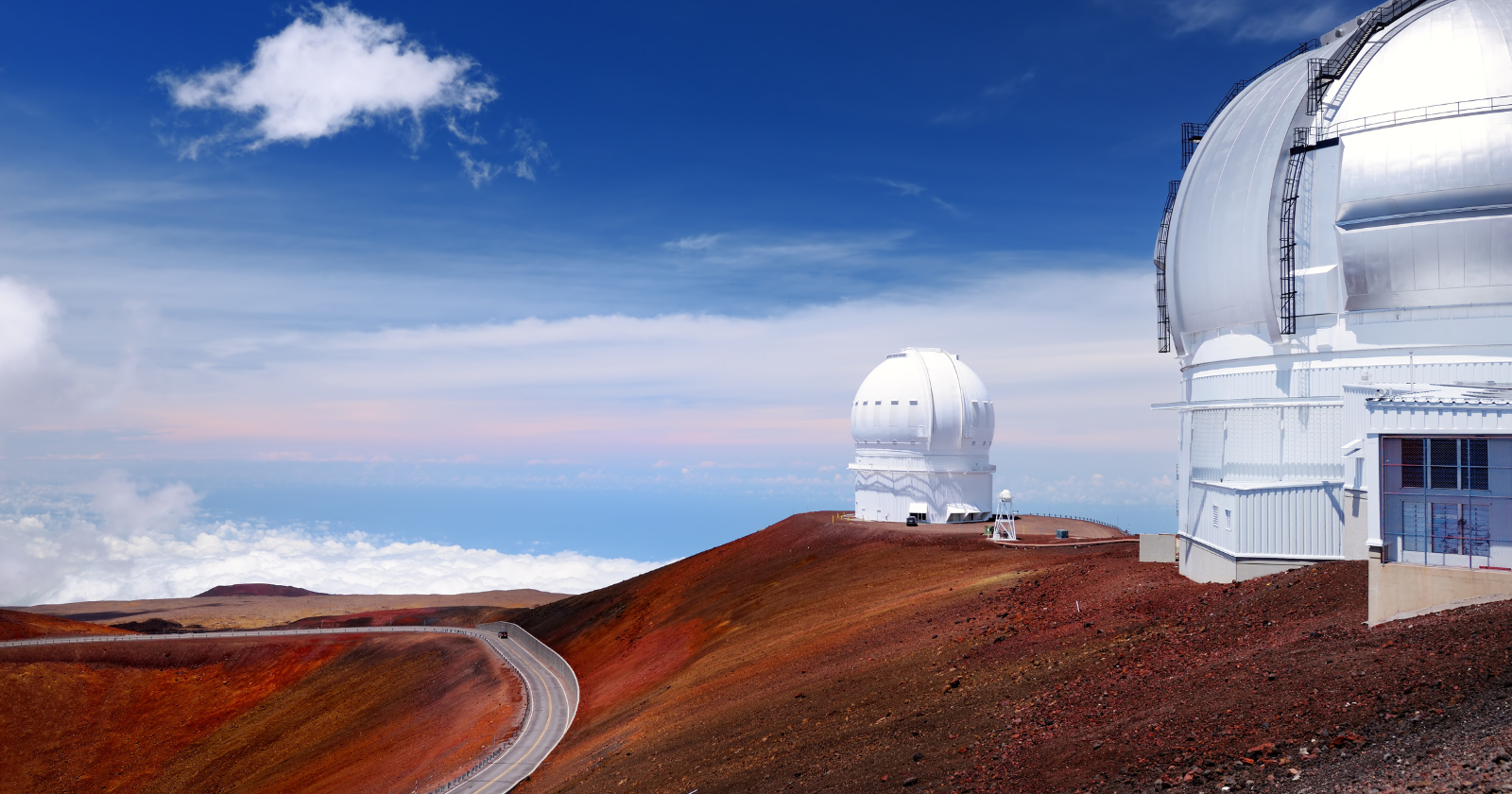
At the summit of Mauna Kea, above roughly 40 per cent of the Earth’s atmosphere and close to 90 per cent of its water vapour, sits one of the densest concentrations of large telescopes anywhere on the planet. Thirteen have been built near the top since the 1960s, funded and operated by institutions and cooperatives drawn from eleven countries. The mountain is the highest point in Hawaii at 4,207 metres, or 13,803 feet, according to the United States Geological Survey. It is also, technically, a dormant volcano.
Each of those claims stands on its own, and each rewards a closer look.
Why the air matters
The case for the site is atmospheric. Astronomical seeing depends on how still, dry and thin the air above a telescope is, because turbulence and water vapour blur and absorb incoming light. Mauna Kea’s summit clears most of the atmosphere’s mass and the overwhelming bulk of its moisture. The surrounding ocean provides a thermally stable environment with no nearby mountain ranges to churn the upper air, and there is very little light pollution from the ground below.
The result is a location that performs well across optical, infrared and submillimetre wavelengths, which is unusual. Most observatories are strong in one band. The University of Hawaii’s Institute for Astronomy, which developed the site, describes the combined light-gathering power of the telescopes there as many times that of older reference instruments such as the Palomar telescope. The relevant point is not any single comparison figure but the clustering: more major telescopes have been placed on this one peak than on any other.
The multinational build-up
The eleven-country figure reflects how the mountain filled up. Rather than one national programme, Mauna Kea accumulated separate facilities over six decades, each with its own backers. The list of nations involved across the observatories includes the United States, the United Kingdom, Canada, France, Japan, the Netherlands, Taiwan, Chile, Brazil, Argentina and Australia.
Of the thirteen telescopes, nine work in optical and infrared light, three in the submillimetre range and one in radio. They include the twin ten-metre Keck telescopes, Japan’s 8.2-metre Subaru, and Gemini North, itself operated by an international consortium. The instruments range from small survey telescopes under a metre across to the large segmented mirrors that have contributed to work on distant galaxies, exoplanets and the structure of the early universe.
The scale of the enterprise is easy to state and easy to overstate. The mountain provides observing conditions; using it requires coordination among institutions that do not otherwise share a budget, a language or a government.
What “dormant” actually means
Mauna Kea is a shield volcano in what geologists call its post-shield stage. Its last eruption is dated to somewhere between 6,000 and 4,000 years ago. The USGS classes it as dormant rather than extinct, with a threat potential rated moderate, and notes that it is likely to erupt again at some point.
Dormant is a technical term, and it carries no promise of permanence. The volcano is quiet, monitored by seismic and GPS instruments, and shows no current signs of unrest. It is not, on the available evidence, finished. Building a permanent scientific installation on a volcano that has erupted within the span of recorded human settlement is a calculated bet on very long odds over the working life of the instruments, not a claim that the mountain is dead.
Why the number is starting to change
The count of thirteen is a historical tally. Fewer telescopes are operating today.
Two of the observatories have now been taken down entirely. The Caltech Submillimeter Observatory and the University of Hawaii at Hilo’s Hoku Kea telescope were both decommissioned and their sites restored in 2024, the first formal removals in the mountain’s history. In mid-2025 the university began the process of decommissioning a third, the United Kingdom Infrared Telescope, which has operated on the mountain since 1979.
This follows years of dispute over the summit’s use. Mauna Kea is sacred in Native Hawaiian tradition, and plans for the Thirty Meter Telescope drew sustained protests that stalled construction in 2019. In 2022 the state legislature created the Mauna Kea Stewardship and Oversight Authority, which is co-managing the mountain with the university and is due to take full responsibility in 2028. The university’s master lease over the summit land runs to the end of 2033, and observatories that do not secure new terms before it expires would then have to dismantle their facilities and restore the ground beneath them.
What to watch
The open questions now are administrative ones. Whether the older telescopes secure new leases, whether the Thirty Meter Telescope is ever built or relocated, and how the new authority balances research access against cultural stewardship will determine what the summit looks like a decade from now.
The physics that drew eleven countries to the mountain has not changed. The air is still thin, dry and steady. What has changed is the governance underneath it, and that is now the part of the story worth following.