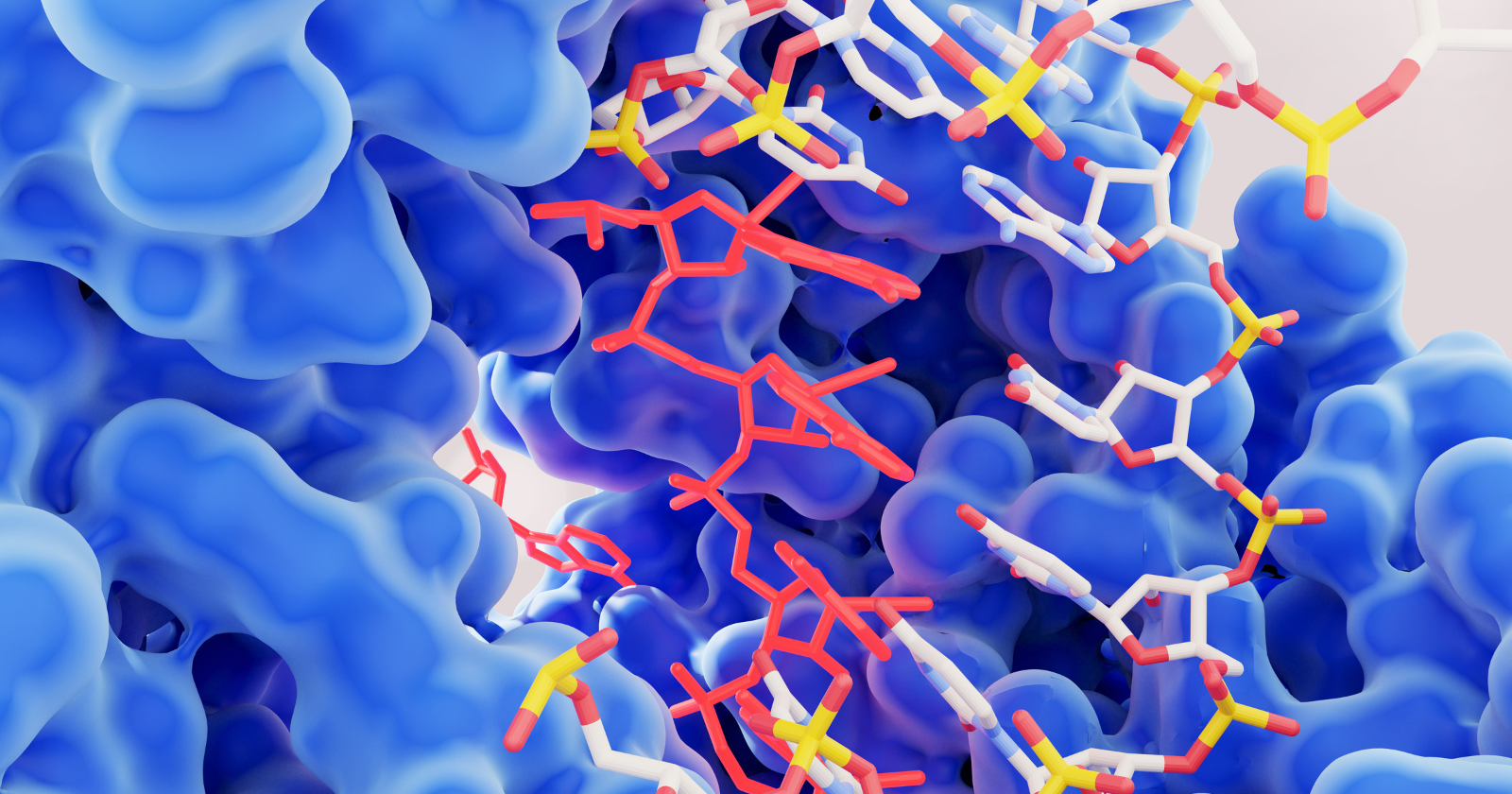
Evolution has had roughly four billion years, every organism that ever lived, and an unlimited budget for failure. It still only managed to build a sliver of the proteins that are chemically possible.
That is not a failure of ambition. Evolution can only tinker with what it already has, one mutation at a time, so it never wandered far from the handful of shapes it stumbled into early on. Vast regions of protein space sit there untouched, perfectly viable, simply never visited. Software has no such handicap, and over the past three years a set of AI tools has walked into that empty territory and started building.
What designing a protein from scratch actually means
A protein is a chain of amino acids that folds into a particular three-dimensional shape, and the shape is what does the work. Nature runs this forward: sequence produces structure, structure produces function. Design runs it backwards. Decide what the molecule should do, work out what shape would do it, then ask a model which sequence folds into that shape.
Most of the tools are open source and named like minor Marvel villains. RFdiffusion generates a protein backbone, ProteinMPNN decides which amino acids to hang on it, AlphaFold checks whether the thing would really fold that way. A review of the field published in Nature in April 2026 by Wei Yang and colleagues puts the position bluntly: the long-standing structural problems are close to solved, and the live question is no longer how to design a protein but what to design.
The snakebite proof of concept
Snakebite kills more than 100,000 people a year, mostly where there is least money to treat it. Antivenom is still made roughly the way it was in the 1890s, by injecting a horse with venom and harvesting the plasma. It often fails against three-finger toxins, the small, nasty proteins that make cobra and mamba bites so dangerous.
A team led by Susana Vázquez Torres, with David Baker at the University of Washington and Timothy Jenkins at the Technical University of Denmark, designed miniproteins that bind those toxins directly, publishing in Nature in January 2025. Survival in mice given a lethal dose ranged from 60 to 100 per cent depending on the toxin, the dose and the timing: full protection when the designed protein was mixed with the toxin beforehand or given within fifteen minutes of it, dropping to 60 per cent for one binder when treatment was delayed to thirty minutes. The molecules are heat stable and can be brewed in bacteria instead of livestock, which matters enormously in places without reliable refrigeration. One paper, one toxin family, mice not people. Still a real result.
Enzymes are the harder trick
Binding a target is one thing.
Catalysing a chemical reaction is considerably harder, because the active site has to hold several amino acids in position to within a fraction of an angstrom, and hold them there through every step of the reaction.
In February 2025 Baker’s lab reported serine hydrolases built entirely from scratch, enzymes that snip the ester bonds found in fats, pesticides and polyester. More than 300 computer-generated candidates went into the lab. The successful ones had folds that appear nowhere among natural serine hydrolases, with catalytic efficiencies in the range of natural enzymes acting on similar substrates. Co-lead author Anna Lauko called the results efficient, with room for improvement. Fair enough, for a field that could not manage this at all a few years earlier.
Materials evolution never bothered with
Proteins self-assemble, which makes them appealing as construction material. Sanela Rankovic, Neil King and colleagues described a designed nanoparticle with two chemically distinct faces in Nature Materials in 2025, each face able to grab a different target and drag the two together. Nature builds symmetric protein shells constantly. Two-sided ones, apparently not.
MIT went sideways instead. A model called VibeGen, built by Bo Ni and Markus Buehler and published in the journal Matter in March 2026, designs proteins by specifying how they should move rather than what shape they should settle into. Buehler’s framing is that a protein’s shape is one frame of a much longer film. His group found that many different sequences produce the same pattern of motion, hinting that evolution picked one answer from a large family and never looked at the rest. These designs have so far been checked in physics simulations, not in a wet lab, which is a meaningful gap.
The obvious problem
Anything that can design a useful protein can design a horrible one.
DNA synthesis companies screen incoming orders against databases of known toxin sequences, which works well when the order resembles the toxin. Eric Horvitz and Bruce Wittmann at Microsoft asked what happens when AI rewrites the sequence while preserving the shape. Their team generated 76,089 variants of 72 proteins of concern, largely well-known toxins, and put them through commercial screening software. A great many slipped past.
What happened next is the encouraging part. Instead of publishing, the group spent ten months working quietly with synthesis providers and software vendors, then released the findings in Science in October 2025 only after patches had been distributed. The updated screening catches far more. It does not catch everything, and nobody involved pretends otherwise.
The striking thing about all of this is how unremarkable the workflow has become. A postgraduate with a laptop and a modest budget can now propose molecules that no lineage on Earth ever produced. The bottleneck has quietly shifted from designing the thing to testing it, and from testing it to deciding who gets a say in what is worth building at all.