Endeavour could cross the Pacific in about twenty minutes. Getting it past a row of street trees on Manchester Boulevard took most of an afternoon.
For nineteen years the orbiter did the genuinely difficult work without complaint. NASA’s mission record for STS-134, its final flight, puts the career total at 122,883,151 miles over 25 missions, 4,671 orbits and 299 days off the planet. Then it retired to Los Angeles, and the last twelve miles nearly broke everyone involved.
Why the streets were the hard part
Weight was solvable. Shape was not.
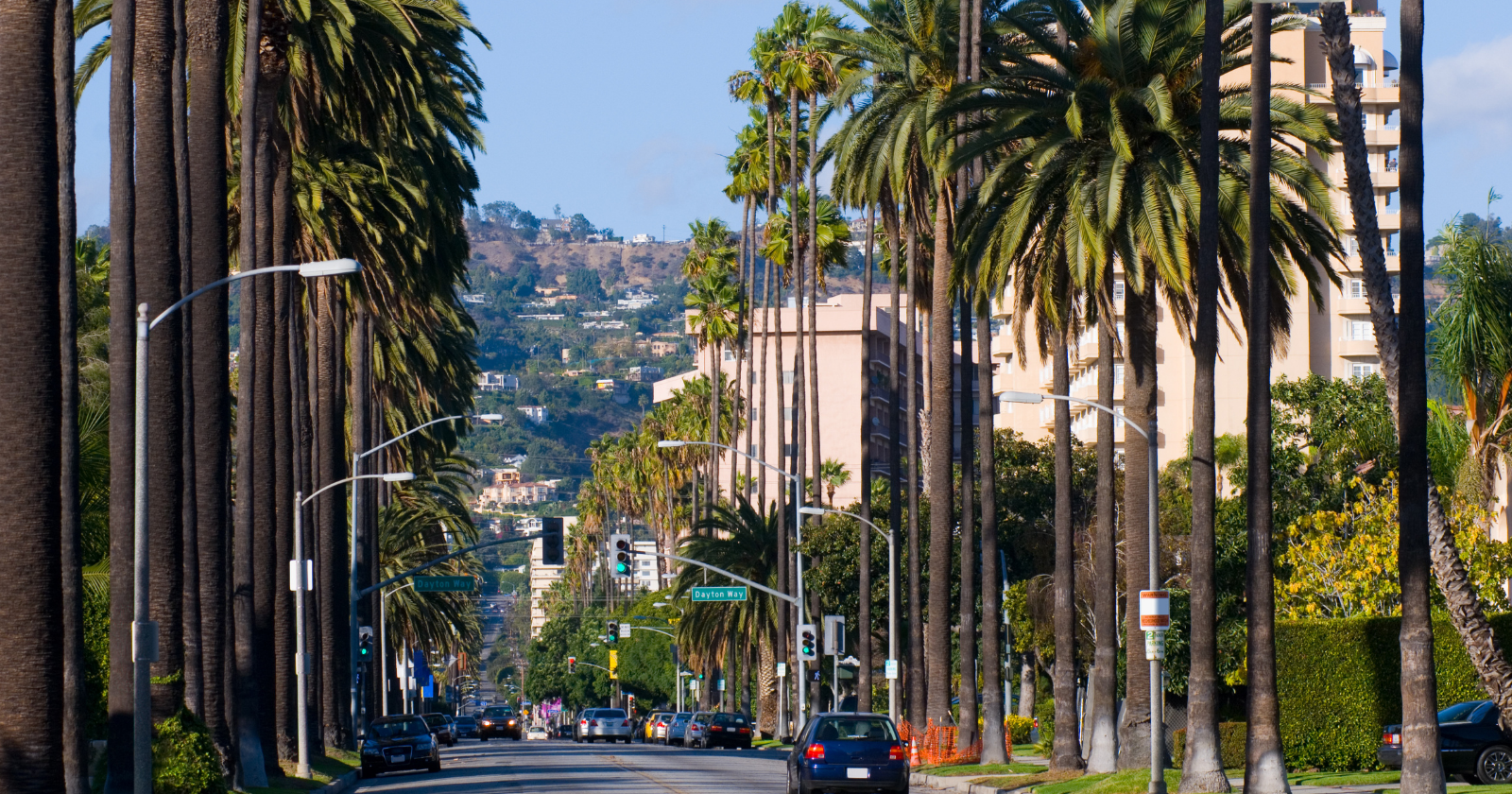
Endeavour is 78 feet across the wings. As NPR reported before the move, that ruled out every freeway overpass in the city, since the orbiter simply wouldn’t fit beneath them. Taking it apart would have destroyed the heat tiles, and airlifting 170,000 pounds of spacecraft was never realistic either. What remained were surface boulevards through Inglewood and South Los Angeles, complete with medians, kerbs, power lines, streetlights and about four hundred trees standing exactly where a wingtip wanted to be.
So the trees came down. Crews worked along Manchester and Crenshaw for weeks beforehand, leaving stumps in the medians and a lot of unhappy residents behind them.
That was the bit nobody forgave quickly.
The cleared route delivered one enduring image, at least. Further up Manchester, as Fox News captured at the time, the orbiter rolled past Randy’s Donuts, the giant rooftop doughnut that has advertised the place for decades, producing photographs that are about as Los Angeles as anything ever taken.
The California Science Center, which had won the orbiter from NASA and was paying for the move, promised to replace what came down. By early 2013, new trees were going into the ground across Inglewood, Westchester and other stretches of the route, per NBC Los Angeles. Saplings still take decades to become real shade.
Three days at less than walking pace
Endeavour rolled out of a United Airlines hangar at 11.25pm on Thursday 11 October 2012, riding a 160-wheel, self-propelled transporter. Space historian Robert Pearlman, writing in coverage for Space.com, tracked it out of the airport at 2am and onto Westchester Parkway, where it promptly parked in a shopping centre car park for a nine-hour wait while utility crews de-energised and lifted transformer lines.
Top speed was 2mph. Actual progress was rather worse. CBS and the Associated Press reported that the first leg ran two hours late thanks to a fault on the carrier, and that the shuttle managed three miles before stopping again at 5.30am.
It got slower from there. On Crenshaw Boulevard, where apartment buildings crowd close to the street, the transporter kept meeting branches that surveys had marked clear, and crews returned with chainsaws while the shuttle idled, as the engineering blog Practical Engineering later recounted. A planned Saturday evening arrival came and went. Then the transporter began leaking oil in the small hours of Sunday, CBC noted, adding several more hours to a schedule that had already lost its shape.
Endeavour finally reached the science center on Sunday afternoon, a full day behind schedule. Pearlman’s account of the arrival puts the delay down to natural and utility obstacles along the route, plus the need to service the transporters. Door to door, per NBC News, the twelve miles took 68 hours, at an average of about 0.18mph, roughly one city block an hour.
What a slow parade costs
CBC put the final price tag at around ten million dollars, covered by the science center and private donations. Close to a thousand Los Angeles police officers worked the route as part of a multi-agency task force. Every traffic signal that went dark during the move had to come back on afterwards, and city transportation spokesman Brian Kolacinski told NBC Los Angeles that each one took about ninety minutes to restore.
Jim Hennessy, speaking for the heavy-transport contractor Sarens, told CBC his crew felt a real sense of accomplishment at the end of it, and that not many people get to say they moved a space shuttle through Inglewood.
He had a point. Science center president Jeffrey Rudolph told Space.com he’d walked most of the route himself and reckoned well over a million people turned out along it, a strange crowd size for a vehicle moving slower than a tortoise.
Most of those four hundred trees never came back. Their replacements are only now, more than a decade later, filling in enough to shade the same medians the shuttle spent three days trying to clear.