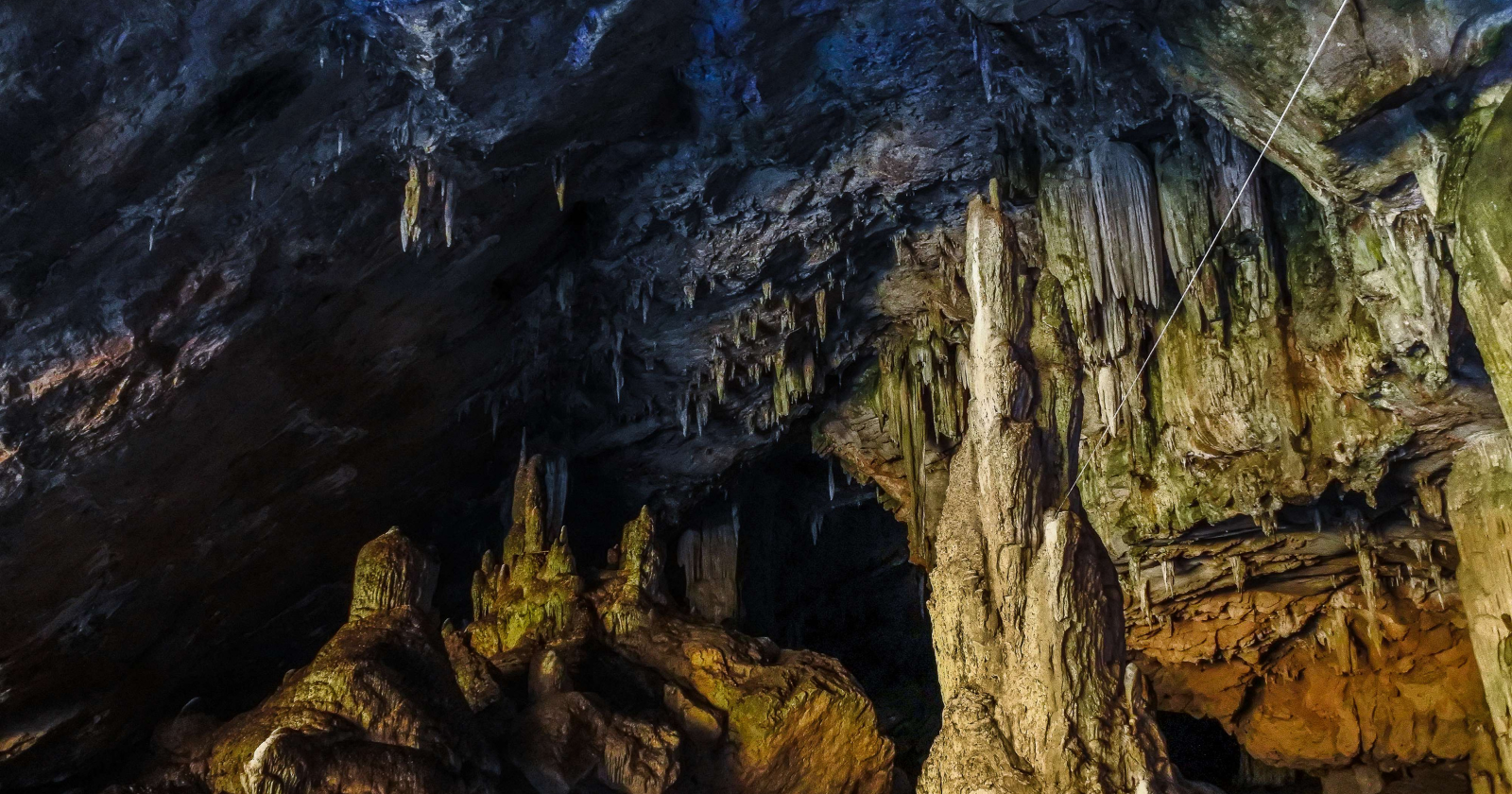
Two and a bit tonnes of snapped rock, stacked into neat circles, in a chamber that has never once seen daylight.
Nobody has worked out why.
Bruniquel Cave sits above the Aveyron gorges in the Tarn-et-Garonne region of southwestern France. Cavers dug through a scree slope in 1990 and opened a passage running deep into the hillside. Three hundred and thirty-six metres in, well past the point where anyone could see a hand in front of their face, the floor stops looking like geology and starts looking like furniture.
What is on the floor
Six structures, all built from the same material: stalagmites snapped into lengths and laid on the cave floor. Two are rings, one measuring 6.7 by 4.5 metres and the other about 2.2 by 2.1 metres. Four smaller heaps sit nearby, two inside the larger ring and two outside it.
The excavation team’s inventory counted roughly 400 pieces, about 112 metres of stalagmite in total, with an estimated combined mass of 2.2 tonnes, per a summary released by the CNRS, France’s national research agency. Pieces were laid in up to four layers. Short lengths were wedged inside the stacks to hold them steady, and others were stood upright against the outer edge like props. Since nothing similar had turned up anywhere else, the researchers had to invent a word for them: speleofacts.
Working out the age
Calcite is patient.
Once the builders walked away, fresh mineral crept over their work and sealed the whole arrangement under a rind of stone. That rind is a clock. Jacques Jaubert of the University of Bordeaux and a large team returned to the site in 2013. They dated three separate things: the tips of the stalagmites used in the rings, the regrowth that had formed over them, and calcite associated with burnt bone. All of it agreed. Writing in Nature in 2016, the team put the construction at 176,500 years ago, give or take 2,100.
That figure is carrying the whole argument. Modern humans were nowhere near Europe at the time, which leaves early Neanderthals as the only candidate. It also shifted the goalposts on cave use. Before Bruniquel, the oldest formally demonstrated occupation of a deep cave was Chauvet, at roughly 38,000 years.
The fires
How do you light a space that far inside a hill? Open flame, carried in and kept going. Traces show up on all six structures, in the form of 57 reddened speleofacts and 66 blackened ones, plus charred animal bone, as reported by Sci-News. Dripping water was ruled out early, since no matching stains appear on the ceiling.
Raman spectrometry, a laser technique that reads the molecular structure of a sample, later confirmed that bone fragments had been heated to temperatures consistent with a controlled burn. Palaeoanthropologist John Hawks makes the point that these were small, localised fires set on the stonework itself, not long-tended domestic hearths, closer in spirit to candles in a church than to a kitchen stove.
How they got in
A modern caver reaches the site through a squeeze nobody would attempt without a helmet, a fixed rope and a mapped route. That passage cannot be how Neanderthals got in, which meant the real entrance had to be somewhere else, and nobody could say when it closed. Work led by Kim Génuite, published in Quaternary Science Reviews this year, went after the mouth of the cave itself. The team combined 3D survey, geomorphological mapping and further uranium dating with electrical resistivity tomography, a technique that maps buried rock by measuring how it conducts electricity.
Their reconstruction puts the ancient opening at under two metres high, with the passage behind it going black almost straight away. Rockfall sealed the system before 142,900 years ago, with a margin of about 1,300 years, independently supporting the age of the rings inside.
Why the purpose is still open
Function is the one part nobody has cracked, and the excavation team said as much when they first published. What makes it hard is the emptiness. No stone tools were found in that chamber. No hominin bones, no living floor, no debris, nothing whatsoever beyond the arrangements themselves and the burn marks on them. Somebody walked in, broke and arranged hundreds of stalagmites, tended small fires, and left without so much as a stone flake behind.
Ideas on offer include shelter during a cold phase, a ritual space, and plain domestic use. All of them are guesses. One site is one site, and this one is unusually isolated even by the standards of Palaeolithic archaeology, with no equivalent found anywhere else in the record. A similar problem hangs over the notched wooden structure from Kalambo Falls in Zambia, reported in Nature by Lawrence Barham and colleagues and dated to at least 476,000 years ago. Clearly built, clearly deliberate, purpose unknown.
What the circles meant, or whether they meant anything, is anyone’s guess. What the floor of that chamber records is a sequence of decisions: somebody picked up a piece of broken stone in total darkness, worked out where it belonged, and set it down. Then did it four hundred more times.