

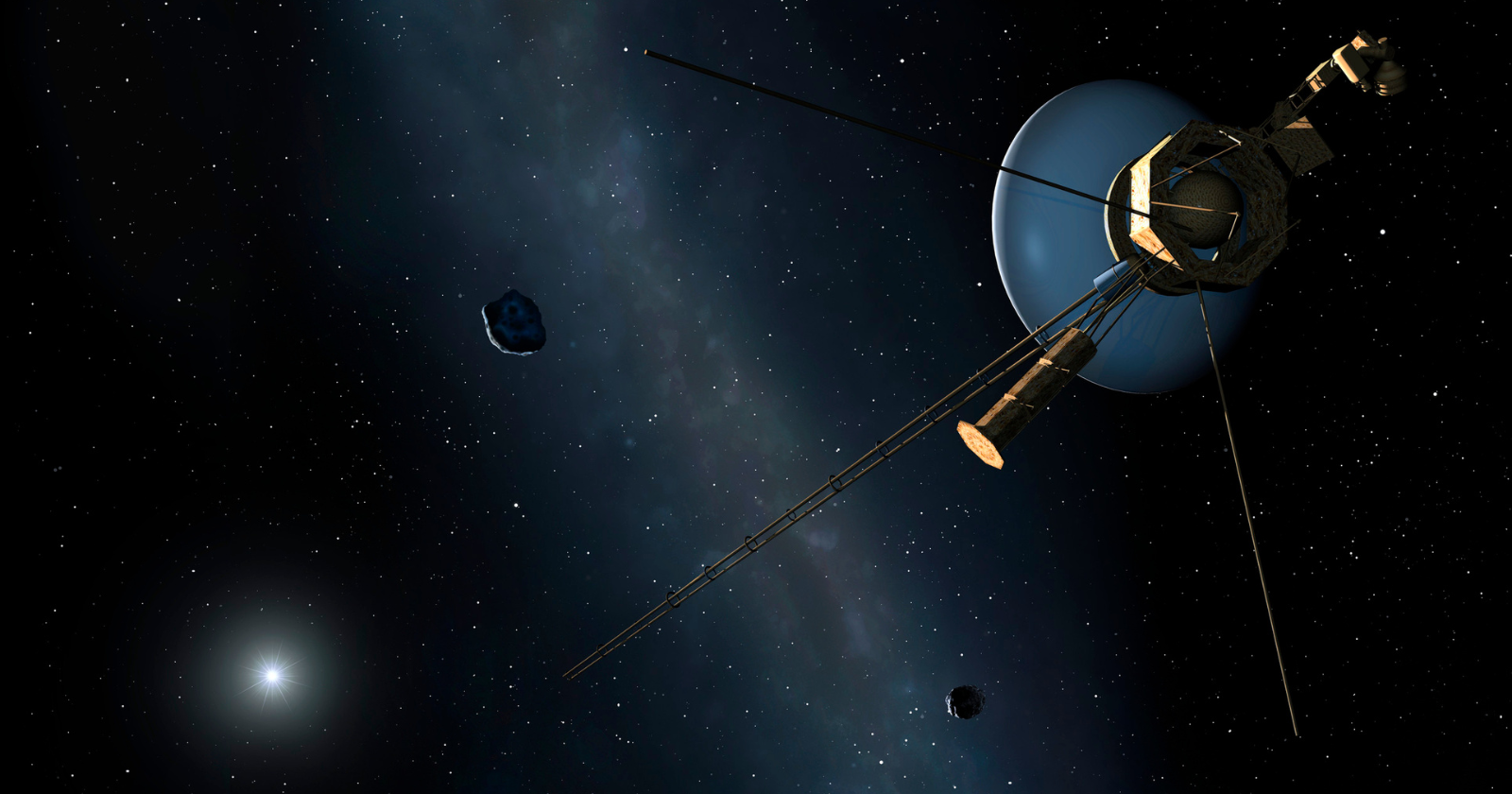
Voyager 1 has been in flight for longer than most of the people on Earth have been alive. The spacecraft was assembled, in essential respects, by a group of engineers and scientists who had grown up in the 1940s and 1950s, were trained in the 1960s, and arrived at the Jet Propulsion Laboratory in Pasadena in the early-to-mid 1970s to work on what was conceived at the time as a four-year mission to study the outer planets. The mission scope was modest: get to Jupiter, get to Saturn, take photographs, take measurements, send back data, finish in approximately 1981. What happened instead was that the spacecraft continued to function after the original mission ended, and then continued to function for the next several decades, and is now operating in the 49th year of what was initially scheduled as a four-year project — sending back occasional whispers of data from a region of space that no human-made object had reached before, while the team that originally built it has slowly aged out of the workforce, retired, and in many cases died, leaving the spacecraft to be operated by a generation of JPL engineers who were children, or not yet born, when it launched.
According to a comprehensive reference summary of Voyager 1’s full mission history and current operational status, the spacecraft itself was assembled with the most advanced computing technology available in the mid-1970s, which is to say: very little, by current standards. The three onboard computers contain approximately 68 kilobytes of memory between them, with CPU clock speeds of 250 kilohertz. A modern smartphone contains approximately 30 million times more memory and operates approximately 16,000 times faster. The data transmission rate from Voyager 1 to Earth is 160 bits per second — approximately half a million times slower than typical domestic broadband. The data is stored, when it cannot be transmitted in real time, on an 8-track tape recorder. The total electrical power available to operate the spacecraft, generated by three radioisotope thermoelectric generators using the radioactive decay of plutonium-238, was approximately 470 watts at launch and is now down to roughly 250 watts — somewhere between an incandescent bulb and a small toaster. The engineers operating Voyager 1 from JPL turn off one instrument approximately every two years to keep the remaining instruments powered. The current operational complement is two: the plasma wave subsystem and the magnetometer.
The September 1977 launch
The cultural context surrounding Voyager 1’s launch is the part of the story that does not, in the standard tellings of the mission, receive much attention. The spacecraft left Earth in a year that was, by any reasonable historical measure, formative for late 20th-century American culture. Star Wars had opened in cinemas in May 1977 and was, by September, the highest-grossing film in history; the Apple II had been released in April 1977; Saturday Night Fever would be released in December; Elvis Presley had died in August. The President of the United States was Jimmy Carter, inaugurated in January. The General Secretary of the Communist Party of the Soviet Union was Leonid Brezhnev. The Berlin Wall divided Germany. The European Union did not exist. The internet did not exist as a public network. The personal computer industry was approximately one year old. Voyager 1 was assembled and launched in a world that has, in essentially every cultural, political, and technological dimension, ceased to exist — while the spacecraft itself has not.
As reported by BBC Sky at Night Magazine’s technical analysis of the spacecraft’s design and current operational state, the durability of the 1977 hardware has surprised essentially everyone who worked on the project. The radio antenna still points at Earth. The radioisotope generators still produce electricity. The two operating instruments still detect plasma waves and magnetic fields in the interstellar medium. The cumulative number of unanticipated problems that the JPL team has encountered over five decades is large — a 2023 corruption in the telemetry stream took five months to diagnose and fix, requiring the team to send a patch that travelled for 22 hours each way, with two days between sending and confirmation — but the overall pattern has been that the spacecraft works, that the team finds workarounds when it does not, and that the operational lifespan of the hardware has now substantially exceeded the operational lifespan of most of the people who designed it.
The generational turnover at JPL
The single individual most closely associated with the Voyager mission across its entire duration was Edward Stone, who served as Voyager Project Scientist continuously from 1972 to 2022 — a 50-year tenure that is the longest of any scientist on any NASA mission in the agency’s history. Stone was born in 1936, joined the Voyager project as project scientist before the spacecraft had been built, oversaw the launches in 1977, oversaw the planetary encounters of the 1980s, oversaw the post-Saturn extension into the outer solar system, oversaw the heliopause crossing in 2012, and finally retired in 2022 at the age of 86. He died on 9 June 2024, at 88. Stone was, by every account, the institutional memory of the mission — the only person who had been continuously involved from before the spacecraft was assembled to the present-day operational phase. His death, two years after his retirement, marked the end of a continuous personal connection between the spacecraft and any single human being.
Carl Sagan, who led the team that designed the Golden Record bolted to the side of each Voyager spacecraft, died in 1996 at the age of 62. Frank Drake, who co-designed the Golden Record with Sagan, died in 2022 at 92. John Casani, the Voyager Project Manager at the time of launch, died on 19 June 2025. Bruce Murray, who was Director of JPL when the Voyagers launched, died in 2013. The engineers who designed the radioisotope thermoelectric generators, the high-gain antenna, the tape recorder, the computers, and the propulsion system have, in the great majority, either retired, died, or both. The current Voyager Project Manager at JPL, Suzy Dodd, took the role in 2010. The team operating the spacecraft today consists almost entirely of people who joined NASA after the spacecraft had been in flight for at least a decade.
What is still in flight
Per NASA’s official tracker for the current positions of the Voyager spacecraft, Voyager 1 is currently approximately 166 astronomical units from the Sun — roughly 25 billion kilometres, or 15.4 billion miles. It crossed the heliopause and entered interstellar space in August 2012, becoming the first human-made object to leave the heliosphere — the region of space dominated by the Sun’s magnetic field and solar wind. Its current speed of approximately 17 kilometres per second has already carried it more than four times beyond the orbit of Pluto. It will continue moving outward at approximately that speed for an effectively unbounded duration, with the radioisotope generators projected to drop below the minimum operational threshold sometime in the early 2030s.
The spacecraft itself, as detailed in IFLScience’s analysis of the spacecraft’s long-term trajectory and the timeline of its eventual stellar encounters, will not stop existing when its power supply finally drops below the threshold for transmission. It will continue moving through interstellar space, silently, for billions of years. In approximately 40,000 years, it will pass within 1.6 light-years of a red dwarf called Gliese 445 in the constellation Camelopardalis. In approximately 303,000 years, it will pass within about a light-year of another star called TYC 3135-52-1. The Golden Record bolted to its side — containing greetings in 55 languages, music from across human cultures, scientific diagrams, and a star map showing Earth’s location relative to nearby pulsars — has been engineered to remain readable for approximately a billion years, which is several times the expected remaining lifespan of human civilisation by most reasonable estimates, and approximately equal to the time remaining before Earth itself becomes uninhabitable due to the gradual brightening of the Sun. Voyager 1 will outlast the people who built it, the institution that operates it, the country that paid for it, and probably the species that designed it. The Wednesday-morning reply to a Monday-morning command sent in 2026 is one of the smaller milestones in a journey that will, on every available projection, continue for billions of years after every Earth-based party to it has gone silent.