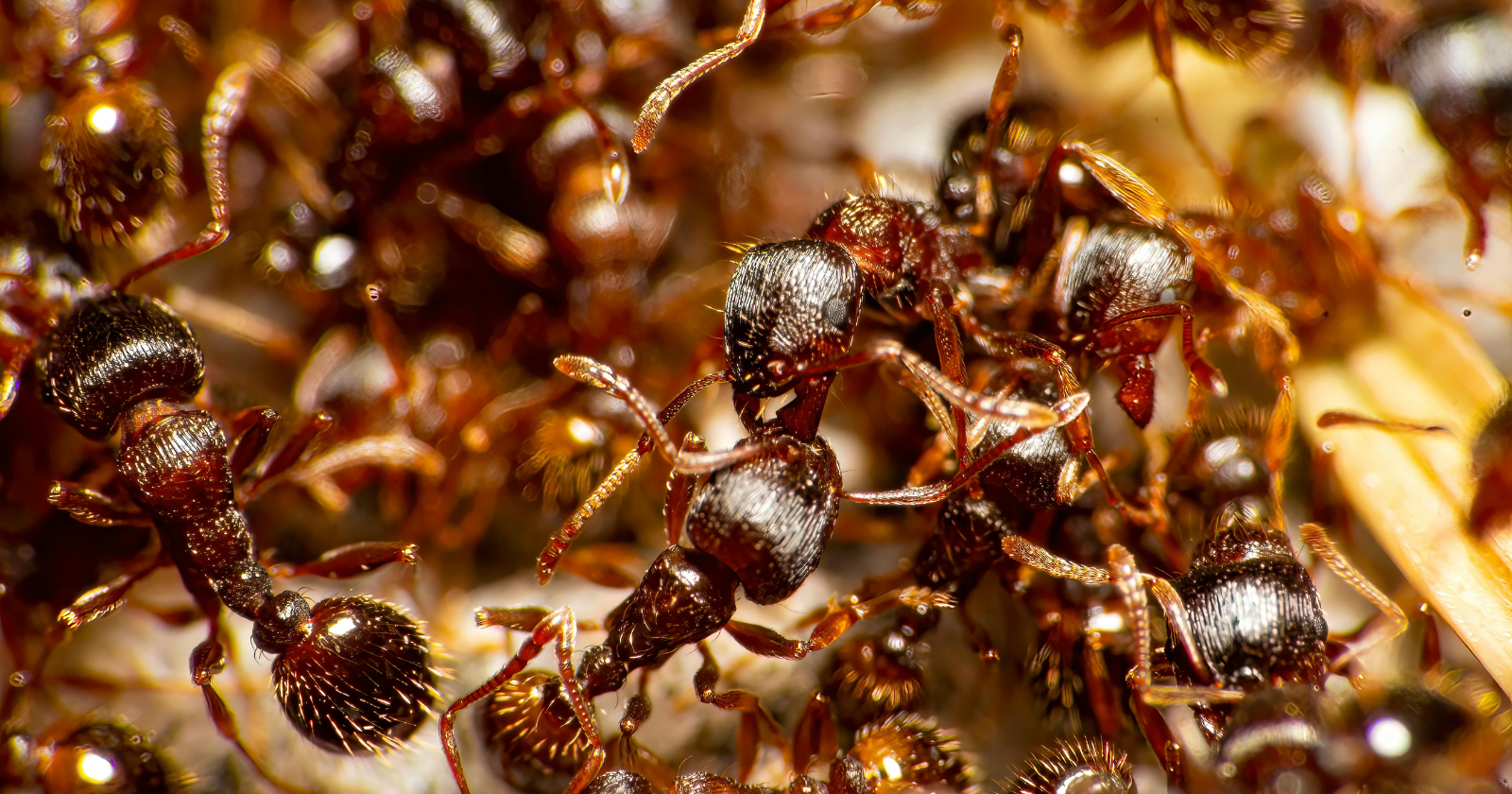
Stand beside an army ant raid in a Central American forest and the first thing that registers is the sound. Scott Powell, a biologist who has spent years crouched over these columns, told Science News that the pitter-patter of the foragers “sounds a lot like rain”. Hundreds of thousands of insects, each weighing almost nothing, adding up to weather.
Eciton burchellii colonies can run to 700,000 workers. At dawn as many as 200,000 of them pour out and fan into a swarm front that takes spiders, crickets, other ants and anything too slow to leave.
Nobody is directing any of it.
The queen is not in charge
Her title invites the wrong picture. She lays eggs in enormous numbers and gets carried along when the colony shifts camp, and that is close to the whole job. She gives no orders, has no mechanism for giving them, and holds no picture of the raid she would base them on.
Neither does any worker. Foragers of this species are effectively blind, navigating by pheromone and touch, so the largest thing a single ant can perceive is a few centimetres of trail and whoever happens to be standing on it. Everything the colony builds has to come out of that.
Three lanes and no road rules
How do two lanes of blind insects share one narrow trail without jamming it solid? A raiding column carries ants heading out and ants coming back, at speed, along a path only centimetres wide, and a jam costs the colony food.
Colonies of this species move more than 3,000 prey items an hour along columns running past 100 metres, and the traffic sorts itself into three lanes without anyone directing it: loaded ants down the middle, empty ants along both margins. Iain Couzin and Nigel Franks traced that order to a single, almost embarrassingly small asymmetry when they modelled the columns for Proceedings of the Royal Society B. Ants hauling prey are reluctant to swerve when they get bumped, ants carrying nothing swerve readily, and that difference alone is enough to sort the column. Their model put the real animals squarely in the range where lanes form and flow peaks.
Workers who become the road
A single plugging ant registers as nothing more than a brief give underfoot to every sister who runs over her, for as long as the raid keeps moving.
Scott Powell and Nigel Franks, working at the University of Bristol, documented something strange on the home trail. Certain workers wedge themselves into holes and dips in the forest floor and stay there, letting the traffic run across their backs. In experiments described by the university, planks drilled with holes of various sizes were laid in the ants’ path, and the ants size-matched themselves to the gaps with real precision. Larger holes got plugged cooperatively. Once the traffic thinned, the pluggers climbed out and rejoined the column.
A prey-laden forager runs at roughly 8 centimetres per second on a smooth surface and drops to about 6 on a rough one, which sounds like nothing until it is multiplied across a day’s haul. Their calculations indicated the pluggers, who carry no food at all while they are being walked on, more than pay for themselves in what arrives home.
Bridges that walk
The showpiece is the bridge. When a gap opens in the trail, ants link legs and bodies across it, and the resulting structure refuses to sit still. It lengthens, widens and slides sideways over time, drifting away from where it started to cut the corner off a bend, a pattern Chris Reid, Matthew Lutz and colleagues measured directly in a PNAS field study.
Where they stop is the interesting part. A bridge halts well short of the crossing that would save the most walking, because every ant locked into it is an ant not carrying food, and lengthening the shortcut means spending more of them. The structure settles where those two pressures cancel. No ant in it has any concept of a foraging rate.
The colony corrects its own errors
What keeps a structure like that from falling apart the moment conditions shift? Scaffolds, the structures that appear on steep surfaces where ants keep losing their footing, emerge from individual ants correcting their own slips rather than from any reading of the slope, according to a 2021 study in PNAS. Bridges show the same self-correction on a different axis: they sit larger after a gap widens than after it narrows, per a Nature Communications study by Helen McCreery and Radhika Nagpal, with collaborator Simon Garnier. That lag lets the structure shrug off brief wobbles while tracking changes that last. Ants build on leaves. Leaves move.
When the trade-off turns bad
The cost-benefit sums behind all of this only work if they land in the ants’ favour, and Powell and Franks tested what happens when they don’t. Their own worst-case scenario, folded into the later PNAS bridge analysis, assumed a fifth of a colony’s foragers get tied up as pothole plugs and each one costs a lost prey item. Run those numbers and a day’s food intake can drop by as much as 79 percent.
Nothing in the system is watching for that slide. The daily total exists nowhere except in what actually comes home, no ledger, no running tally, only the gap between food going out on the trail and food coming home, widening or narrowing on its own.
That is the trade a colony makes for having no manager at all. The same local rules that sort three lanes of traffic, patch potholes and walk a bridge sideways towards a shortcut are the only rules on offer when conditions turn hostile. Roboticists studying these ants aren’t chasing a system that never fails. They’re chasing one that gets this much built, this reliably, with nobody ever holding the full picture.