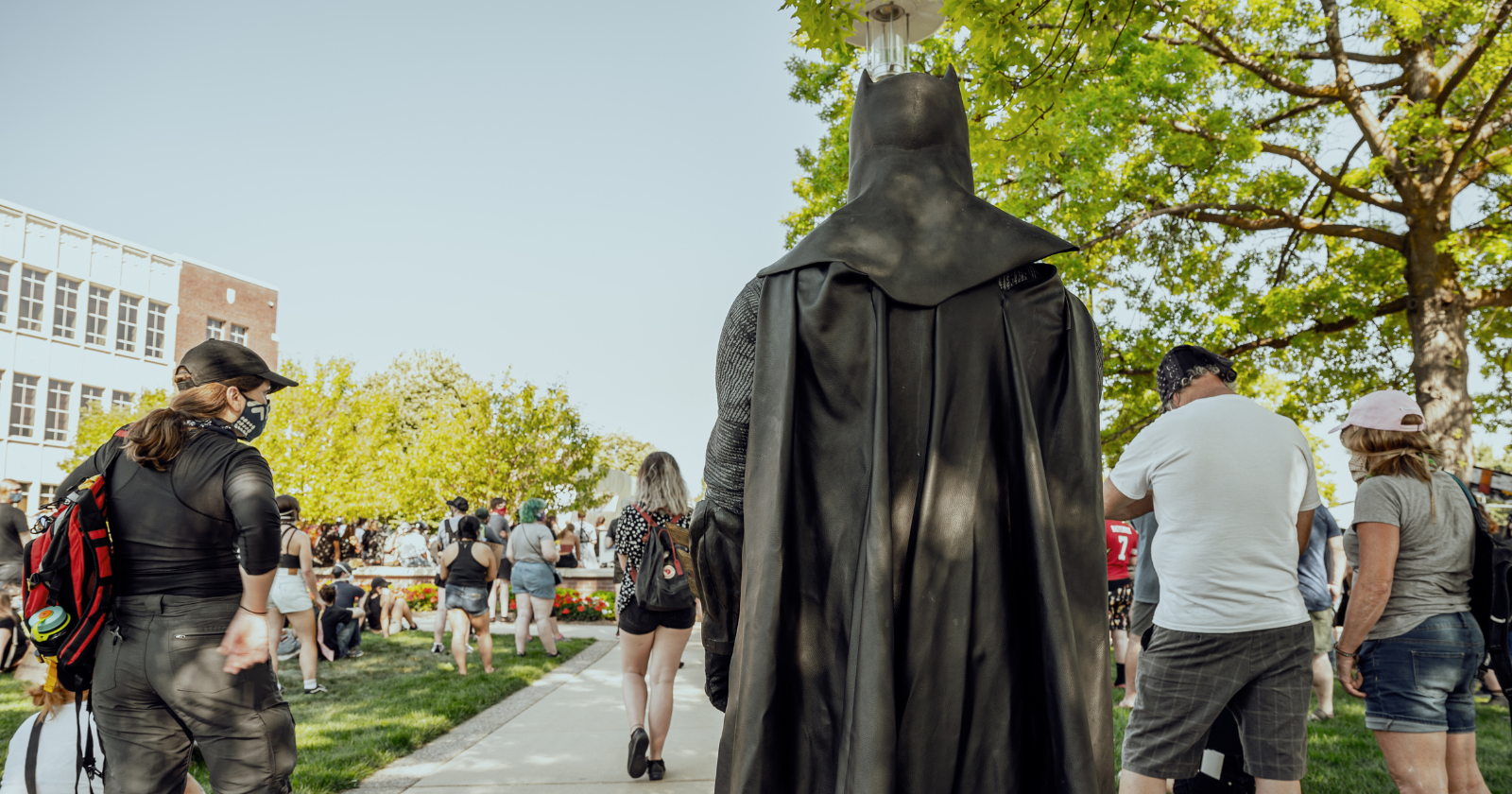
Nobody on the Milan metro asked why Batman was catching the train.
He had the cape, the chest logo and the pointed cowl, though not the full mask, which the researchers left off so he would not frighten anyone. He boarded through one door, stood roughly three metres away, spoke to nobody and touched nobody. A woman with a prosthetic belly stood in the carriage, every seat around her taken. Nearby, an observer with a phone was quietly keeping score. All of this played out sometime between June and October of 2024, the estimated window on the trial’s registration record, months before anyone outside the research team saw a number.
What the counting turned up
Across 138 rides, a team led by clinical psychologist Francesco Pagnini at Università Cattolica del Sacro Cuore recorded whether any seated passenger got up for her. Their field study in npj Mental Health Research found that on plain rides, someone offered a seat 37.66 per cent of the time. On rides with Batman aboard, that figure climbed to 67.21 per cent, an odds ratio of roughly 3.4.
None of this was decided after the fact. The design was lodged on ClinicalTrials.gov in July 2024, before anyone put on the suit, which is more discipline than a lot of eye-catching psychology bothers with.
Rides only counted if the carriage had no spare seats and no more than five people stood in the aisle, so both the woman and the man in the cape were plausibly in view. Each observation ran a single stop, two to four minutes, after which the team got off and waited for the next train.
One detail keeps the result from being tidy. Among the passengers who gave up a seat while Batman was in the carriage, not one connected the gesture to him, and 14 of them, close to 44 per cent, said they had never seen him at all.
One possibility, offered in the paper as speculation rather than fact, is that attention is socially catching. One person’s head turn pulls a few more heads around, and the alertness spreads through the carriage past anyone who registered the original cause.
Mindfulness, or plain old priming
Pagnini’s group favours a disruption story. An oddity in the carriage jolts people out of autopilot and into the present moment, and a person actually paying attention notices the woman on her feet. Call it involuntary mindfulness.
They also concede a simpler reading, and describe it as the more parsimonious one. Batman is a hero, and heroes prompt good behaviour. Daryl Van Tongeren and colleagues reported in Frontiers in Psychology in 2018 that people who had sat near a Superman poster were more willing to help a researcher with a tedious task than those who had passed a picture of a bicycle.
Which sounds neat until you look at what happened to that literature. Erik Mac Giolla and colleagues, writing in Meta-Psychology, gathered 70 close replication attempts of social priming findings. Of the 52 run by teams containing no author from the original paper, not a single one produced a significant effect in the expected direction, and the average effect sat at essentially zero.
Pagnini’s paper cites that record itself, which is the right instinct.
The figures were revised once
In June 2026 the journal published an author correction. Percentages in the original text disagreed with those in the table, because the number of valid observations in each condition had been misreported: 61 rides in the Batman condition and 77 in the control, rather than 68 and 70. Corrected figures are the ones quoted above. Conclusions held, and the authors put their hands up.
What it would take to believe it
Pagnini has said in coverage by PsyPost that the pattern resembles earlier work linking present-moment awareness to kindness, and he framed that as a family resemblance rather than a verdict.
His team’s list of caveats is long and unusually frank. One metro system, one city, one costume, one narrow flavour of helping. Nobody has tested whether the effect belongs to Batman specifically or to any sufficiently strange thing standing in a train carriage, and the statistical model accounted for only about 11 per cent of the variation in who rose.
So the honest version is smaller than the headline and considerably more interesting than nothing. On 138 crowded rides in one Italian city, a silent man in fancy dress shifted the odds. Whether he caused that, or simply happened to be standing near people already halfway out of their seats, belongs to the next experiment.
Somebody is going to have to buy another costume.