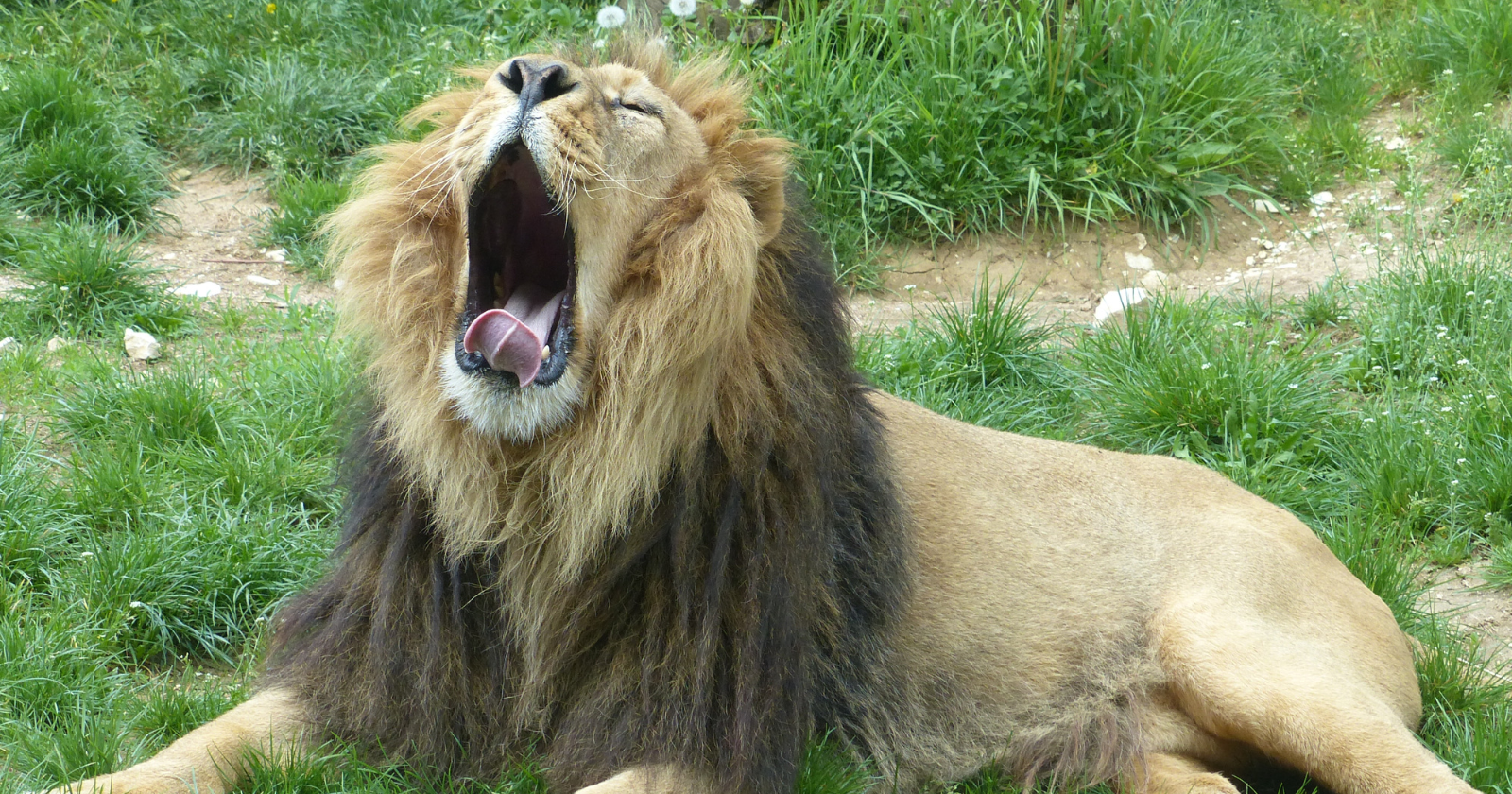
The spines on a lion’s tongue are made of keratin, the same material as its claws, and they point backwards towards the throat. They are routinely credited with scraping meat off bone, and sometimes with separating hair from flesh. They are also why a lick from a house cat feels like sandpaper, since the structure is the same one, scaled up until it behaves more like a wood rasp.
Anatomists have described these spines, called filiform papillae, for well over a century. What they got wrong was the shape. A 1982 paper in Acta Anatomica, the journal now published as Cells Tissues Organs, by Boshel, Wilborn and Singh characterised the cat papilla as a solid cone, and that account stood largely unchallenged for decades. In 2018 Alexis Noel and David Hu at Georgia Tech ran papillae from six cat species through a micro-CT scanner and found the cone was hollow.
Their paper, Cats use hollow papillae to wick saliva into fur, appeared in PNAS in November 2018. Almost everything precise that can be said about the mechanics of a lion’s tongue traces back to it. This is one study, not settled consensus.
What the scans actually showed
Each papilla holds two cavities: one at the base, where it anchors into the soft tissue of the tongue, and a U-shaped scoop at the tip. Noel and Hu touched the tips with drops of food dye and the fluid climbed into the scoop in under a tenth of a second, at a rate consistent with Washburn’s law for wicking into a half-pipe. Once inside, it stayed put. Inverting the papilla did not empty it.
The volumes are tiny. A domestic cat carries roughly 290 of the large papillae in the region of the tongue that actually contacts fur, each holding around 0.014 microlitres, for a total near 4 microlitres, or a tenth of an eyedropper drop. That accounts for about five per cent of the fluid sitting on the tongue at any moment.
Reach matters more than volume here. By the authors’ calculation, saliva from the flat surface of the tongue soaks fur to a depth of only 0.54 millimetres, wetting the topcoat and leaving the undercoat dry. Papillae are long enough to push through and deliver saliva at the roots of the hairs.
Papillae length barely changes with body size
Across six species spanning a thirty-fold range in body weight, from domestic cat through bobcat, cougar, snow leopard and tiger to lion, the fitted relationship between papilla height and body mass is effectively flat, with a mean of 2.3 millimetres, give or take 0.2. Lion papillae were the longest measured in the set at 2.7 millimetres, roughly a third more than the domestic cat’s. Scaled geometrically, that mass range would predict spines three times longer. A lion’s tongue is vastly bigger than a tabby’s; its individual hooks are close to the same size, spread across a much larger surface.
One tongue per species was examined, all donated post mortem, and a single largest papilla from each was scanned, giving six height measurements in total. The stiffness figure often quoted from this work, a Young’s modulus of 1.66 to 1.94 gigapascals, similar to human fingernail and five orders of magnitude stiffer than the surrounding tongue tissue, comes from three indentation tests on one domestic cat papilla. No lion papilla was tested for stiffness at all, so the rasp comparison rests on a house cat measurement.
The lion in the sample was female. Noel and Hu raise the possibility that males have longer papillae for grooming and wetting a mane, and label it as conjecture. Nothing in the paper tests it.
The meat-stripping function is asserted more often than it is measured
Zoo Atlanta’s carnivore team describes the papillae as helping to remove hair from flesh and flesh from bone. Denver Zoo’s African lion fact sheet is narrower, listing the backward-curving spines as tools for scraping meat from bone and for grooming, with no claim about hide. Neither description is controversial, and both fit the shape of the structure. The 2018 PNAS work, though, measured grooming rather than feeding. In its discussion the authors go only as far as noting that earlier studies suggest papillae shape may assist in gripping food, and that the sharp tip may help deform and penetrate meat.
Their review in the Journal of Experimental Biology, The tongue as a gripper, is more direct about the gap. Rigid papillae above about a millimetre serve grip and tissue penetration, and cat tongues hook into raw meat to hold it, but how those hooks tear flesh without being torn out of the tongue themselves has not, the authors write, been studied in detail.
Whatever the tongue contributes, lions cut with their carnassial teeth: a rasp working behind a set of blades, not instead of them.
Cooling, and the hairbrush
Cats have sweat glands only on their paws, so grooming has long been suspected of doing thermal work. Thermal imaging in the PNAS study recorded temperature differences of up to 17 degrees Celsius between wetted skin and topcoat after a lick. From there the authors modelled how much cooling papillae-delivered saliva could supply: about 1.3 watts against the roughly 5.7 watts a 2.2 kilogram cat must shed, or something under a quarter of the total, with conduction, convection and radiation doing the rest.
That figure assumes every papilla refills completely in the mouth after every lick, which makes it an upper bound from a model rather than a measurement of an animal in the heat.
The study ends in an engineering application: a silicone brush at four times scale, built around 3D-printed papillae, which settled to about half the steady-state grooming force of a conventional hairbrush and shed trapped hair in a single swipe. The paper discloses that both authors filed a provisional patent on the design. Readers can weigh that as they like, but it belongs alongside the result.
What is still unmeasured
Comparative descriptive work has continued, species by species. Sadeghinezhad and colleagues published a morphological study of the Persian leopard tongue in Anatomia, Histologia, Embryologia in 2017; Freire and colleagues described the papillary architecture of the ocelot tongue in the same journal in 2019. These papers map form in detail across the cat family. Very few of them measure force.
Which leaves the popular version of this fact resting on anatomy, on captive-animal observation, and on inference from shape. Nobody has instrumented a lion’s tongue while it worked a carcass. Whether papillae shape tracks diet across felids in any way that can be quantified is the question the descriptive literature keeps approaching and not yet answering.