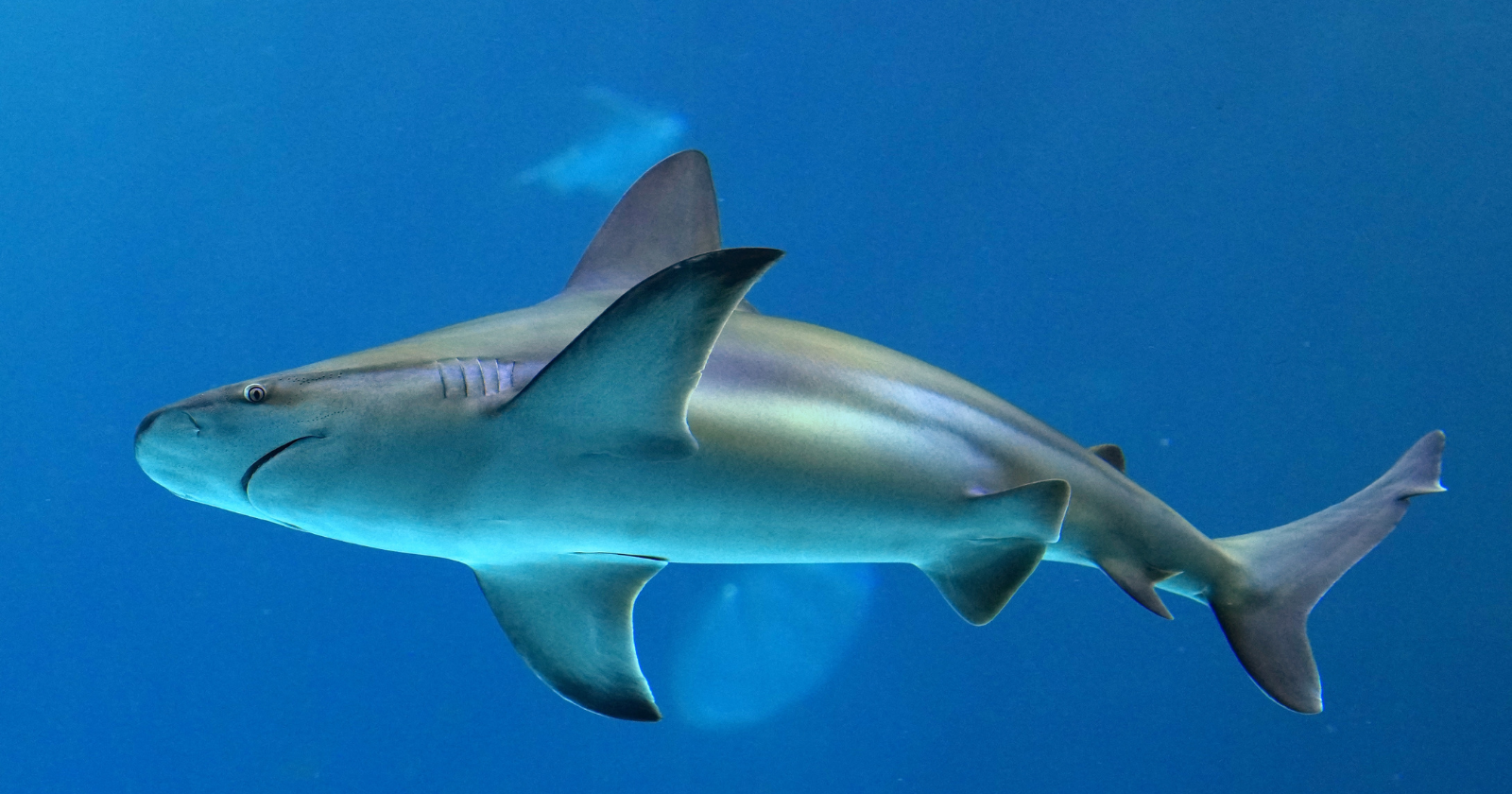
Three female bonnethead sharks shared a tank at the Henry Doorly Zoo in Omaha, Nebraska, with no male of their species on site for around three years. Then one of them gave birth.
Genetic testing of that pup, reported by Demian Chapman and five co-authors in the Royal Society journal Biology Letters in August 2007, found it homozygous at every microsatellite locus examined, carrying no allele that could have come from anywhere but its mother. The paper, Virgin birth in a hammerhead shark, was the first genetic confirmation of parthenogenesis in any cartilaginous fish. Another confirmed case followed in 2008, in a blacktip shark, published by Chapman, Beth Firchau and Mahmood Shivji in the Journal of Fish Biology.
Before that, births of this kind had a standard explanation, and a defensible one.
What the genetics ruled out
Female sharks store sperm. They store it well, and for a long time. In whitespotted bamboo shark work published by Jennifer Wyffels and colleagues in Scientific Reports on 13 May 2021, a single artificial insemination produced fertile eggs for up to 121 days afterwards, close to four months of viable storage inside the female reproductive tract. Longer durations have been recorded elsewhere, including 45 months in the related brownbanded bamboo shark. Keepers who saw a lone female give birth had reasonable grounds to look back to a previous season.
Homozygosity is what separates the two accounts. A pup conceived from stored sperm inherits alleles from a father, and those show up as differences between its two copies of each gene. A pup that develops without fertilisation has nowhere else to draw from. When every marker tested returns two identical copies, the stored-sperm hypothesis fails.
Why the pups are not copies of their mothers
The mechanism generally proposed for sharks is automixis, most often terminal fusion, in which an unfertilised egg is joined by a genetically related cell formed during the same division. Every gene in the resulting animal traces back to the mother. She is not, however, duplicated in it. Her own heterozygosity largely collapses in one step, and the offspring ends up carrying identical copies at loci where she held two different versions.
Doubling up that way is the leading explanation for the poor survival recorded in these births, since recessive variants that a two-parent inheritance would mask are left exposed. It remains an inference rather than a demonstrated cause. What the records do show plainly is the attrition. In the zebra shark case described below, the 2014 to 2015 season yielded live embryos in six of 47 eggs, and all six died between 35 and 94 days of incubation.
The shark that switched
Christine Dudgeon’s team at the University of Queensland and Reef HQ Aquarium, writing in Scientific Reports in January 2017, documented the clearest instance of an individual changing strategy. A female zebra shark taken from the wild in 1999 mated successfully with a male at Reef HQ Aquarium in Townsville from 2006 and laid viable eggs every year from 2008. He was removed permanently after mating in 2012. Offspring from that final encounter followed, she skipped the next season entirely, resumed laying in 2014, and hatched three juveniles between February and April 2016. Genotyping across nine informative microsatellite loci placed those hatchlings as parthenogenetic, which puts the whole switch inside a two-year window.
Her daughter, hatched in 2009 and moved into the same tank, began reproducing asexually in her second year of maturity, having never been housed with a mature male.
Dudgeon’s team read the removal of the mate as the likeliest trigger, while noting they cannot rule out cues passing between mother and daughter. They are also explicit about the limits of the genetic evidence: elevated homozygosity fits terminal fusion, but gametic duplication and the development of an unfertilised haploid egg produce a similar signature and cannot be excluded from microsatellite data.
One set of cases from the wild
Everything above happened under managed care, which is where the phenomenon is easiest to observe and hardest to generalise from. In June 2015, Andrew Fields, Kevin Feldheim, Gregg Poulakis and Demian Chapman reported in Current Biology that routine DNA fingerprinting of critically endangered smalltooth sawfish in Florida estuaries had turned up seven immature individuals whose genotypes fitted parthenogenesis, roughly three per cent of the fish sampled. They were living alongside sexually produced sawfish and were tagged and released.
A badly depleted population, on the team’s proposed reading, makes finding a mate unreliable. That fits the data without being established by it.
What the bamboo shark counts complicate
The same bamboo shark paper that measured sperm storage also did the counting work nobody else had. Over 105 consecutive days, all 1,053 eggs laid in a habitat holding 48 females and no males were incubated and monitored. Five of the 28 fertile eggs hatched. Confirmed parthenotes accounted for 1.1 per cent of eggs laid, rising to a maximum of 2.5 per cent if every embryo that could not be genotyped is assumed to be one, and at least four of the 48 females were involved.
Two of twenty artificially inseminated females then laid clutches containing both asexual and sexually fertilised hatchlings, 10, 80 and 83 days apart. The authors record this as the first instance of both modes inside a single reproductive cycle in any fish.
A background rate of one to two per cent, in animals that also breed normally, sits awkwardly with the description of parthenogenesis as an emergency measure. Giuseppe Esposito and colleagues, whose July 2024 paper in Scientific Reports reported the first case in the endangered common smooth-hound shark, note that the phenomenon in elasmobranchs has mainly been documented in captivity. Whether isolation causes these births or merely makes them visible is unresolved. The bamboo shark females were housed without males throughout, so that study cannot separate a baseline rate from an isolation effect, and its authors say as much.
For anyone running a breeding programme the consequence is concrete. Asexually produced offspring add no new genetic material, so a studbook that assumes two parents behind every hatchling will record more diversity than the tanks actually hold.
What remains unknown is whether these animals reproduce. Parthenogenetic whitespotted bamboo sharks have survived for years, and a second generation was documented by Nicolas Straube’s group in 2016, but no wild parthenote has been followed through to breeding adulthood. The sawfish released in Florida are the obvious test, and the screening method that team published for microsatellite databases remains the cheapest way to find out how common any of this is.