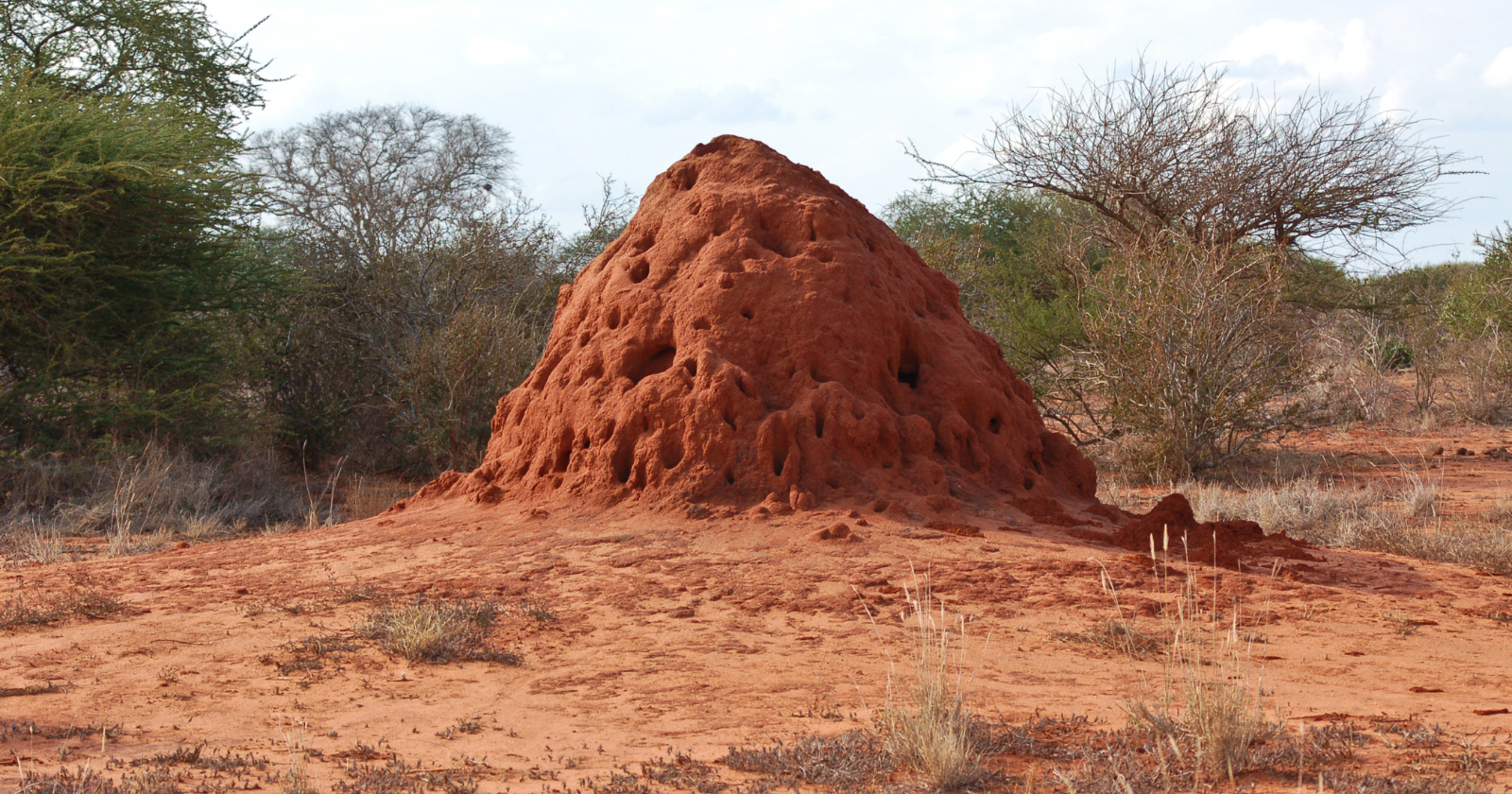
Two hundred million cones of red dirt, spaced out like a car park grid, and for four thousand years almost nobody bothered asking what they were for.
They sit in the caatinga, a dry thorn-scrub forest across much of northeastern Brazil that drops its leaves for most of the year. Locals call the cones murundus and have farmed around them for generations. Each stands about 2.5 metres high and nine metres across, spaced roughly 20 metres from its neighbours, repeating in every direction over an area of some 230,000 square kilometres. That is a patch of Brazil the size of Great Britain, evenly tiled with piles of soil.
Counting them took satellite imagery, a habitat model and thousands of kilometres of driving. Entomologist Stephen Martin of the University of Salford and botanist Roy Funch of the Universidade Estadual de Feira de Santana put the total at roughly 200 million, in a 2018 paper in Current Biology.
What is inside the mounds
Not much.
Cut one open and you get an amorphous lump of soil with a single narrow shaft up the middle, sealed at the top, no ventilation, no chambers, no residents. Funch and Martin concluded the cones are spoil: earth hauled up and dumped by a single leaf-eating termite species, Syntermes dirus, while it dug a colossal network of feeding tunnels below. Martin’s verdict, as reported by Phys.org, was blunt: “These are just waste heaps.” The tunnels are the structure. The cones are the tailings.
Scale is what makes it strange. Around 10 cubic kilometres of soil has been shifted, an amount the team likened to 4,000 Great Pyramids of Giza. In a Cell Press statement, Martin called it the most extensive bioengineering effort ever undertaken by a single insect species.
Why the piles are still standing
Why has none of it washed away? Rain, or rather a shortage of it.
Syntermes dirus lives in wetter parts of Brazil as well, including the Amazon, where identical spoil gets flattened by wind and rain within a few years. Caatinga rainfall arrives in a handful of concentrated weeks and then the place bakes, so the cones just sit there. Soil samples from the centres of 11 mounds returned dates between 690 and 3,820 years, as documented by Revista Pesquisa FAPESP. Some of that dirt was dumped while Egypt was still putting up pyramids.
Pasture is how anyone noticed
Landowners clearing brush for cattle kept running into the things, which is how outsiders started noticing them. A decade of improving Google Earth imagery then let researchers map how far the pattern actually spread. To a farmer, it is just a stubborn lump of dirt in the middle of a future paddock, a nuisance and nothing more.
Clearing is also the risk. Caatinga has been shedding native vegetation since the 1980s. MapBiomas estimates that between 18 and 54 per cent of what survives may already be degraded, and its Caatinga team warns the trend can widen the zones exposed to desertification. Four millennia of murundus made it through because the soil there is too acidic and nutrient-poor to farm profitably. Bad dirt is a thin sort of protection.
Then South Africa turned up something older
“We knew they were old, but not that old,” said soil scientist Michele Francis of the mounds her team had just dated. Her Stellenbosch University group radiocarbon-dated termite mounds along the Buffels River in Namaqualand, built by a different species and still occupied today. As the university announced in 2024, the carbonate inside dated back as far as 34,000 years. Brazil lost the age record in one round of lab results.
Different animal, different job. Namaqualand’s heuweltjies are nests, actual homes with termites living inside, the kind of thing most people picture when they hear the word mound. The murundus are the opposite kind of artefact, a landscape-sized by-product of digging for lunch.
Nobody has found the queen
Martin and Funch fed fibre-optic cameras down the shafts as far as the cable would reach. The tunnels kept bending out of sight before giving up a royal chamber, a queen, or anything resembling a map. Funch told Popular Science the plan was to “back-hoe a few mounds into oblivion” and run a proper expedition, since the architecture and geography of the network remain a blank.
Even the spacing is guesswork. Funch’s first instinct was that each cone marked a colony defending its turf, but neighbouring soldiers placed together mostly refused to fight, which points to local clusters being related rather than rival. The paper’s suggestion is self-organisation, with termites chasing episodic leaf-fall through a well-connected tunnel system and dumping soil at regular intervals without anything like a plan. That is one proposal in one paper, untested by anyone digging out a network end to end.
Which leaves an unseen queen somewhere under all that dirt, in a network four thousand years in the making that nobody has ever actually mapped.