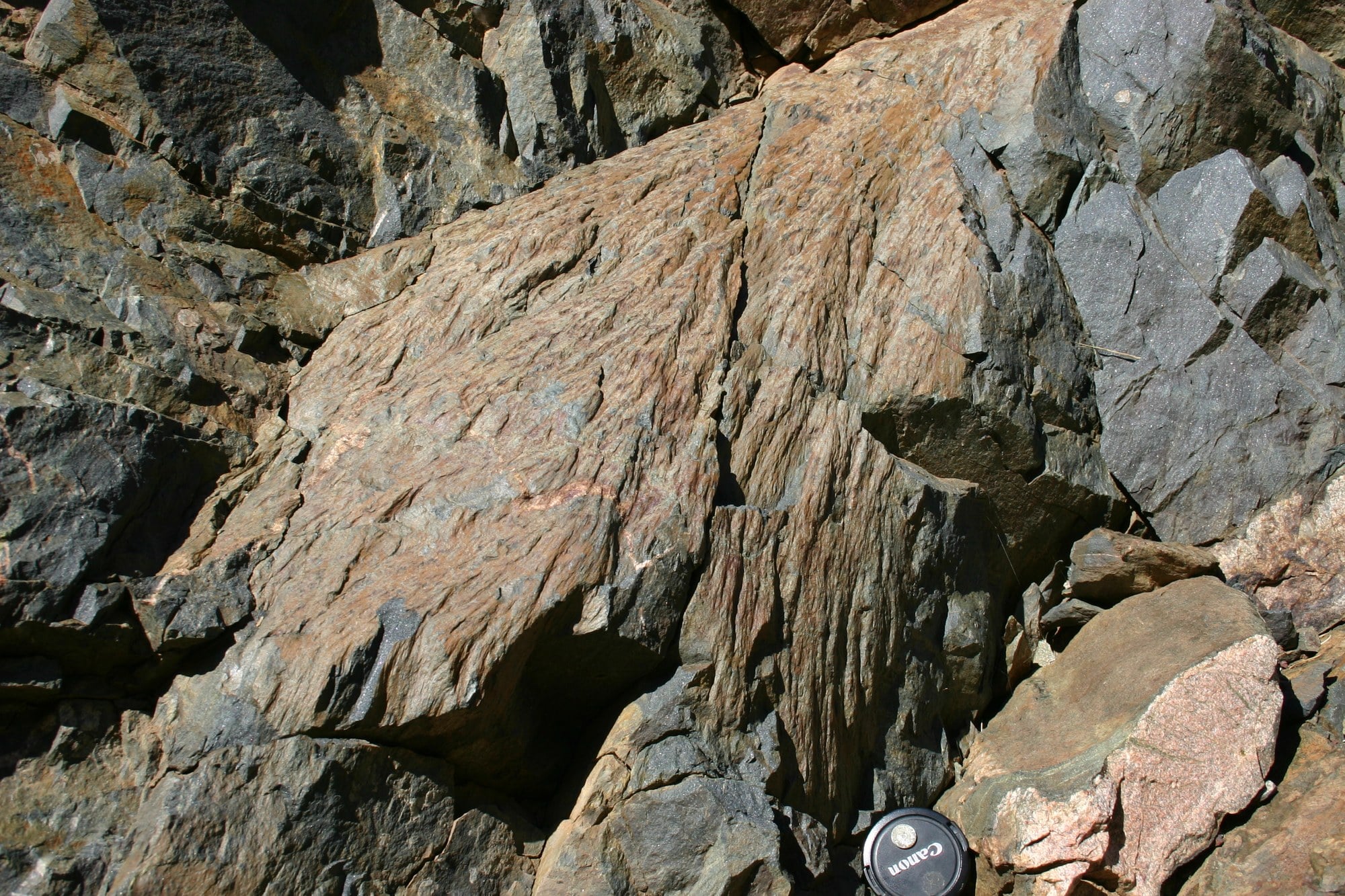
Austin, Texas: A meteorite impact buried under the town of Ames, Oklahoma, struck about 370 million years ago, nearly 100 million years later than previously believed, University of Texas at Austin researchers have found.
The study, published in July 2026 in Meteoritics & Planetary Science as an open access paper, dated zircon crystals from granite struck by the impact. Zircon is a mineral that forms small crystals and is used in uranium-lead dating.
The earlier age of 467 million years placed the impact in the Ordovician period. It was grouped with a series of North American impacts centred around 467.5 million years ago, called the Ordovician Meteor Event, according to a University of Texas press release.
The new date puts Ames in the Late Devonian, close to the Frasnian-Famennian mass extinction about 372 million years ago. The release says that event led to the extinction of a huge percentage of marine life on Earth.
Whether the impact and the extinction are connected remains an open question.
“Our results establish a new hypothesis that the Ames impact is linked to the Late Devonian mass extinction, but they do not demonstrate the causal relationship,” Elizabeth Catlos, lead author and associate professor in the Department of Earth and Planetary Sciences at UT’s Jackson School of Geosciences, said in an email.
“Establishing this connection requires additional evidence, such as finding impact-related material in Late Devonian sedimentary rocks, identifying other impact structures of this age and understanding their environmental consequences,” she said.
Catlos said she had “a high degree of confidence in the age”. It came from two independent radiometric dating approaches, laser ablation and ion-beam methods, applied to zircon grains taken directly from the impacted granite, she said.
For an impact structure, the strongest age constraint comes from dating minerals in the impacted material directly and showing that they record the impact, she said. That is what the team did.
“No matter what technique we used, it was coming back to this younger signal,” Catlos said in the university’s press release. The release says the result means Ames could not have been part of the Ordovician Meteor Event.
Doubts over the fossil date
The old date was biochronological, meaning it came from fossils. Researchers had found teeth of conodonts, eel-like creatures that lived during the Ordovician, in rock from the site. The teeth were probably already millions of years old when the asteroid struck and got jumbled in the impact, Catlos said in the release.
Catlos said in an email that she does not question the identification of the Ordovician conodonts. “The issue is whether they remain in their original stratigraphic position and can therefore reliably date the impact itself,” she said.
The conodont evidence came from a conference abstract and a PhD dissertation, Catlos said. Those sources did not go through the same formal peer review as a journal paper, but they gave the historical basis for assigning an Ordovician age to the structure.
To show the zircons recorded the impact, the team worked with NASA to image the crystals using cathodoluminescence and electron backscatter diffraction, two imaging methods. A zircon hit by an impact recrystallises in a specific way that these methods reveal, the release says.
Danny Stockli, dean of the Jackson School and a co-author, said in the release that uranium-lead dating of zircon is the most accurate way to tell when such events occurred. Microstructures in zircon can also record the shock pressures of impacts, he said.
He said he would like to see the same done for more impact sites across the continent to build a more accurate timeline of these events.
Catlos said in the release that a more accurate timeline for mass extinctions and other big moments in Earth’s history is needed to understand how the planet works. The question is whether such extinctions were driven by an extraterrestrial force or an interior one such as a series of massive volcanic eruptions, she said.
In her email, Catlos said the findings allow researchers to investigate a possible connection that had not been considered before.
The work was begun by Andrew Parisi, a Jackson School graduate student who collected the Ames rock core from the Oklahoma Geological Survey, extracted the zircons and helped date them. He graduated in 2018 and has since died, as has co-author Michael Brookfield. Sean Gulick and Mark Cloos of the Jackson School also contributed.
The Ames impact structure is a major oil and gas producer, the release says. The crater is more than eight miles wide and lies about 20 miles southwest of Enid under 9,000 feet of sediment, according to the American Oil & Gas Historical Society.
It went unrecognised until 1991, when Continental Resources found an oilfield there. Many geologists had believed impact craters were unlikely places for petroleum, the society says.
Sources:
- Catlos et al., Meteoritics & Planetary Science, July 2026: https://doi.org/10.1111/maps.70191
- UT Jackson School of Geosciences press release, 28 Sep 2026: https://www.jsg.utexas.edu/news/2026/09/meteor-hit-oklahoma-100-million-years-later-than-previously-thought/
- American Oil & Gas Historical Society, Ames Astrobleme Museum: https://aoghs.org/energy-education-resources/ames-astrobleme-oil-museum/