

Ask which planet is closest to Earth and everyone gives the same answer. Venus. Its orbit is next door to ours, and at closest approach it swings within about 38 million kilometers — nearer than any other planet ever gets.
NASA’s own materials call Venus our closest planetary neighbor. Textbooks agree. Search engines agree.
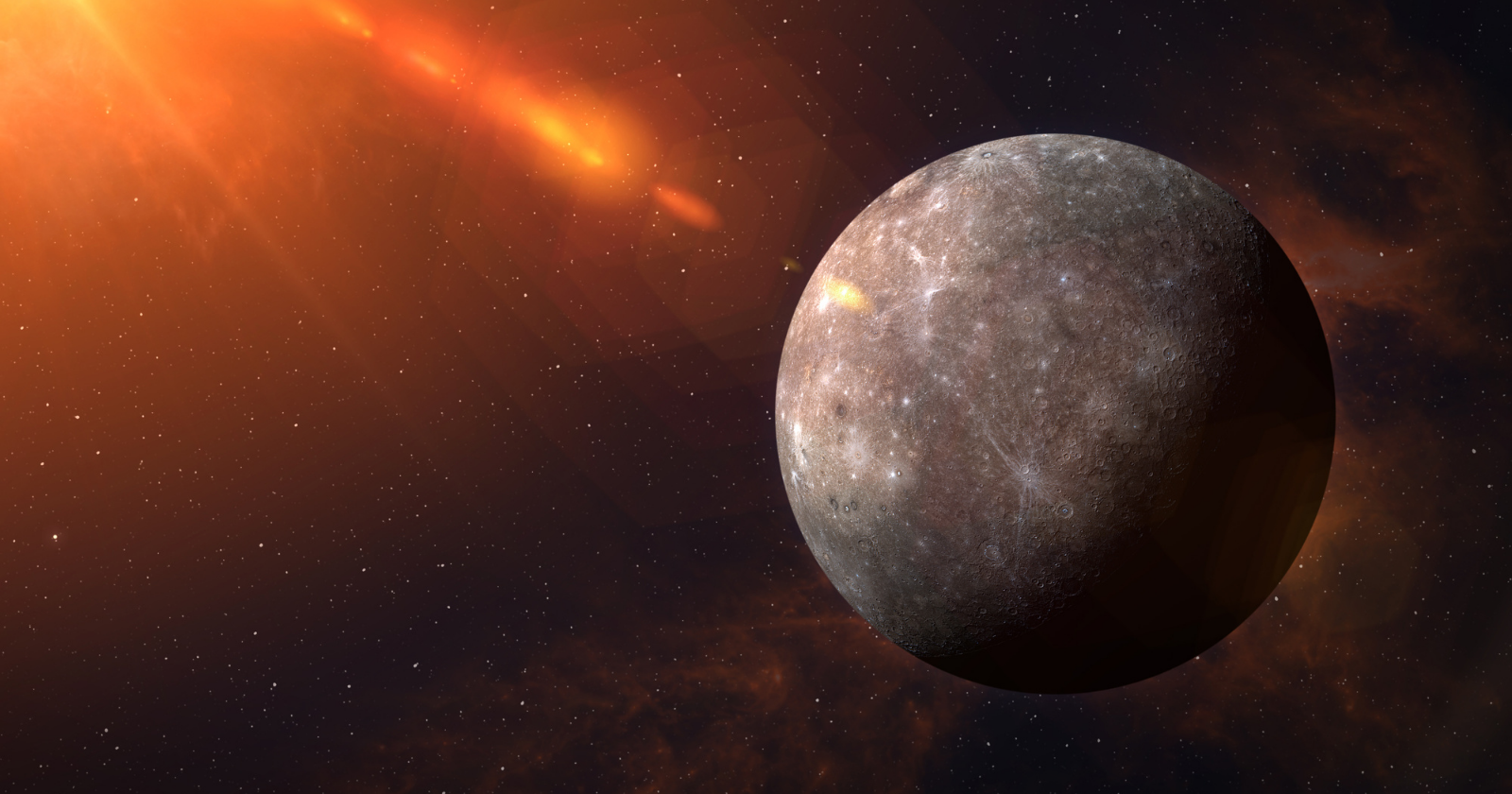
And, in the sense that actually matters most of the time, they’re all wrong. Averaged over the years, the planet closest to Earth is Mercury. Stranger still: Mercury is the closest planet, on average, to every planet in the solar system. Including Neptune, five billion kilometers away.
The mistake everyone made
The error hides in how the distances get calculated.
The usual shortcut: Earth orbits at 1 astronomical unit from the Sun, Venus at about 0.72 AU. Subtract, and Venus is 0.28 AU away — the smallest gap of any planetary pair. Case closed.
But that subtraction only describes the moment when both planets line up on the same side of the Sun. Planets don’t stay lined up. They lap each other constantly, and Earth spends just as much time on the opposite side of its orbit from Venus — at which point Venus is 1.72 AU away, on the far side of the Sun, farther than Mars ever gets.
The question “which planet is closest” quietly assumes the planets hold still. They never do.
Run the clock properly
In 2019, three engineers — Tom Stockman, Gabriel Monroe and Samuel Cordner, affiliated with NASA, Los Alamos and the U.S. Army’s engineer research center — did the arithmetic the honest way. In a commentary in Physics Today, they simulated the planets’ actual positions over 10,000 years and averaged the true separations.
Venus, the “closest” planet, averaged 1.14 AU from Earth.
Mercury averaged 1.04 AU. Closest planet: Mercury, comfortably.
The reason is the one folded into this article’s title. Venus is sometimes very near, but it spends long stretches enormously far away, and the far stretches drag its average up. Mercury, hugging the Sun on a tight little orbit, can never get very far from anybody. Its maximum distance from Earth is capped at roughly the Sun’s distance plus a little; it never disappears to the other side of a bigger orbit, because it doesn’t have one.
The part that breaks brains
Then comes the corollary. Run the same 10,000-year average for any planet you like, and Mercury wins every time.
Closest planet to Mars, on average: Mercury. Closest to Jupiter: Mercury. Closest to Saturn, Uranus, even Neptune at the solar system’s edge: Mercury.
It sounds like a trick, but picture Neptune’s situation. Its “neighbor” Uranus is sometimes nearby — and sometimes on the opposite side of the Sun, an extra 19 AU of orbit-diameter away. Mercury, meanwhile, is always within a whisker of the Sun, and the Sun sits at the middle of everyone’s sky. From Neptune’s distance, Mercury effectively is the Sun, positionally speaking: never nearer than about 29 AU, never farther than about 31. Small orbit, small swings, low average.
The authors formalized it with a formula they called the point-circle method, and named the general rule — the smaller the inner body’s orbit, the smaller the average distance to it — the whirly-dirly corollary, after a Rick and Morty episode. Physics permits whimsy when the math checks out. A planetary scientist ran an independent simulation for the BBC and got the same result.
Does “closest” even mean anything?
The finding is genuinely useful mental furniture, because it exposes how slippery the word “closest” is.
Closest ever? Venus, at 38 million km. Closest orbit? Venus again, no contest. Easiest to travel to? Also Venus — it takes less fuel to reach than any other planet, which is why “neighbor” still fits. But closest on average, over any long stretch of time — the planet most often nearest to us in the sky’s geometry? Mercury, and it isn’t close.
One astronomer offered the homeliest version: your next-door neighbors in Wisconsin who spend seven months a year in Florida are, for most of the year, not your nearest neighbors. The house across the street, occupied year-round, is.
Mercury is the house across the street — for Earth, for Neptune, for everyone. Small, scorched, forever underfoot of the Sun, it holds the least glamorous title in the solar system by the most unarguable method: it simply never goes anywhere. A body that cannot wander far from the fire cannot wander far from anyone sitting around it.
