

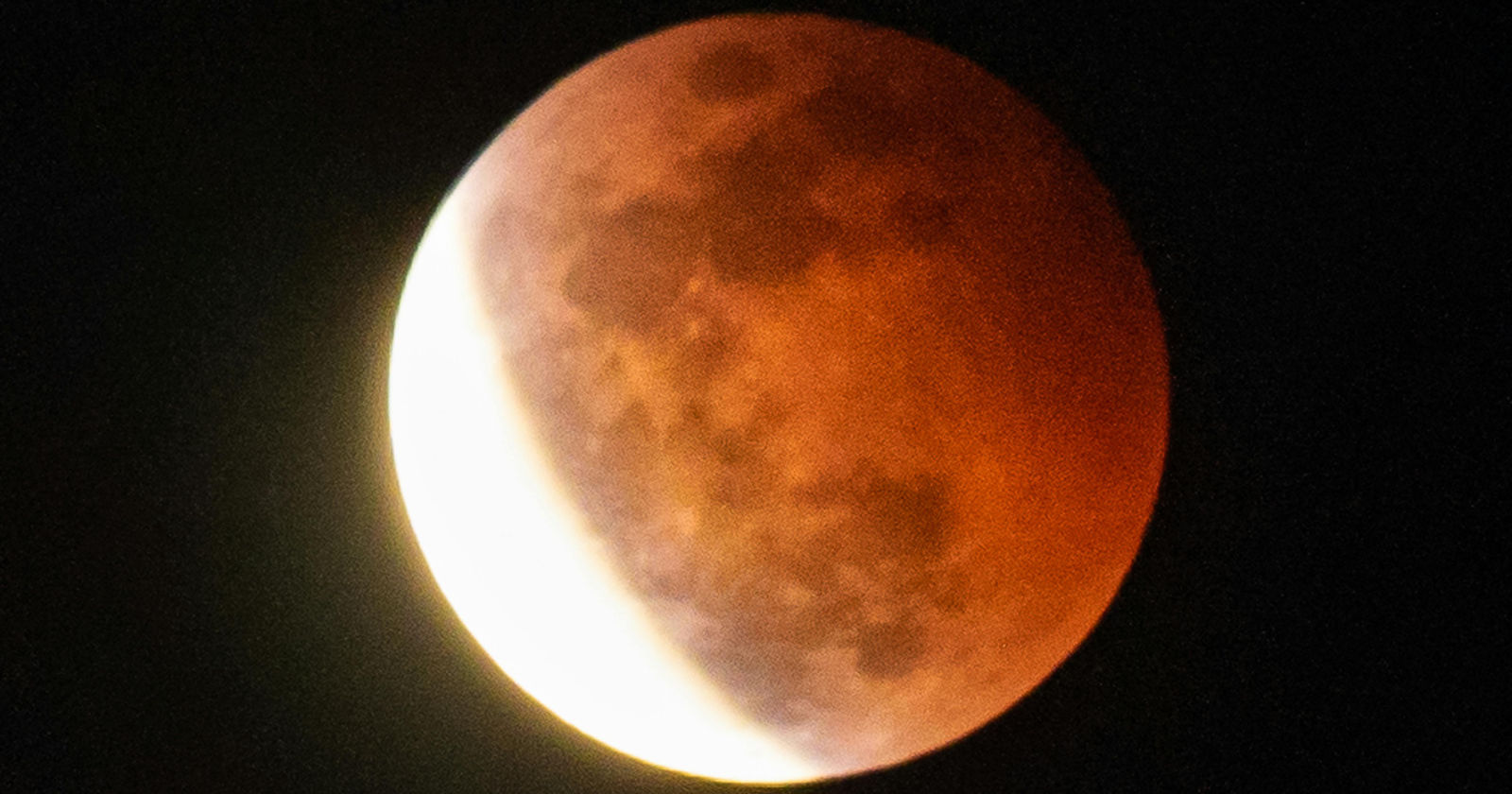
Astronomy keeps its categories strict. On Thursday night, over the Americas, the full Moon will sink so deep into Earth’s shadow that 96.3 percent of its face goes dark, dimming to the rusty copper of a classic blood moon. And the official record will file the whole event under the same heading as an eclipse that nibbles five percent off one edge: partial.
The reason is a strip of Moon perhaps a fingernail’s width at arm’s length. At maximum, the northern edge of the lunar disc misses the deepest shadow, staying in direct sunlight, and that one surviving sliver disqualifies the night from totality. It is also, perversely, the best thing about the eclipse.
The near miss, measured
A lunar eclipse is a game of alignment. Earth’s dark inner shadow, the umbra, is a circle in space roughly two and a half Moon-widths across at the Moon’s distance, and the Moon either threads fully inside it or it does not. Thursday night the Moon crosses the umbra’s northern region rather than its center, and the geometry falls agonizingly short: at the deepest moment, 4:12 Universal Time, 96.3 percent of the disc is immersed and the last few percent of the northern limb pokes out into raw sunlight.
Had the Moon tracked a few hundred kilometers further south along its orbit, the Americas would be getting a total eclipse. Instead they get something arguably rarer to see: the deepest partial eclipse until the total eclipse of New Year’s Eve 2028, and a Moon wearing two kinds of light at once.
Why the sliver changes everything
The dividing line matters because of what shadow does to color. The 96 percent of the Moon inside the umbra receives no direct sunlight at all; the only light reaching it has been filtered through Earth’s atmosphere, stripped of its blue, and bent inward, which is what paints an eclipsed Moon copper-red. The remaining sliver receives the Sun full strength, hundreds of times brighter.
So near maximum, the Moon becomes a study in contrast: a dim, ember-colored disc with a brilliant white arc blazing on its northern edge, like a coal with one polished rim. Photographers often prefer deep partials to totals for exactly this reason. A totally eclipsed Moon is a uniform red ball; this Moon has structure, a hard bright edge that makes the red look redder. The human eye, adapting to the bright sliver, tends to see the shadowed portion as darker and more dramatic than it would during totality.
The trade-off is the stars. During a true total eclipse the sky darkens enough for the Milky Way to emerge around the red Moon. Thursday’s surviving sliver keeps the Moon collectively too bright for that full effect, one more consequence of a few percent of sunlit rock.
When to look
For North America, the schedule favors the east. The Moon enters the umbra at 10:34 pm Eastern on Thursday the 27th, the shadow spreads across the disc for the next hour and a half, and maximum, the copper-and-white spectacle, arrives at 12:12 am Eastern, 11:12 pm Central, 10:12 pm Mountain, 9:12 pm Pacific. The partial phases run three hours and eighteen minutes in total, with the deep, dramatic stretch concentrated in the hour around maximum. West Coast observers get the eclipse already in progress at moonrise, low over the southeastern horizon; South America sees it high overhead; western Europe and Africa catch it toward dawn.
No equipment is needed and no eye protection either, unlike a solar eclipse; binoculars simply sharpen the show, resolving the curve of Earth’s shadow, which is, incidentally, the oldest proof humans have that our planet is round. Aristotle cited the circular shadow on the eclipsed Moon more than two millennia before anyone photographed Earth from space.
The unfairness of categories
There is a mild absurdity in the terminology, and astronomers know it. A 96 percent eclipse resembles a total eclipse far more than it resembles a 10 percent one, and some almanacs have taken to calling events like this “near-total” or “deep partial” to rescue them from the filing system. The November 2021 eclipse, which reached 97 percent, drew the same complaint: technically partial, visually magnificent.
But the strict line exists because totality is a genuine physical threshold, not a matter of degree. Only when the last sliver slips into shadow does the Moon go fully dark, the sky fully open, and the disc turn uniformly red. Thursday’s Moon stops one step short of that door, and holds the pose for the better part of an hour, which is its own kind of spectacle. Total eclipses are common enough; a Moon caught at 96 percent, wearing shadow and sunlight simultaneously, is the sky showing its machinery, the great circle of Earth’s shadow made visible by the one bright edge it failed to swallow.
