

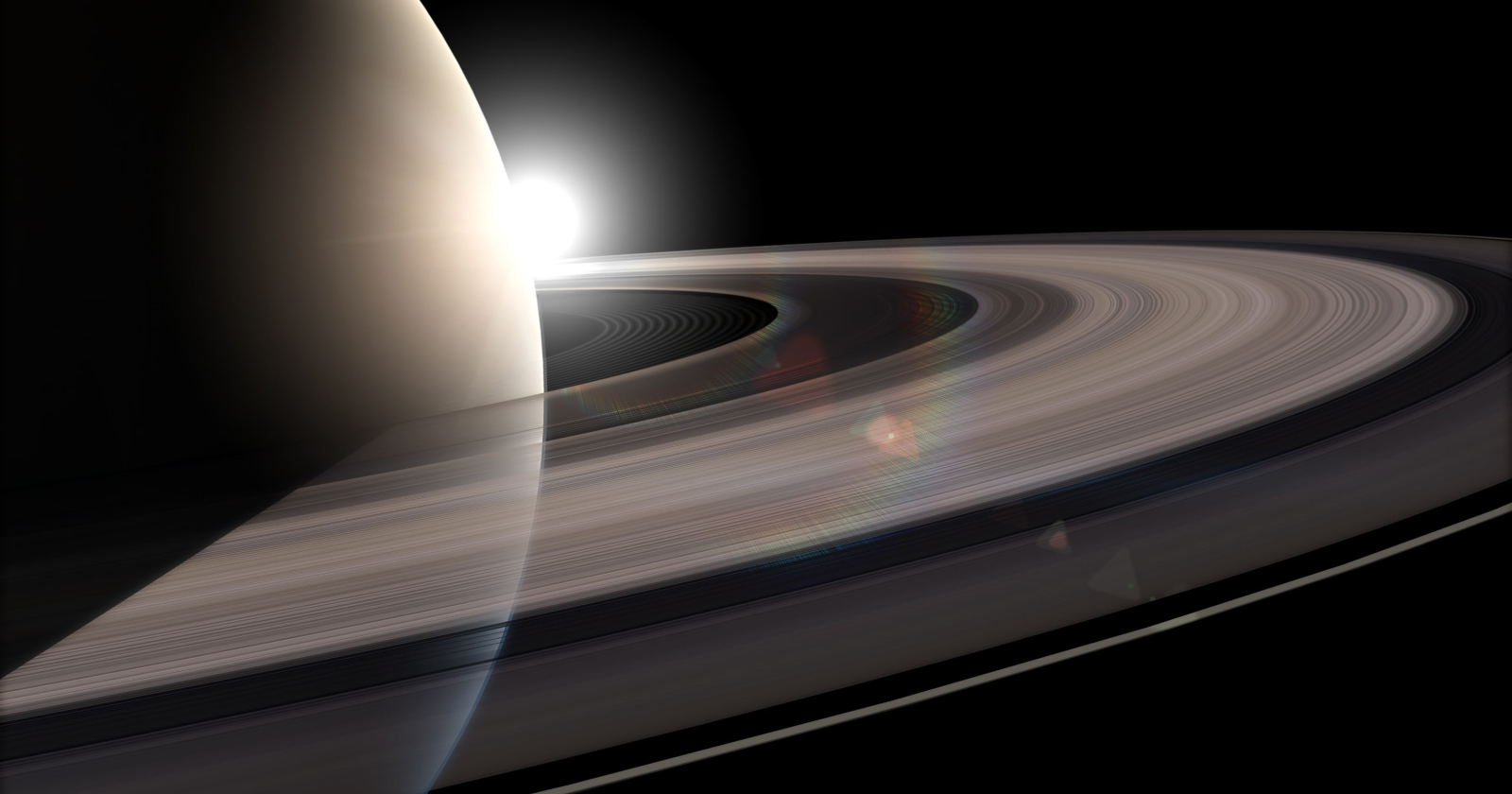
Saturn has been keeping a secret at its bottom, and it took the planet’s own calendar to give it away.
This week, NASA and an international team announced that Hubble has confirmed a decagon — a giant, regular, ten-sided atmospheric wave — wrapped around Saturn’s south pole. The study, led by Agustín Sánchez-Lavega of the University of the Basque Country, was published in Science Advances on September 2.
It is the first large geometric jet pattern ever found in Saturn’s southern hemisphere. And the strangest part is not the shape. It is the timing.
The planet that already had a polygon
Saturn was already the solar system’s geometry showpiece. Since the Voyager flybys of the early 1980s, astronomers have known that the planet’s north pole is ringed by a hexagon — a six-sided jet stream, wider than two Earths, that has held its shape for more than 40 years.
The hexagon made the north pole famous. It also made the south pole a control group. Cassini orbited Saturn from 2004 to 2017 — 13 years — and mapped the southern pole in detail: a monstrous hurricane-like vortex at the center, yes, but no polygon. Just ordinary circular bands.
The reasonable conclusion was that the hexagon was a one-off, a fluke of the northern jet stream. As co-author Amy Simon of NASA Goddard put it, the northern hexagon has been there every time anyone has looked for four decades — and the south had nothing.
The reveal, on a 29-year timer
Saturn takes 29.5 Earth years to orbit the sun, so its seasons crawl. For most of the Cassini era and after, the south pole was tilted away from Earth, sliding into southern winter, hard to see.
Only recently have the changing seasons brought the south pole back into Earth’s view — and the planet had redecorated. Amateur astronomers feeding images to the team’s Planetary Virtual Observatory noticed an odd undulating band in 2024. Polar projections built from images by observers in Australia and France sharpened it in 2025: ten sides, unmistakable. Hubble’s high-resolution images confirmed the polygon and, looking back through the archive, traced its presence to 2023 — but no further.
Sánchez-Lavega was blunt about the surprise: neither earlier Hubble images nor anything Cassini captured across its 13 years in orbit shows the feature. The team’s reading is that the decagon developed recently — a continent-scale geometric structure that assembled itself, in effect, while nobody could watch.
Not the hexagon’s twin
The decagon rides an eastward jet stream between about 58 and 63 degrees south, a wave threading through multiple layers of the atmosphere. But it is not simply the hexagon with four extra sides — and the differences are what excite the researchers.
The hexagon is stationary, locked to Saturn’s rotation, and eerily stable across decades. The decagon drifts eastward and is strengthening — a young, evolving structure rather than a fossil. Just north of it churns a 4,000-kilometer anticyclone the team calls a Red Spot, a smaller cousin of Jupiter’s, and the decagon is most sharply drawn near that vortex — a clue, backed by the team’s simulations, that the storm may be involved in sculpting the wave.
In other words, astronomers may be watching the thing the hexagon never let them see: a polar polygon in the act of forming.
What Cassini’s silence is worth
There is a lovely inversion at the heart of this discovery. Cassini’s 13-year, close-up, billion-dollar watch would seem to trump anything a telescope near Earth could do — and for most questions it did. But for this one, Cassini’s exhaustive maps matter most for what they don’t contain. Because the probe documented the south pole so thoroughly and found no polygon, its archive converts a mere absence into evidence: the decagon is new, and its birth can be dated to a window after 2017.
Now the shape belongs to the patient instruments — Hubble, and the worldwide relay of amateur telescopes that flagged it first. Whether the decagon settles into hexagon-like permanence or dissolves back into the jet stream is the question the team says only continued watching can answer.
Saturn, meanwhile, has quietly doubled its portfolio: geometric storms at both poles, six sides on top, ten below, on a planet that reveals its bottom half to Earth once per 29-year lap. The probe that lived there for 13 years missed the show by six. The planet was always going to run on its own schedule.
