

The Bibliothèque nationale de France still holds Marie Curie’s laboratory notebooks. Access to the originals is limited to exceptional requests under a strict monitoring protocol, and the library uses microfilms to reduce handling.
Inside are ordinary-looking hardback notebooks filled with neat handwriting, columns of figures and small sketches. More than 120 years later, some still retain active traces of radioactive contamination. A roughly 1,600-year half-life for radium-226 means its activity falls by half over that interval; it does not stop after one half-life.
A shed on the rue Lhomond
The story of how they got that way starts in 1898. Marie Curie was 30, a Polish immigrant in Paris who had just finished a physics degree and was looking for a topic for her doctorate. She chose a strange new phenomenon that Henri Becquerel had noticed the year before: uranium salts gave off invisible rays that could fog a photographic plate.
Marie began measuring the rays with an instrument her husband Pierre had built. She soon found that pitchblende, a heavy black uranium ore mined in what is now the Czech Republic, was far more active than the uranium in it could explain. Something else in the rock was giving off rays. Something new.
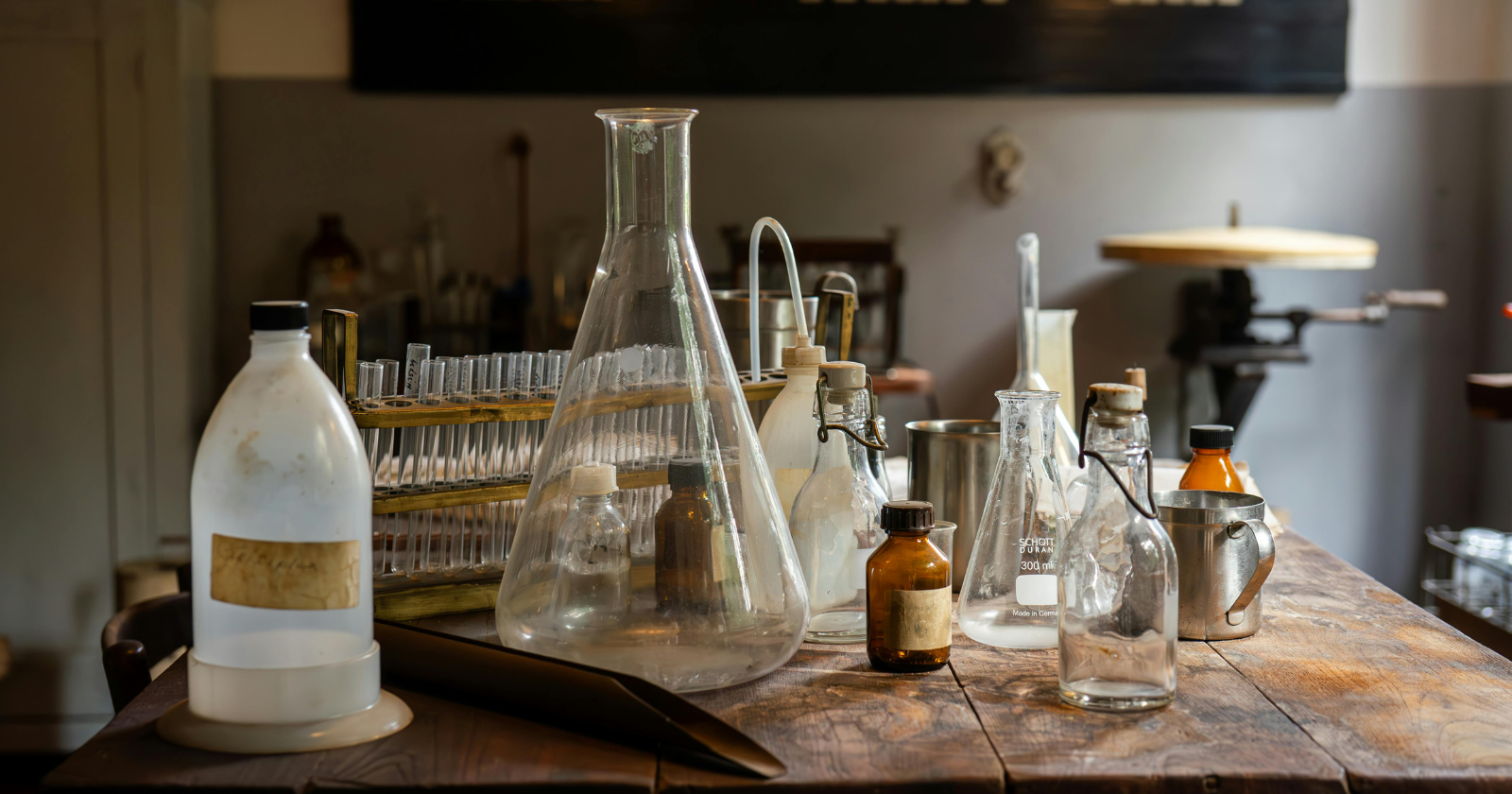
She and Pierre needed a place to find out what it was. The school where Pierre taught, on the rue Lhomond, gave them an abandoned shed across the courtyard. It had once been a dissecting room for medical students. The glass roof leaked when it rained. In winter it was close to freezing, and in summer the heat was brutal. There was no proper ventilation, so a lot of the work had to be done outside in the yard, and when the weather forced them in, the fumes stayed in with them.
Tonnes in, a pinch out
Pitchblende was expensive. The Curies could not afford much, so they arranged to get the leftover waste from a uranium mine in Bohemia, the crushed rock left after the uranium had been taken out. It arrived by the cartload, mixed with pine needles from the forest floor where it had been dumped.
Marie did most of the heavy work. She later wrote that she sometimes spent a whole day stirring a boiling mass in a cast-iron basin with an iron rod nearly as tall as she was. The ore was dissolved in acid, filtered, precipitated, redissolved and crystallized again and again. Each round threw away the ordinary elements and kept a slightly purer, slightly more radioactive residue.
The numbers were staggering. To get anything they could hold up and call radium, they eventually worked through several tonnes of ore, commonly put at around seven, over close to four years. In 1902 Marie finally had one-tenth of a gram of pure radium chloride, roughly the weight of a few grains of rice, enough to measure the new element’s atomic weight and give it a place on the periodic table.
Working in the dark
The shed had one feature the Curies loved. At night the shelves glowed. Rows of little glass dishes and tubes of concentrated radium salts gave off a faint blue-green light. Marie wrote that she and Pierre would sometimes go back after dinner just to look at them.
Nobody yet understood what those glowing tubes were doing to the people around them. Pierre carried a sample of radium in his waistcoat pocket to show colleagues and got a burn on his skin that took months to heal. Marie handled the material with bare hands, kept samples in her desk drawer and breathed the shed’s air for years. Radioactive dust settled on everything: benches, papers, clothing, the pages she was writing on.
Radium-226, the isotope they had isolated, has a half-life of about 1,600 years. Radioactive particles absorbed by paper and fabric can therefore remain active over many generations. The BnF confirms that contamination remains in parts of the Curie archive, although the two notebooks it has displayed were measured and presented safely behind museum glass.
What the notebooks say
The books themselves are mostly the daily grind of the work: weights, readings, temperatures, dates. In one you can see the entry from the days when Marie recorded the atomic weight of radium. In others there are notes in Pierre’s hand alongside hers, before his death in a street accident in 1906.
The Bibliothèque nationale de France in Paris holds them now, along with a great deal of the Curies’ other papers. The most contaminated leaves were encapsulated and some covers protected with plastic; the originals are consulted only for exceptional requests under a closely monitored protocol. The library also produced microfilms so the originals would not need to be brought out routinely.
Marie Curie herself was reburied in the Panthéon in 1995, the first woman honored there on her own merits. A Musée Curie review of the evidence says her fatal aplastic anaemia was probably connected to her many radiation exposures, including both X-ray work during the First World War and years of handling radium and polonium. The available evidence cannot reliably separate the contribution of one exposure from the others.
The cost of the shed
The Curies shared the 1903 Nobel Prize in Physics with Becquerel for the discovery of radioactivity. Marie won a second Nobel, in Chemistry, in 1911 for isolating radium and polonium, and remains the only person to have won in two different sciences. She died in 1934 of aplastic anaemia after decades of occupational radiation exposure.
The shed on the rue Lhomond was demolished long ago. What survives of it are the notebooks, carrying trace contamination from the laboratory and preserved under safeguards that the BnF continues to reassess.
