

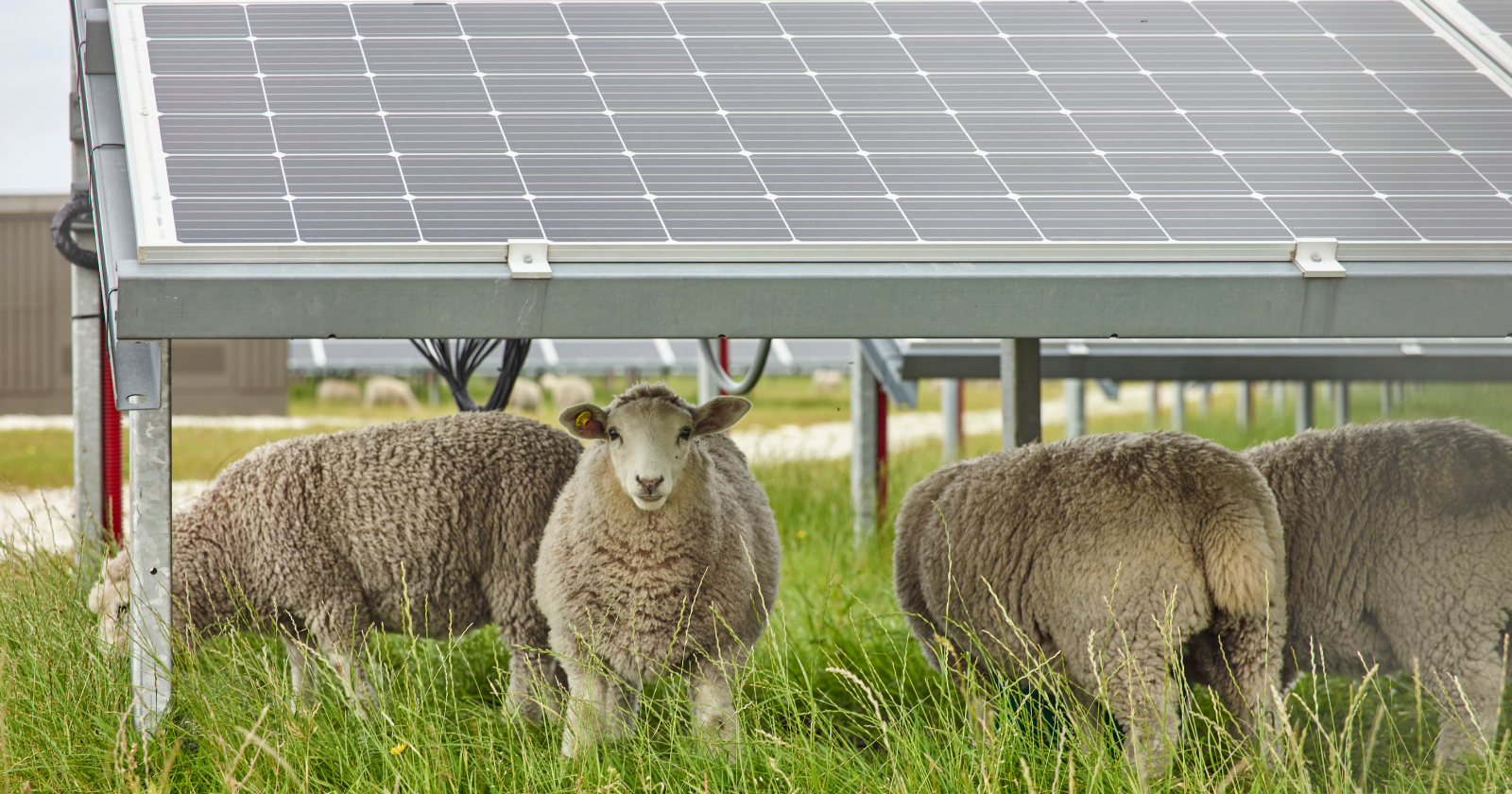
The experiment at Oregon State University’s research farm in Corvallis was set up like a fair fight. Two groups of weaned Polypay lambs, matched and weighed. Two pastures side by side: one open to the full Willamette Valley sky, the other planted beneath the rows of a working solar array. Turn the lambs out, let them graze a spring, and weigh what happens.
Across the two years, pasture beneath the panels produced 38 percent less herbage than the open field, with the fully shaded strips directly beneath the panels growing thinnest. That figure describes pasture production, not the amount each lamb ate.
The lambs nevertheless grew at comparable rates. In spring 2019 the solar lambs gained 120 grams a day and the open-field lambs 119; in 2020 the figures were 89 and 92 grams. The differences were not statistically significant, but the measured values were not identical.
The quality loophole
The resolution of the paradox was sitting in the forage analysis. Grass grown in shade is not simply less grass; it is different grass. Plants under the panels, receiving less light, put less energy into the coarse structural carbohydrates, the stemmy, fibrous bulk that fills a pasture and fills a rumen without feeding it especially well. What the shaded plants did produce stayed leafier, softer and richer, with the study finding higher nutritive quality in the solar pasture’s forage, more protein and digestibility packed into fewer kilograms.
The researchers’ summary states the trade clearly: lower herbage mass in the solar pasture was offset by higher forage quality, resulting in similar lamb production to the open field. The experiment did not directly establish that each lamb consumed 38 percent less material.
The panels chipped in a second, sneakier subsidy. Lambs in the open field spent their afternoons standing in full sun, burning energy on staying cool, and in the hot weeks of late spring they drank measurably more water, nearly three-quarters of a liter more per head per day, than the lambs loafing in panel shade. Every calorie a solar lamb did not spend on heat regulation was a calorie available for growth. The researchers watched the flocks organize their days around the geometry, grazing the open strips, then drifting under the panels to ruminate through the heat, using the array the way sheep on old pastures use a hedgerow tree.
The arithmetic that interests everyone else
The study, published in Frontiers in Sustainable Food Systems in 2021 and believed to be the first anywhere to measure livestock production under a working solar array, then did the sums that matter to landowners. Grazing returns came out at $1,046 per hectare per year in the open pasture and $1,029 under the panels, a difference of less than 2 percent. As co-author Serkan Ates noted, the returns are about the same before counting the electricity, and the panels’ output is the entire point of the land. The same hectare was producing its full agricultural value and a power plant’s worth of energy at once, the double-cropping that the agrivoltaics field exists to prove.
There were honest wrinkles in the data. The 38 percent forage deficit was not evenly spread; the strips in permanent full shade grew poorly and established badly, while partially shaded ground between rows sometimes out-produced the open field in high summer, when the panels’ shade kept soil moisture alive after the open pasture had browned off. An earlier Oregon State study on the same site had found late-season grass under panels benefiting from exactly that moisture effect. Shade, in a dry Pacific Northwest summer, cuts both ways.
What the lambs settle
The Corvallis result has been cited ever since in the argument it was designed to inform, the land-use fight between food and energy. The reflexive objection to solar on farmland is that every panel’s shadow is subtracted pasture, and by the crudest measure, biomass, the objection is true; the study measured the subtraction at 38 percent. What the lambs demonstrate is that the subtraction never reached the animal. Growth, liveweight per hectare, water use, returns per acre: on every metric that ends in meat or money, the shaded pasture matched the open one.
The useful result is that the quantity of forage fell while its measured quality improved, and lamb growth remained statistically comparable. The animals also used the panels for shade during hot afternoons, showing how grazing and electricity generation can share the same ground.
Correction, 31 August 2026: An earlier version said the lambs gained the same weight “to the gram” and ate one-third less. Their growth rates were statistically comparable but not identical, and the study measured herbage production rather than individual intake.
