

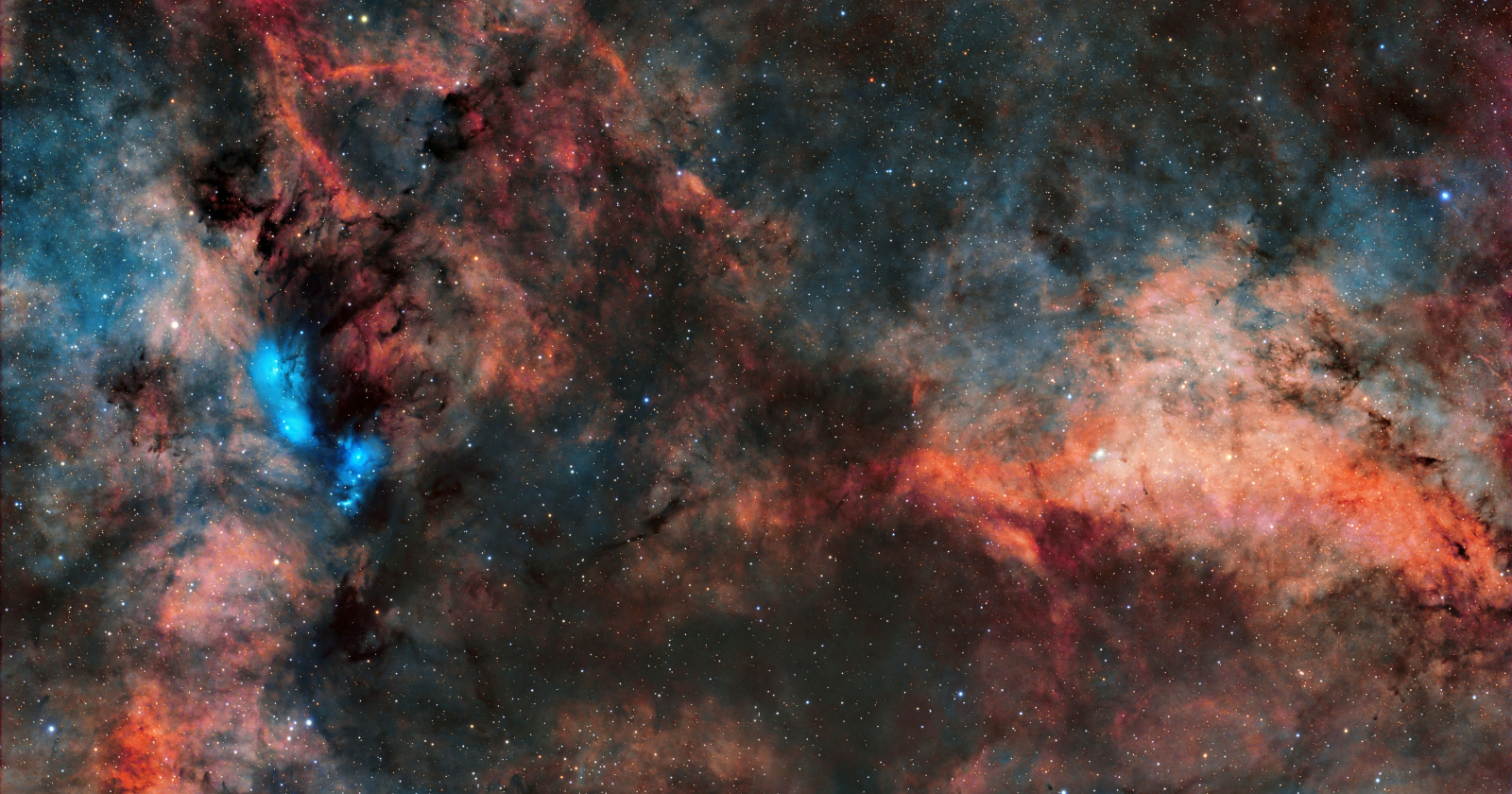
Every telescope before it was built to look around. Kepler was built to stare.
Launched in March 2009 into an orbit trailing the Earth around the sun, the spacecraft carried one instrument, a 95-megapixel camera behind a meter-class mirror, and a single instruction that never changed: point at one patch of sky between the constellations Cygnus and Lyra, about as much sky as your open hand at arm’s length, and do not look away. Inside that patch, mission planners had preselected roughly 150,000 stars, and Kepler’s job was to measure the brightness of every one of them, over and over, every half hour, for years, hunting for the faintest imaginable flicker.
The audacity of the method
The flicker it wanted has a name, the transit, and the nerve of the whole mission lives in its arithmetic. If a star’s planetary system happens to be tipped edge-on to our line of sight, its planets will periodically cross the star’s face, and the star will dim by the fraction of its disk the planet covers. For a Jupiter crossing a sun, that is about one percent, detectable from a good mountaintop. For an Earth crossing a sun, it is 84 parts per million, a dimming of less than one-hundredth of one percent, lasting perhaps half a day, once a year. Detecting it is regularly compared to noticing, from miles away, a flea crawling across a car’s headlight.
That is why the stare had to be unbroken. A transit missed is a planet missed, and confirming a true Earth analogue means catching three or four transits, which means three or four years of continuous vigil on the same stars. Kepler’s designers accepted every cost that logic imposed: one field, chosen away from the ecliptic so the sun never intruded; a photometer stable to a few parts per million; and four years of institutional patience while the data accumulated, transit by transit, in a discipline no human observer could sustain for an evening. The spacecraft did not sleep, did not blink, and did not get bored.
Four years, then the wheels
The vigil’s end came from the humblest components aboard. Kepler held its exquisite pointing with four reaction wheels, gyroscopic flywheels that steady the spacecraft without thruster fuel, and it needed three working at once. Wheel two failed in July 2012. In May 2013, wheel four followed, and the telescope that had held 150,000 stars motionless on its detector for four years could no longer hold still. The primary mission was over; engineers later improvised a second act called K2, balancing the crippled spacecraft against the pressure of sunlight itself to survey new fields in shorter campaigns, until the fuel ran out and NASA retired Kepler in October 2018.
But the treasure was already in the vault. The four-year stare had produced a brightness ledger of unprecedented depth, and astronomers have been mining it ever since; confirmations continued for years after the wheels stopped, as candidates were checked and vetted, and the tally from Kepler’s data now stands at more than 2,600 confirmed planets, with thousands of further candidates still awaiting verdicts. More than half of all planets known beyond the solar system, decades into the field, trace to that one patch of Cygnus.
What the ledger said
The individual discoveries filled headlines for a decade, the first confirmed rocky exoplanet, worlds orbiting two suns, planets in their stars’ habitable zones, entire packed systems like Kepler-90’s eight planets. But Kepler’s real product was statistical, and it rewrote the galaxy’s demographics. Because the mission watched a known number of stars with known sensitivity, every detection could be scaled up, and the extrapolations landed on conclusions that would have sounded like science fiction when the telescope launched: planets outnumber stars in the Milky Way, small rocky worlds are the commonest kind, and a meaningful fraction of sun-like stars, plausibly somewhere between a fifth and a half, host a roughly Earth-sized planet at a temperate distance. Before Kepler, the abundance of other Earths was a philosophical argument. After Kepler, it is a measured quantity with error bars.
There is a fitting austerity to how the numbers were won. Kepler discovered no planet directly; it never saw a single one. It saw dips, hundreds of thousands of half-hour brightness measurements per star, stacked and folded until periodic shadows emerged from the noise, worlds reconstructed entirely from the geometry of their interruptions. The spacecraft is dead now, drifting in its Earth-trailing orbit, but the method it vindicated runs the field: its successor TESS stares at the whole sky in shifts, and every next-generation habitable-world telescope inherits Kepler’s founding bet, which was less about optics than about temperament. The universe does not reward the observatory that glances everywhere. It rewards the one willing to watch 150,000 stars do almost nothing, for four years, in case a few thousand of them dimmed by a hundredth of a percent, and they did.
