

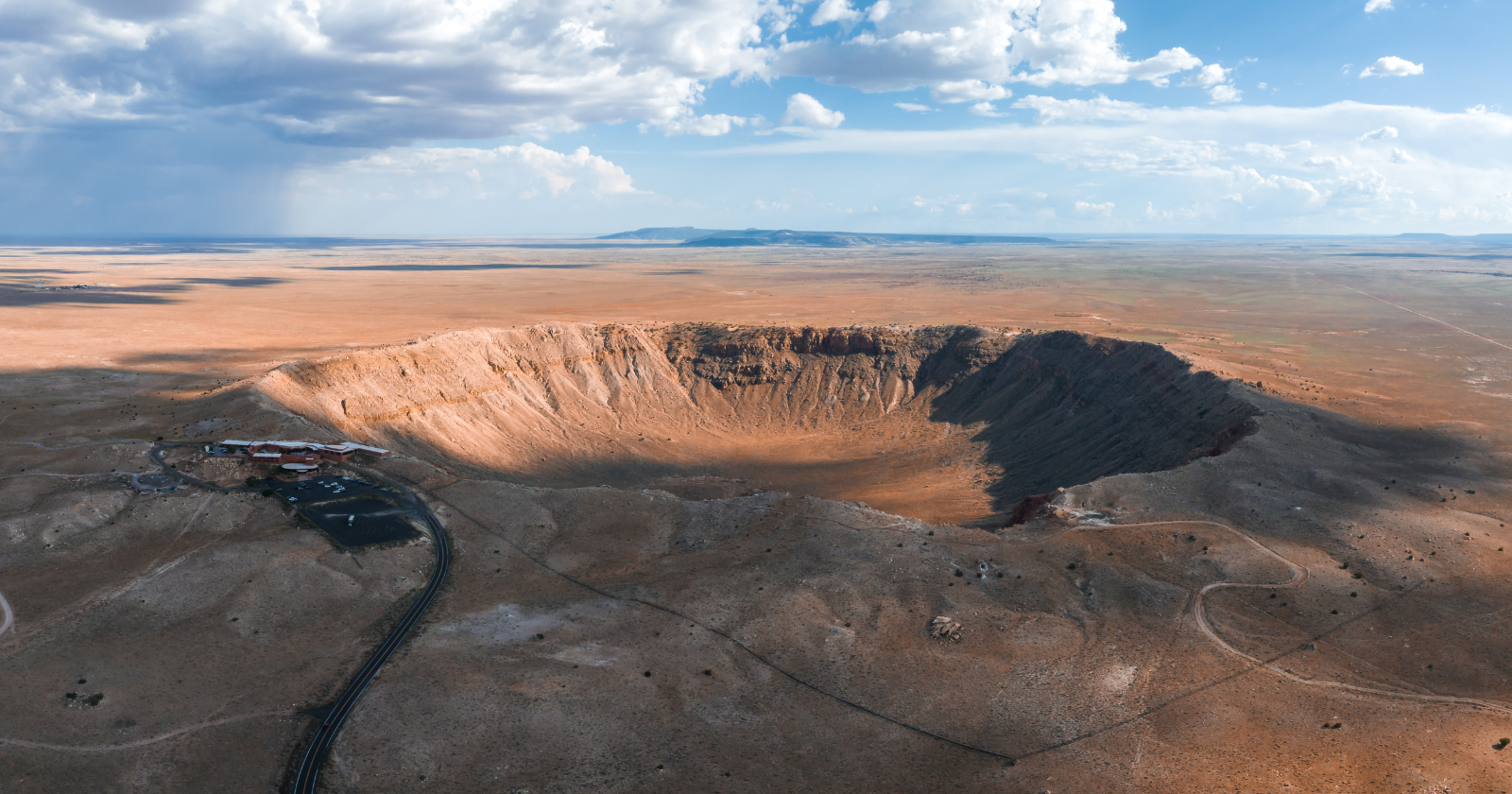
The hole in the ground east of Flagstaff is nearly a mile across and deep enough to swallow a 50-story building. In 1903, an influential scientific explanation held that it formed in a steam explosion rather than a meteorite impact.
That was the verdict of Grove Karl Gilbert, chief geologist of the U.S. Geological Survey and one of the most respected scientists in America, who had examined the crater and ruled it a steam explosion — despite the tons of iron meteorite fragments scattered for miles around it, which he dismissed as coincidence. The scientific establishment agreed, filed the matter away, and moved on.
Daniel Moreau Barringer — Philadelphia lawyer turned mining engineer, wealthy from a silver strike, stubborn by profession — heard about the iron-strewn crater and drew the conclusion the establishment had declined: a giant iron meteorite had punched the hole, and the meteorite must still be down there. A body big enough to dig this crater, he reasoned, would run to millions of tons of nearly pure iron-nickel — one of the richest ore bodies on Earth, conveniently pre-delivered from space, waiting under the floor.
In 1903 he staked mining claims on the crater, and soon held a federal land patent to the surrounding land. Then he started drilling for his buried treasure.
He would drill, on and off, for 26 years.
The best-documented failure in mining
Barringer’s Standard Iron Company bored hole after hole into the crater floor and found crushed rock, meteoric dust, and no mother lode. He reasoned — cleverly, wrongly — that the impactor had come in at an angle and lodged under the southern rim, and moved the rigs there. In the late 1920s a drill at 1,376 feet ground into something hard amid increasing meteoric material, then jammed for good; the money, some $600,000 of his own and his investors’, was gone.
The cruelest part is that the failure was written into the physics from the first day, and the physics arrived in 1929. Astronomer Forest Ray Moulton, commissioned to review the project, calculated what Barringer had never wanted computed: an iron mass hitting at cosmic speed — some 26,000 miles per hour — delivers the energy of a multi-megaton bomb, and that energy goes into the impactor as much as the ground. The meteorite Barringer sought, perhaps 150 feet across and 300,000 tons, had largely vaporized and splashed away in the instant it made the crater. The treasure and the excavation were the same event. There was no vault under the floor, because the act of digging the hole had spent the deposit.
Barringer received Moulton’s report in November 1929, within weeks of the stock-market crash. Days later, he died of a heart attack, at 69 — believing, by most accounts, that his life’s obsession had ended in ruin.
The vindication he didn’t live to bank
Then the verdict reversed — on everything but the money.
Over the following decades, impact science grew into a field, and its founding shrine was Barringer’s hole. In 1960, E. C. T. Chao, Eugene Shoemaker and B. M. Madsen reported the first natural occurrence of coesite in the crater’s shocked sandstone; stishovite was identified there later. Arizona’s crater became the first proven meteorite impact site on Earth — the type specimen, the place where scientists learned to read impact scars before reading them on the Moon; Apollo astronauts trained in it. The scientific community formally calls it Barringer Crater, and the top award in impact studies is the Barringer Medal.
Gilbert’s steam-explosion interpretation had been wrong. Barringer was right about the impact origin, against the government’s chief geologist, but his mining assumption was wrong. The meteorite had existed; the buried iron mother lode he expected did not.
The family holding
And here the story takes its final, very American turn: the Barringers kept the hole.
The Barringer family still owns the land, while a separate company operates the visitor facilities under a long-term lease. Where the drills failed, the visitor center succeeded: the crater operates as a tourist attraction with a museum, rim tours and an admission fee. The iron that largely vaporized about 50,000 years ago earns money anyway — not as ore, but as a story.
It amounts to one of science history’s tidiest ironies. Daniel Barringer bet everything on two propositions: that a meteorite made the crater, and that a large recoverable mass remained below it. Later research confirmed the first and rejected the second. The fortune was never under the floor. It was the hole itself.
Correction, 15 September 2026: An earlier version overstated Barringer as right about everything except the treasure and imprecisely described current ownership and the 1960 mineral evidence. The headline and text have been corrected and sourced.
