

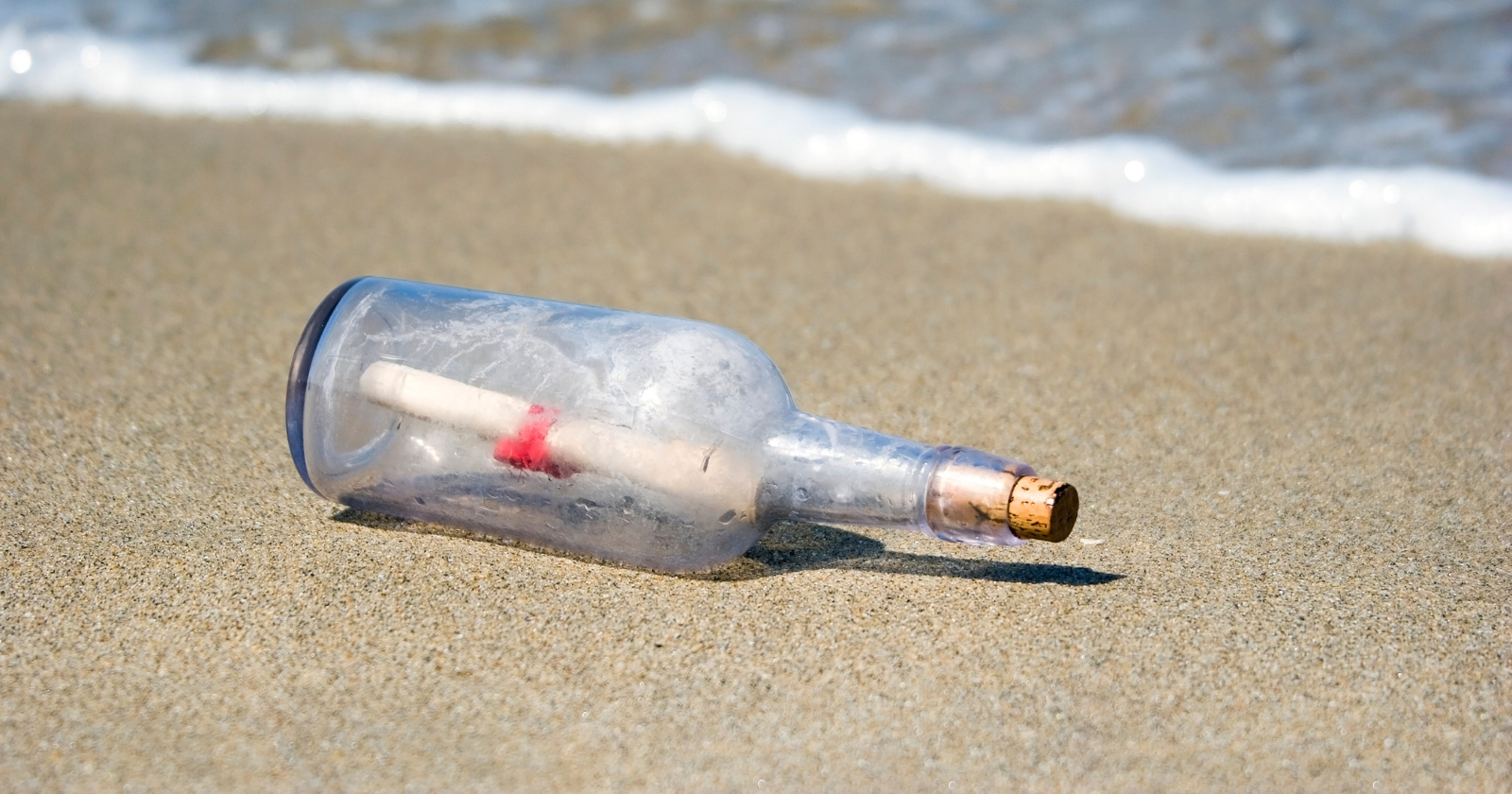
On a January morning in 2018, Tonya Illman was walking through the dunes north of Wedge Island, on the coast of Western Australia, when she spotted a bottle half-buried in the sand. She picked it up because it was pretty — a dark glass bottle with raised lettering that she thought would look nice on a bookshelf.
It turned out to be the oldest message in a bottle ever found: 131 years and 223 days out of human hands, thrown from a German ship in 1886.
The bottle that was rubbish, then treasure
Illman nearly missed it entirely. She and a friend had stopped to pick up litter on the walk back to their bogged-down car; the bottle looked like more of the same, just older and prettier.
Back at the car, she handed it to her son’s girlfriend, who tipped out the sand packed inside — and noticed what looked like a tightly rolled cigarette wedged in the neck. It was paper, tied with string, too damp and fragile to unroll. The family took it home and dried it briefly in the oven, and when they carefully unfurled it, they found a printed form in German, with handwriting on it, dated 12 June 1886.
That is when a beachcombing curiosity became a genuine historical mystery — one that would take an international archival hunt to solve.
A message that was never a message
The romance of a “message in a bottle” usually imagines a castaway or a lovelorn note. This was something far stranger and more systematic: it was scientific data, deliberately thrown into the sea.
From 1864 to 1933, the German Naval Observatory in Hamburg — the Deutsche Seewarte — ran one of the longest experiments in the history of oceanography. To map the world’s ocean currents and find faster shipping routes, it had ship captains toss thousands of “drift bottles” overboard at set times and places. Each bottle held a printed slip recording the ship, the date and the coordinates where it went into the water, with a request in several languages: whoever finds this, write down where and when you found it, and send it back to Hamburg or the nearest German consulate.
Then you wait, and you let the ocean carry your data point wherever it goes. Over the seven decades of the program, thousands of bottles were thrown; fewer than one in ten ever came back. This one didn’t come back for 132 years.
Matching it to the logbook
The Illmans took their find to the Western Australian Museum, where maritime archaeology curator Ross Anderson began the detective work — and made clear the bar was high. Extraordinary claims, he noted, need extraordinary evidence.
The physical clues lined up first: the bottle was a mid-to-late-19th-century Dutch gin bottle, and the paper and ink were consistent with cheap 19th-century materials. The slip named a ship whose name the Illmans had partly deciphered as Paula, and records confirmed a German barque called Paula had indeed sailed from Cardiff, Wales, toward the Dutch East Indies in 1886.
But the clincher came from Germany. An archival search turned up Paula‘s original Meteorological Journal — and in it, an entry dated 12 June 1886, made by the ship’s captain, recording that a drift bottle had been thrown overboard that day. The date matched. The coordinates on the slip matched the coordinates in the logbook. Anderson also compared the handwriting on the bottle’s slip against the captain’s entries in the journal, and it was consistent — the same hand that had filled out the floating form had written the ship’s daily record. The German authorities who ran the original program, now the Federal Maritime and Hydrographic Agency, confirmed the whole thing.
The bottle had been jettisoned about 950 kilometers off the Australian coast, and researchers think it probably washed ashore within a year — then lay buried under damp sand for more than a century, protected from sun and air, until a storm surge uncovered it for Tonya Illman to find.
The slowest experiment ever answered
There is something wonderful about what this bottle actually is, once you strip away the romance. It was a single data point in a 69-year science project — and it came in late. Very late.
The German Naval Observatory wanted to know where its bottles drifted. This one drifted to a beach in Western Australia and then stopped reporting for 132 years, sitting in the sand long after the experiment that launched it had ended, long after the observatory itself had been folded into other agencies, long after the barque Paula and everyone aboard her were gone. When Tonya Illman picked it up, she unknowingly completed the assignment printed on the slip: she recorded where and when she found it, and the data finally came home.
The captain who dropped it over the rail in 1886 logged it as one routine line in a logbook and sailed on, never imagining his throwaway note would outlive his ship, his century, and himself — or that its greatest value would turn out to be not the current it charted, but the sheer, absurd patience of its journey. A message meant to be answered in months was answered in generations. The ocean, it turns out, is in no hurry to deliver the mail.
