

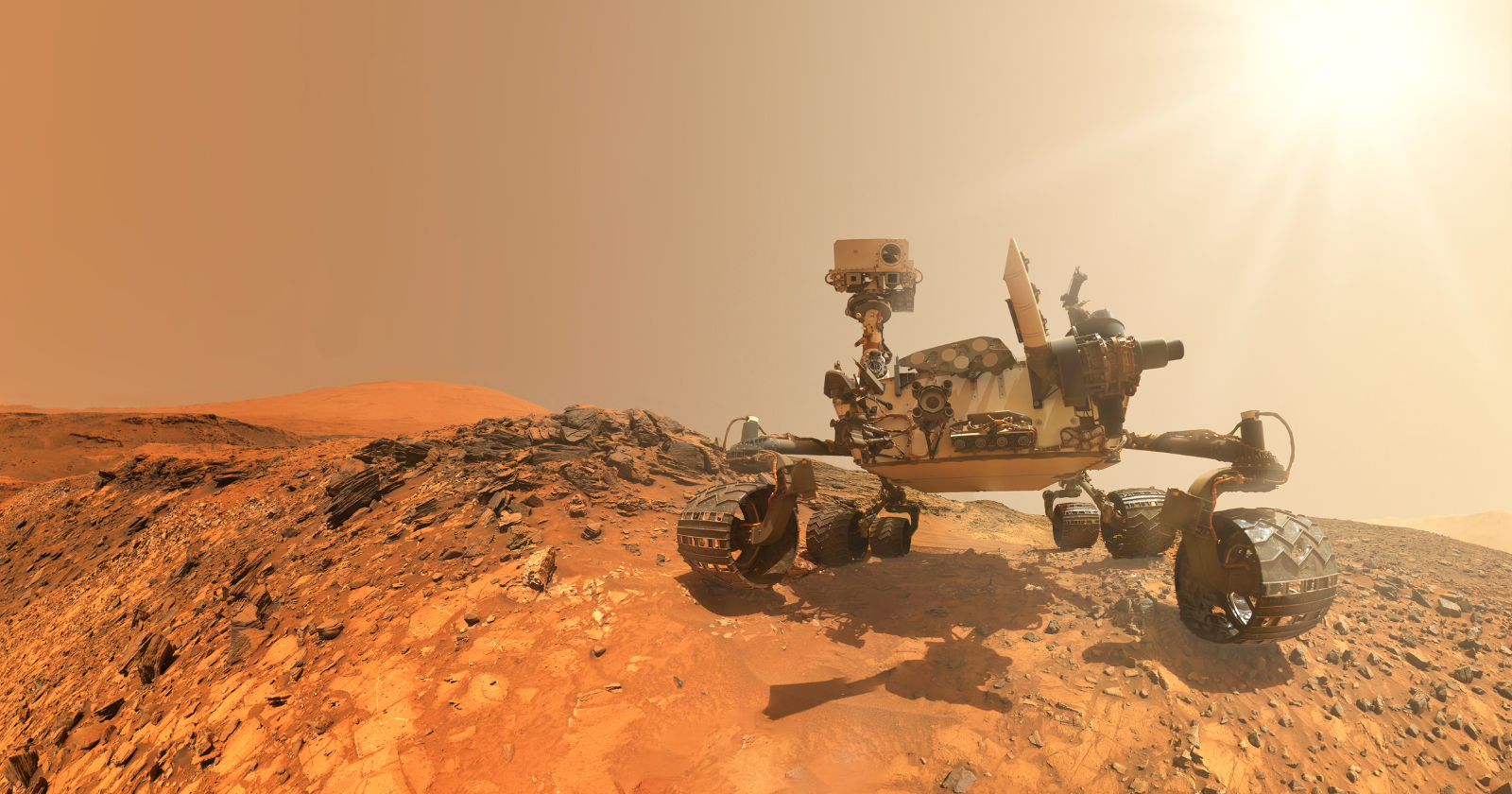
On November 9, 2021, NASA’s Perseverance rover pointed its mast camera west across Jezero Crater and took a picture that most people would not immediately recognize as a sunset. The sun was a small pale disk, about two-thirds the size it looks from Earth, and the sky around it was not orange or gold. It was a soft, cool blue, fading outward into a dull butterscotch.
Nothing about that image is a trick of the camera. Mars really does have a rusty daytime sky and a blue glow at sunset, the mirror image of what we see here. And the physics behind both planets’ colors is the same story told from opposite ends.
Why Earth’s sky is blue
Sunlight is white, which means it contains every color mixed together. When it enters Earth’s atmosphere it runs into nitrogen and oxygen molecules that are far, far smaller than the wavelength of visible light. Particles that small scatter light in a very particular way, first worked out by the British physicist Lord Rayleigh in the 1870s: short wavelengths get bounced around much more than long ones.
Blue light has a shorter wavelength than red, so it gets scattered in every direction while red mostly sails straight through. Look up on a clear day and what reaches your eye from every part of the sky is that scattered blue. The effect is steep. Blue light is scattered roughly five times more strongly than red, which is why the sky is not a pale lilac but a confident blue.
Why Earth’s sunsets are red
At sunset the sun is low, and its light has to travel through much more air to reach you than it does at noon. Along that long, slanting path the blue is scattered out sideways again and again until, by the time the beam arrives, there is very little of it left. What remains is the light that survived the journey: orange and red.
So on Earth, the sky is blue because blue scatters away from the sun’s direction, and the sunset is red because blue has been removed from the direct beam. Same process, two different viewing angles.
Mars swaps the scatterer
The Martian atmosphere is thin, about one percent as dense as ours, and it is mostly carbon dioxide. On its own that gas would still scatter blue light the way Earth’s air does, and on rare exceptionally clear days the Martian sky can look faintly bluish for that reason. But most of the time the atmosphere is full of something else: dust.
Mars is a desert planet with no rain to wash the air, and its winds keep a permanent haze of fine iron-oxide dust suspended overhead. Those grains are around a micron or so across, which is roughly the same size as the wavelength of visible light. That is a completely different regime from Earth’s molecules, and light behaves differently in it.
Bigger particles, opposite result
When particles are about the same size as the light hitting them, the neat Rayleigh rule breaks down. Instead of scattering blue strongly in all directions, dust grains this size do two things. They absorb some blue light outright, because iron oxide is, after all, red. And they scatter blue light preferentially in the forward direction, so that it stays close to the path it was already on.
Red and yellow light, meanwhile, get scattered more broadly across the sky. That is what paints the Martian daytime sky its familiar tan-orange, a color the rover teams usually describe as butterscotch or caramel rather than a true red.
The blue halo at sunset
Now put the sun on the horizon. Its light is passing through a long column of dusty air, and the dust is bending blue light forward, keeping it bunched up around the sun’s direction. Everything else has been scattered off to the sides. So a viewer looking straight at the sunset sees a glowing blue halo around the disk, while the rest of the sky stays its dusty daytime shade.
Mark Lemmon, an atmospheric scientist who has worked on Mars camera teams for two decades, has explained it plainly: the dust is just the right size to let blue light through more efficiently and keep it near the sun, while yellow and red get spread across the sky. Earth’s molecules do the reverse, throwing blue everywhere and letting red through. Same rule of physics, different particle size, opposite outcome.
Rovers keep catching it
The blue Martian sunset has been photographed by nearly every lander that survived long enough to see one, from Pathfinder in 1997 through Spirit, Opportunity and Curiosity, whose 2015 Gale Crater sunset sequence remains one of the most widely shared images from the surface. Perseverance has added several of its own, including a July 2023 shot in which the horizon glowed a striking cool blue.
The color even varies with the weather. Perseverance’s very first sunset in 2021 was more muted than usual because there was less dust in the air that evening, which is exactly what the physics predicts. Less dust means less forward-scattered blue, and the halo fades. Rover teams now use sunset and sky images as a routine way to measure how much dust is overhead.
Two planets, one rule
It is tempting to think of Mars as simply an inverted Earth, and in this one respect it genuinely is. Both planets take the same white sunlight and sort it by wavelength using whatever is floating in the air. On Earth that is molecules a thousand times smaller than a light wave, so blue is thrown across the sky and red is left for the sunset. On Mars it is dust grains about the same size as a light wave, so red fills the sky and blue clings to the sun as it goes down.
The next time you watch the sun sink into an orange haze, it is worth remembering that somewhere about 140 million miles away, a small robot may be watching the same star set into a circle of blue.
