

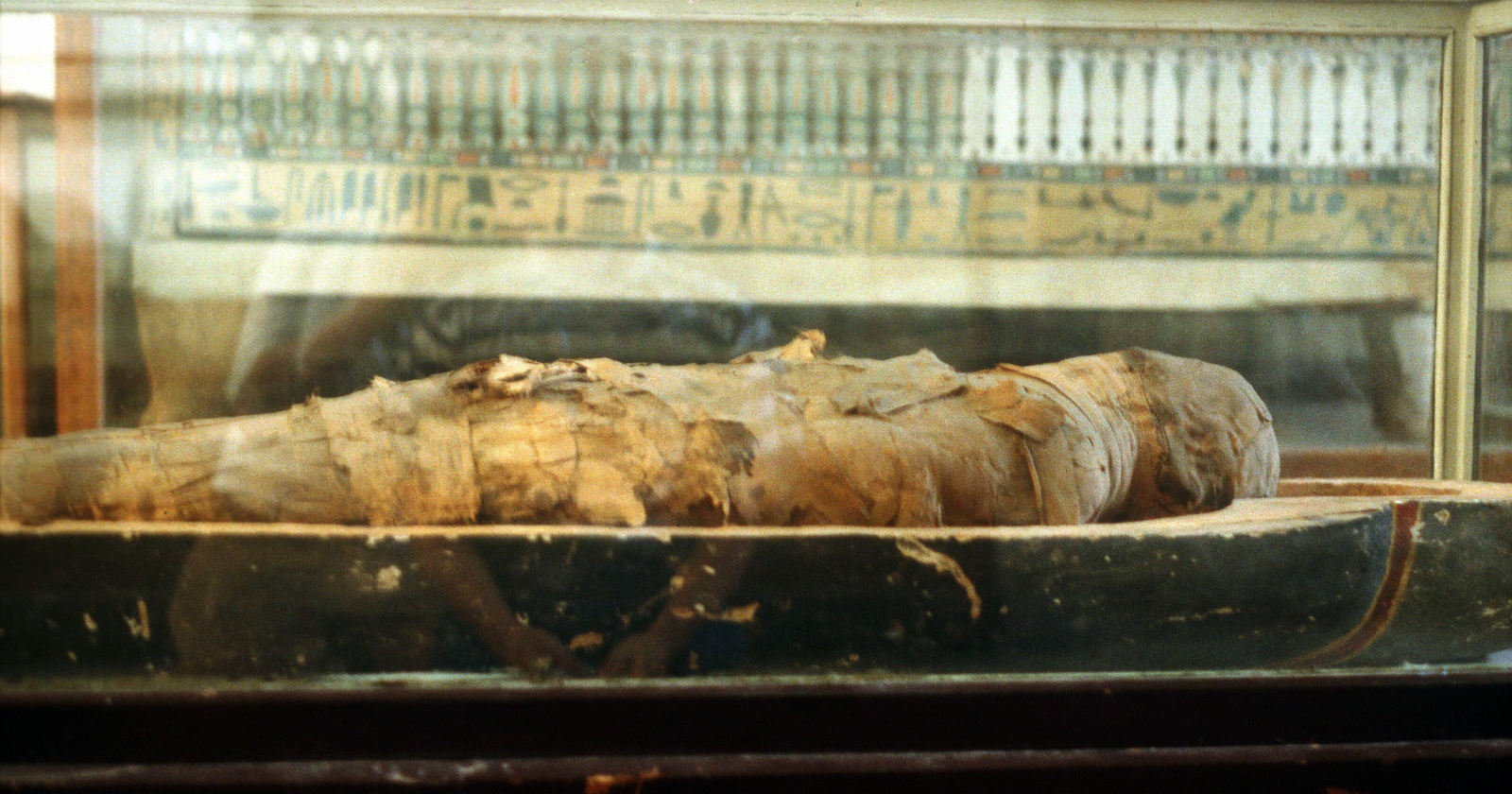
The papyrus was still on the mummy’s abdomen when they found it.
Not folded up next to it. Not preserved beside it in the tomb. Placed deliberately, during embalming, on the front of the body, as part of the specific set of materials wrapped around and packed inside the corpse before the outer bandages went on. Whatever this sheet of writing was doing there, someone had put it there on purpose.
It sat on the mummy for approximately 1,600 years. When the archaeological team from the University of Barcelona lifted it away in late 2025 and began the careful work of reading what was written on it, they discovered something no one had ever seen before in the entire history of Egyptian archaeology: the writing was a passage of Homer’s Iliad.
What the papyrus actually is
The mummy was found in Tomb 65 of an excavation sector called Sector 22, at the ancient city of Oxyrhynchus in central Egypt — a site about 190 kilometres south of Cairo that has been one of the most productive papyrus-yielding locations in the world for over a century.
The discovery was made by a team led by Núria Castellano during the November-December 2025 field campaign. The full identification came during the January-February 2026 follow-up, when the papyrus was carefully studied by conservator Margalida Munar, papyrologist Leah Mascia, and classical philologist Ignasi-Xavier Adiego of the University of Barcelona.
The text they identified is from Book II of the Iliad — specifically, from the section known as the Catalogue of Ships. This is the long, famous passage in which Homer lists the Greek forces that sailed to Troy, naming their commanders, their cities of origin, and the number of ships each contingent brought. It is one of the most-quoted and most-studied sections of the poem, and it has been recognisable to educated Greek speakers for the entire time since the Iliad was composed roughly 3,000 years ago.
By the time the Oxyrhynchus mummy was buried, the Iliad was already ancient. It had been circulating in Greek education for over a thousand years. Every literate person in Roman-era Egypt would have encountered it in school.
Why finding it here is unusual
Papyri turn up in mummies. This is a well-established archaeological pattern. During the Roman period in Egypt — beginning around 30 BCE — embalmers began packing body cavities with a variety of preserved materials, including papyrus. Sometimes these papyri were rolled up and sealed. Sometimes they were pressed together into a papier-mâché-like material called cartonnage, used as a covering for the mummy’s face or torso.
What was written on these papyri, before this discovery, had always been the same broad category of material: magical texts, ritual formulas, or funerary spells. The specific religious content varied, but the general purpose was consistent — the writing was doing spiritual work. It was protecting the deceased. It was helping them navigate the afterlife.
Never before had a literary text — a poem, a play, a piece of secular writing meant for reading rather than religious use — been found in this specific position and role.
Adiego, the University of Barcelona professor who led the identification work, put it plainly in his statement: “Since the late 19th century, a huge number of papyri have been discovered at Oxyrhynchus, including Greek literary texts of great importance, but the real novelty is finding a literary papyrus in a funerary context.”
The specific mystery
The interesting question the discovery raises is why the Iliad was there.
There are two plausible explanations, and archaeologists are actively working on distinguishing between them.
The first is that the embalmers were, essentially, recycling waste. Papyrus was expensive in the ancient world, and old scrolls that had fallen out of use — damaged copies, obsolete records, texts no longer being read — were routinely repurposed. Cartonnage was often made from discarded documents. A worn or damaged copy of the Iliad, if it happened to be available in the embalmer’s workshop, might have been used simply because it was there, with no specific significance attached to the choice.
The second is that someone deliberately placed the Iliad with this specific person. The Roman-era deceased in question was buried in a well-appointed tomb with gold ornamentation and other signs of status. They lived in a Greek-speaking educated culture that revered Homer as the foundational work of literature. If they had been an admirer of the poem — a teacher, a scholar, a lover of Greek verse — it would not be strange for their family or the embalming team to include a copy in the wrappings as a personal gesture.
The two possibilities have very different implications. If the papyrus was recycled waste, the discovery reveals something about Roman-era Egyptian embalming practices. If it was deliberately placed, it reveals something about the personal reading life of a specific individual who died 1,600 years ago in a Greek-speaking Egyptian province.
The Oxyrhynchus team is currently studying both hypotheses. As Mascort and Pons noted in a statement to Smithsonian Magazine: “We are currently studying and proposing various hypotheses.” No definitive answer is likely to emerge quickly.
What the discovery contributes
Even without resolving the question of intent, the finding is significant.
Oxyrhynchus has yielded over 800 fragments of the Iliad since serious excavation of the site began in the late 19th century. These fragments have been essential to the reconstruction and study of the poem as it existed in the Greco-Roman world. But every one of the previous 800-plus fragments came from rubbish dumps, private libraries, or general excavation contexts. None came from inside a mummy.
The new fragment adds a specific piece of evidence to how the Iliad actually moved through the culture of Roman-era Egypt. It was not just a text preserved in schools or on library shelves. It was a physical object that could end up, whether by accident or by intention, wrapped around a specific human body preparing for burial. That fact, in itself, tells us something about how universally present the poem was in the material culture of the period.
The papyrus is now being conserved by the University of Barcelona team. It will probably be published in full over the coming years, and the specific readings on the surviving fragment will be added to the accumulated scholarship on the Iliad’s textual history.
Somewhere in a lab in Barcelona right now, an ancient poem that spent sixteen centuries wrapped around a person is being carefully unrolled, cleaned, and read — for the first time in a very long time.
