

Stellar Chemistry
JUNO begins decade-long mission to probe neutrino mysteries
Neutrinos are the most abundant particles in the cosmos, with trillions streaming through every person each second.

Neutrinos are the most abundant particles in the cosmos, with trillions streaming through every person each second.
Funded through the NSF's Major Research Instrumentation Program, the project will deliver advanced optics, new controllers, and a high-sensitivity tracking detector.

All of this suggests that life might be common on planets that support liquid water, but it might be uncommon to find life that studies the universe and seeks to travel through space, like we do.
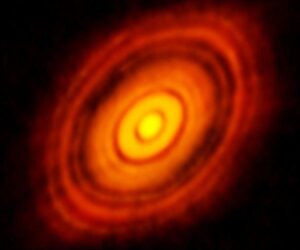
Lead author Jenny Frediani, a PhD student at Stockholm University's Department of Astronomy, said: "Unlike most nearby planet-forming disks, where water vapor dominates the inner regions, this disk is surprisingly rich in carbon dioxide.
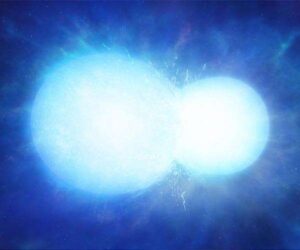
For two decades, it has been known that many massive stars in the Milky Way are part of binary systems.

Yet these are but a sample of the sounds that come from the coast. Most of the acoustic energy from the surf is far too low in frequency for us to hear, traveling through the air as infrasound and through the ground as seismic waves.

"Unlike most nearby planet-forming disks, where water vapor dominates the inner regions, this disk is surprisingly rich in carbon dioxide," said lead author Jenny Frediani, a PhD student at the Department of Astronomy.
The team, led by University of Arizona astronomer Laird Close and Richelle van Capelleveen, an astronomy graduate student at Leiden Observatory in the…

The research team, using the Atacama Large Millimetre/submillimetre Array (ALMA) as part of the exoALMA programme, discovered that many discs tilt by just half a degree to two degrees.

Lead researcher Dr Mikako Matsuura of Cardiff University said: "For years, scientists have debated how cosmic dust forms in space.

The annual awards honor innovation with practical impact across global industries.
The sPHENIX detector is the newest experiment at Brookhaven National Laboratory's Relativistic Heavy Ion Collider (RHIC) and is designed to precisely measure products of high-speed particle collisions.
The study, published in Applied Physics Letters and selected as a "Featured" article, addresses a major obstacle: many superconductors, including transition…
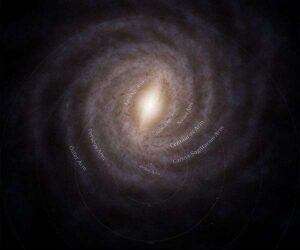
Launched in 2013 and operating until early 2025, Gaia has already transformed astronomy by charting the positions, motions, and brightness of billions of stars with unprecedented accuracy.
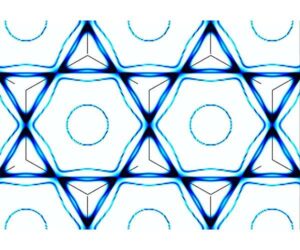
Quantum materials, which underpin next-generation computing and superconductivity, are defined by microscopic behaviors of electrons and atoms.

But because these types of exoplanets tend to be much closer to their host star than Earth is to the Sun, sub-Neptunes are too hot to have liquid water on their surface and support life.