

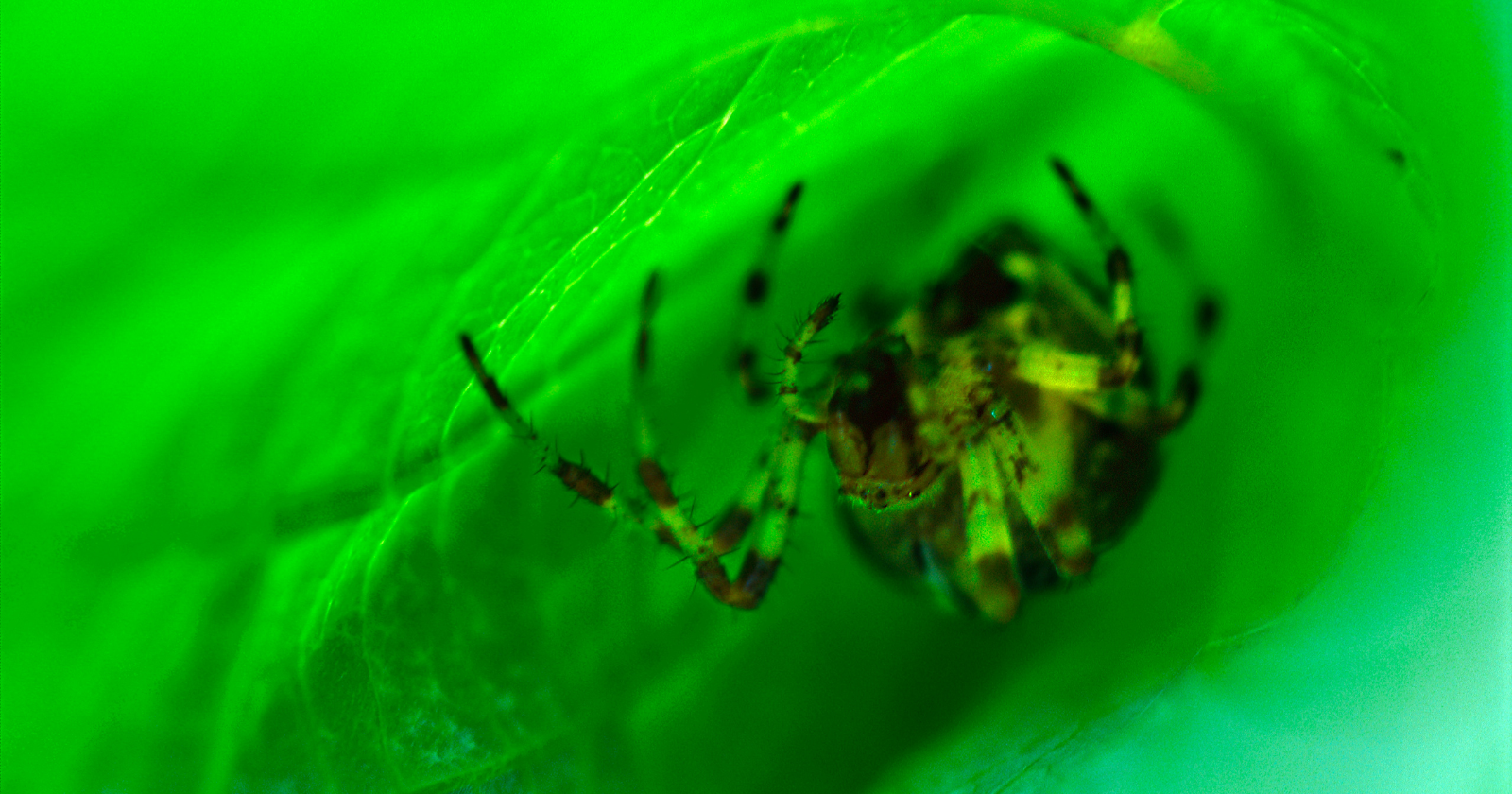
There is a difference between looking like something dangerous and looking like something diseased. Predators avoid venomous prey as a learned or instinctive calculation about harm. But they avoid diseased animals for a different reason — not because of what the disease might do to them directly, but because everything in a healthy animal’s behavioral repertoire tells it to stay away from infection. The disgust response, the avoidance of animals that move strangely or look wrong, the tendency to leave well alone anything that signals pathology: these are among the most deeply conserved behavioral patterns in vertebrates.
Taczanowskia waska, described in Zootaxa in February 2026, appears to have found its way into that response. The spider, newly named from the Ecuadorian Amazon, looks and acts like a spider killed and consumed by a parasitic fungus. It does not mimic a predator, a toxic species, or a piece of the background. It mimics a corpse — or more precisely, the fungal growth that produces one. And it did this without anyone in science noticing for long enough that the species went formally undescribed until now.
The model and the disguise
The fungal genus Gibellula (family Cordycipitaceae, the same family as Cordyceps) specializes in killing spiders. After infecting a host, it grows pale, elongated fruiting bodies outward from the carcass, typically on the underside of a leaf. The dead spider disappears into the fungal structure; what remains looks less like an animal than like a small, irregular growth on the leaf surface.
This is what Taczanowskia waska resembles. The spider has pale coloration and elongated abdominal projections that reproduce the texture and shape of Gibellula fruiting bodies. Members of its genus are known to remain stationary on leaf undersides — the same microhabitat where Gibellula-killed spiders are found — and the authors suggest T. waska does the same.
During a nighttime field survey in the Llanganates-Sangay Connectivity Corridor, researchers initially classified it as a mushroom. The identification as a spider came only after photographs posted to the citizen science platform iNaturalist were reexamined by community members who looked more carefully.
Why it worked so well, and for so long
Mimicry research has catalogued an impressive range of deception strategies, but they have historically shared a common structure: the mimic resembles something the observer has a reason to avoid or engage with in a modified way. Toxic prey, aggressive predators, rewarding flowers, receptive mates. The deceived party is evaluating a signal that fits within an expected category.
Pathogen mimicry sits outside those categories. A dead, fungus-consumed spider is not dangerous. It is not toxic in any meaningful sense. The signal it sends is not “do not eat me” but something more primitive: “do not touch, do not go near, do not investigate.” The appropriate response to what looks like an active fungal infection is avoidance without examination — which is precisely the condition under which a disguise never gets scrutinized closely enough to fail.
It is worth asking whether the rarity partly reflects the disguise. The researchers who described it note that the genus Taczanowskia is genuinely rare and seldom encountered in the field. But it is worth asking whether the rarity partly reflects the disguise: an animal that reliably discourages investigation, by humans as much as predators, is one that accumulates few records. The gap between the spider existing and the spider being recognized may not have been purely a matter of survey effort.
Disease as a category of signal
The paper’s authors describe this as the first documented case of arachnid mimicry of an araneopathogenic fungus and, more broadly, the first recognized instance of an animal mimicking a pathogen organism rather than another animal or plant.
Biologists have been studying mimicry systematically since Henry Walter Bates described Amazonian butterfly mimics in 1862, and in that time, the field has developed a sophisticated taxonomy of deception strategies — Batesian mimicry, Müllerian mimicry, aggressive mimicry, automimicry, masquerade. Disease mimicry has not appeared on that list before.
The reason may be the same one that allowed Taczanowskia waska to go unnoticed. If you are a researcher looking for mimicry, you look for things that resemble other things in legible ways — a harmless species that looks like a venomous one, a predator that looks like a flower. A spider that looks like a sick spider does not trigger the pattern-recognition that produces a research question. It triggers something closer to the response the spider has evolved to produce: mild aversion and a tendency to move on.
What citizen science surfaces
The route by which Taczanowskia waska was formally described illuminates something about how biodiversity data accumulates now. A photograph posted to iNaturalist by someone who thought they were documenting a fungus was reviewed by community members who recognized it as an animal, and that recognition eventually reached taxonomists with access to comparative collections — including Nadine Dupérré at the Museum of Nature Hamburg, who examined reference specimens from across the genus Taczanowskia to confirm the species was new.
That chain would not have produced a description in an earlier era of taxonomy. The photograph would have remained personal documentation, or not been taken at all. What citizen science does, in cases like this, is create a searchable archive of visual evidence wide enough to catch things that professional survey effort misses — including things that, by design, do not want to be found.
Final words
The existence of Taczanowskia waska raises a question that existing literature cannot yet answer: how common is disease mimicry, and how long has it been in plain sight? The evolutionary pressure is real, and the evolutionary pressure to exploit the disgust and avoidance responses of predators is real.
Whether other species have arrived at the same strategy independently — in other taxa, in other ecosystems, mimicking other pathogens — is now a question that can be asked, where before it was not.