

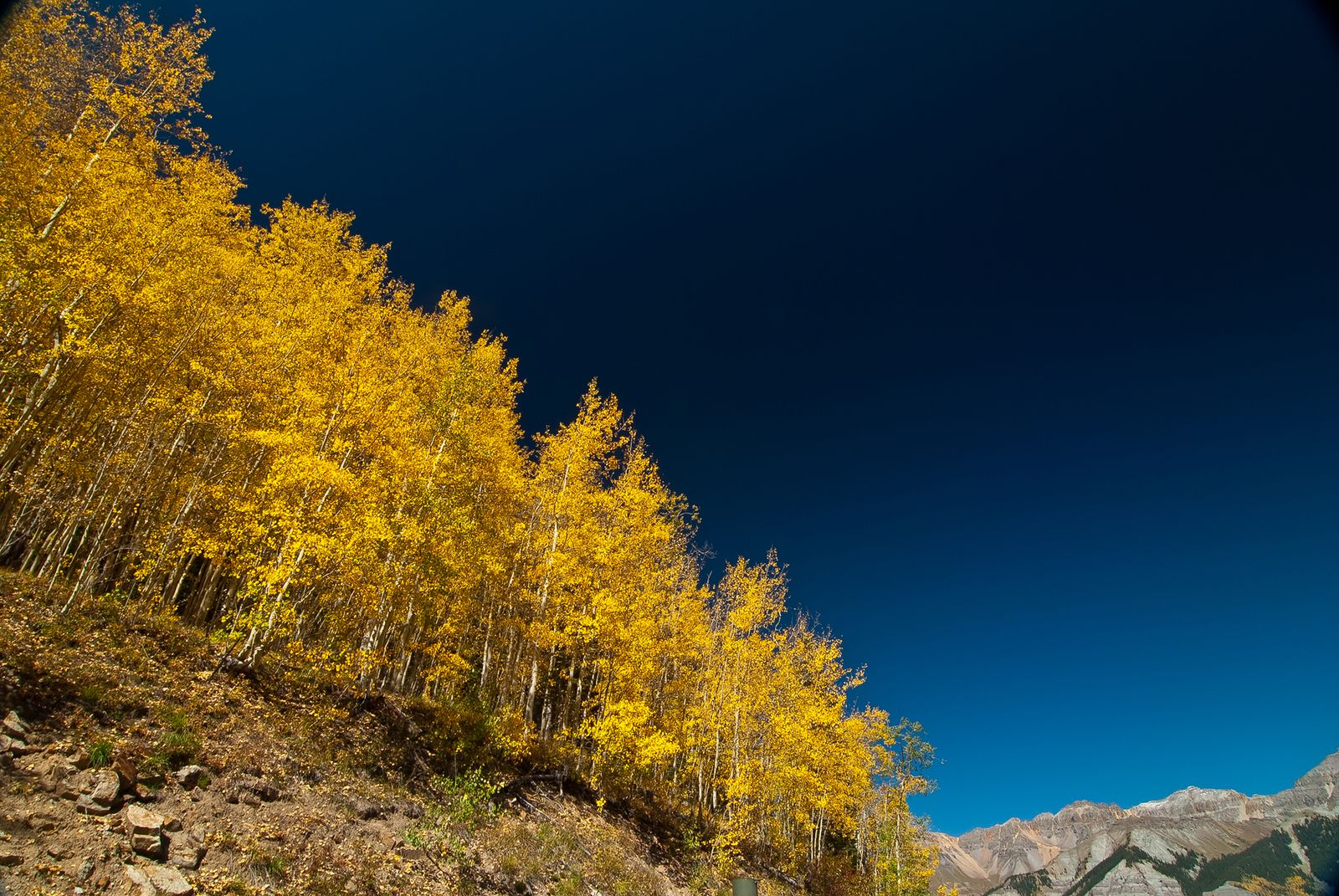
On a ridge above Fish Lake in south-central Utah, Pando looks like a forest until you learn where the organism really is. The grove covers 106 acres. It contains roughly 47,000 genetically identical quaking aspen stems. Together, the stems and roots weigh about 13 million pounds, making Pando one of the heaviest known living organisms on land, according to NASA Earth Observatory.
The trunks are not the old part. The roots are.
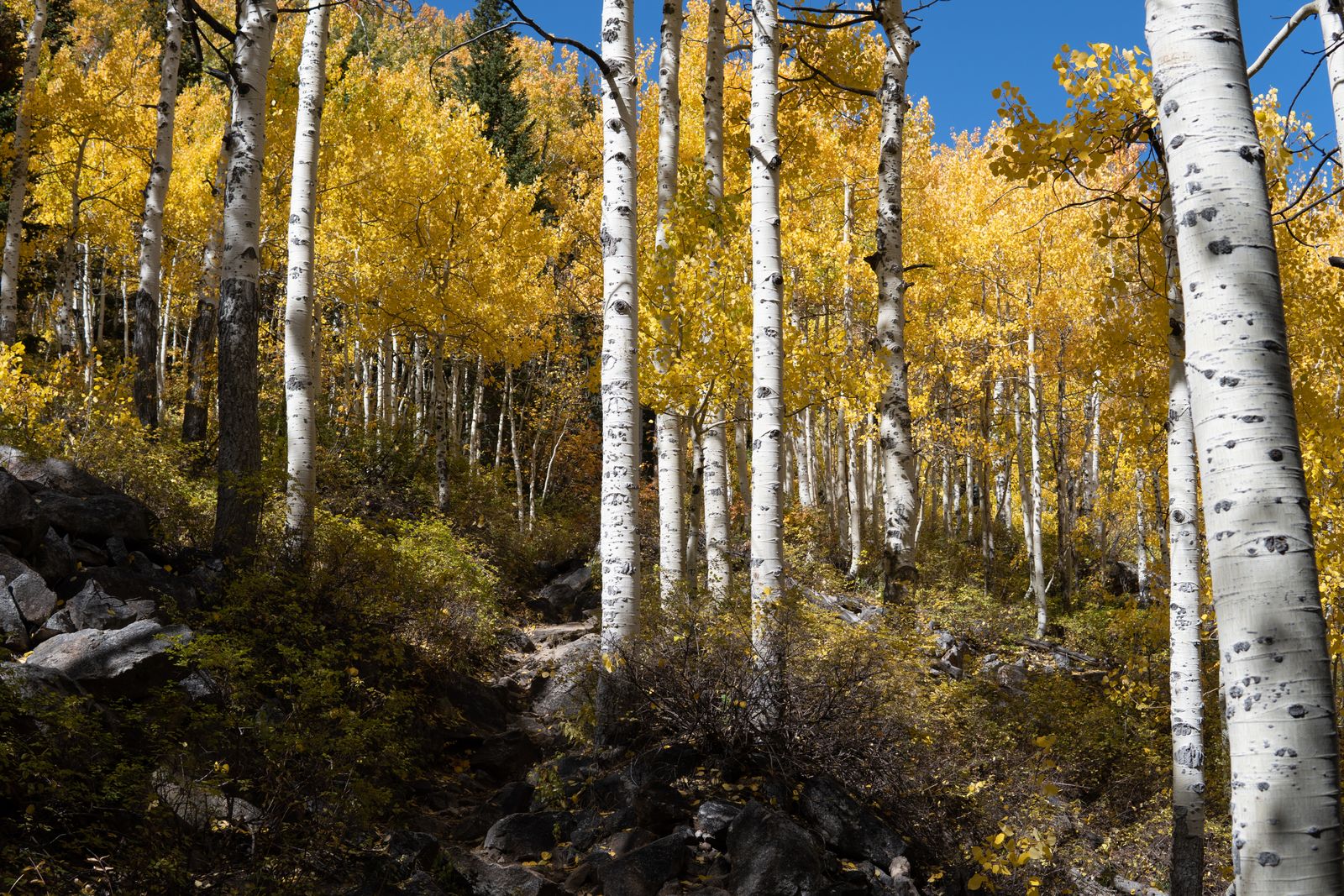
Pando is a male clone of quaking aspen, Populus tremuloides, growing in the Fishlake National Forest. Its name comes from Latin and is usually translated as “I spread,” a fitting name for a plant that has turned one seed into a grove by sending new shoots up from a shared root system.
NASA calls it a “forest of one”. From orbit, its leaves appear as a patch of yellow near State Route 25 west of Fish Lake, but on the ground that patch is a single genetic individual, renewed again and again by roots hidden under the soil.
One plant, thousands of trunks
Botanists call Pando a clonal colony. Each visible “tree” is a ramet, a shoot rising from a larger genet, the genetic individual that produced it. In ordinary speech, Pando looks like tens of thousands of trees. In biological terms, it is one organism with tens of thousands of stems.
The U.S. Forest Service describes quaking aspen as a species that often reproduces by root sprouting, and the agency identifies Pando as a major destination in the Fishlake National Forest. A mature aspen root system can send up suckers, and those suckers can mature into stems that appear separate above ground while remaining connected below it.
That is Pando’s trick at enormous scale. The clone spans about 43 hectares, or 106 acres, and genetic work has confirmed that its stems are part of the same male clone. The visible forest is a repeated expression of the same underground plant.
Individual Pando stems are not ancient. They commonly live about a century, sometimes a little longer, before dying back. The colony persists because the root system replaces them.
How old Pando really is
The age of Pando is difficult to pin down because no single trunk carries the whole history. You cannot core one stem, count rings, and get the age of the organism. The stems turn over. The root system is the archive, and it has not been mapped in full.
The most cautious way to describe Pando’s age is that it is thousands of years old, perhaps as much as about 14,000 years. NASA says the precise age of Pando’s root system is difficult to determine, but scientists think the seed that started it may have sprouted as long as 14,000 years ago, as ice retreated from the Fish Lake Valley.
That still makes the fact almost hard to hold in mind. If the highest commonly cited estimate is close, Pando began after ice retreated from the Fish Lake region and kept sending up stems through the rise of agriculture, the first cities, written language, empires, roads, satellites, and the highway that now cuts near its body.
The uncertainty matters. Some popular accounts have repeated much older figures, but those claims are less secure. For publication, the clean phrasing is “perhaps as much as 14,000 years old,” not a flat statement that Pando has definitely been alive for exactly 14,000 years.
The size of the thing
Pando sits in the Fishlake National Forest, about 200 miles south of Salt Lake City, where high country drops toward drier Utah terrain. NASA gives its footprint as 106 acres, roughly the size of 80 American football fields, and its weight as 13 million pounds.
That mass is not the weight of one trunk. It is the estimated combined biomass of the stems and the root system, the living architecture that keeps replacing the grove above it.
A mature Pando stem can look ordinary by forest standards. What makes it extraordinary is not height but continuity. Walk across the grove and you are not moving from tree to tree in the usual sense. You are crossing the body of one male aspen clone.
Pando is often described as the largest known organism by mass. That claim depends on how organisms are defined and compared, because fungal networks and marine clonal colonies can cover enormous areas. But among documented land organisms, Pando remains one of the clearest and heaviest examples of a single clone made visible as a forest.
How a single plant keeps replacing itself
Quaking aspen can reproduce by seed, but Pando’s long survival depends on vegetative reproduction. When an older stem dies, the root system can push up another. When disturbance opens light, the roots can respond with new suckers.
Fire, cutting, and canopy gaps can stimulate aspen regeneration when browsing pressure is low enough for young stems to survive. That is why the hidden part matters more than the picturesque part. Pando’s future depends less on the old white trunks than on whether new shoots can grow above the reach of animals.
The leaves give the species its common name. Quaking aspen leaves hang from flattened petioles that catch small movements of air, making the canopy tremble and shimmer even in a light breeze.
That trembling canopy is temporary. The roots are the continuity. They store carbohydrates, respond to disturbance, and send up the next generation of stems.
The slow eating
Pando’s main problem now is not that the roots are dead. It is that the young shoots are being eaten before they can become the next forest.
Ecologists Paul C. Rogers and Darren J. McAvoy reported in a 2018 PLOS ONE study that Pando’s recovery was being impeded by mule deer browsing, with cattle also part of the pressure. The study found that successful regeneration depended heavily on whether young shoots were protected from browsing.
The pattern is visible in the understory. Where young suckers should be rising into saplings, many are cropped low. The old canopy remains, but the age structure underneath is hollow.
NASA Earth Observatory summarized the problem through ecologist Paul Rogers: Pando is like a village full of old people with very few children growing up to replace them. That is the demographic issue. A clone can live for millennia only if its newest shoots survive long enough to become stems.
The fences show what is still possible
The strongest evidence that Pando can still regenerate comes from fenced areas. Inside protected sections, young aspen have grown far more successfully. Outside or inside fences that animals can penetrate, recruitment has continued to fail.
The 2018 PLOS ONE study found that fencing combined with active or passive treatments produced the strongest regeneration, while unprotected areas and areas with penetrable fencing remained vulnerable to herbivory. The root system still has the capacity to respond. The variable is whether animals can keep eating the response.
Managers have tried fencing, cutting, burning, shrub removal, and other treatments. None of those tools is magic on its own. Without reducing browsing pressure, new shoots can appear and vanish in the same season.
Pando also faces older-stem disease, drought stress, changing snow patterns, and the broader instability of a warming climate. Those pressures matter, but the immediate bottleneck is simpler and more visible: the next generation keeps being bitten off.
Walk the grove in summer and the leaves still flicker on their flattened stalks. The bark is still pale, marked by dark scars where old branches once grew. Wind through the canopy still sounds like rain on a roof. Under that sound, the roots are still pushing upward, trying to turn one organism into a forest again before the deer take the new stems back down to grass height.