

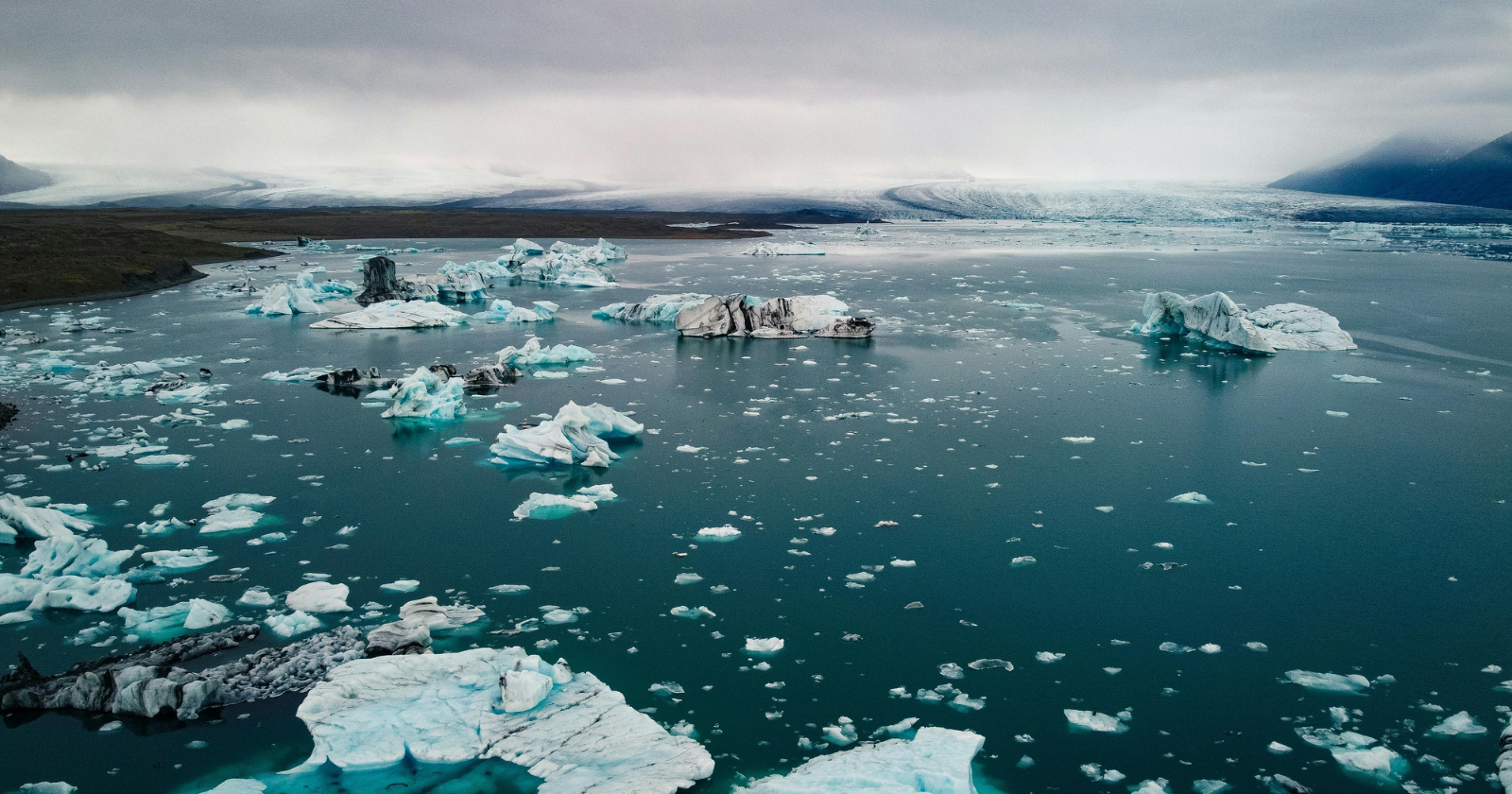
The Arctic Ocean has had ice on it, in some form, for essentially the entire span of recognisably modern human existence. The most recent interglacial period warm enough to have melted the summer ice cap was the Eemian, approximately 130,000 to 115,000 years ago, during which paleoclimate evidence suggests the Arctic was seasonally ice-free at its summer minimum — most clearly during the warmest phase around 130,000 years ago, with conditions gradually cooling toward the end of the period around 115,000 years ago, when the Arctic returned to continuous year-round ice cover. The Eemian ended before any sustained migration of anatomically modern humans out of Africa, before the development of agriculture, before recognisable language families had differentiated, before the construction of the first permanent settlements, and before essentially every aspect of human society that the present civilisation rests on. For approximately the past 115,000 years — through the entire emergence of modern civilisation — the Arctic has carried summer ice. That period is now ending. By the most recent peer-reviewed projections, the first single year in which the Arctic Ocean drops below the technical threshold for “ice-free” status — defined as less than 1 million square kilometres of sea ice, compared to the historical summer minimum of approximately 5 to 7 million square kilometres — is likely to occur sometime in the 2030s.
According to a 2023 study in Nature Communications by Seung-Ki Min and colleagues at Pohang University and the University of Hamburg, the projected date of the first ice-free Arctic September is now substantially earlier than the IPCC’s 2021 Sixth Assessment Report had concluded. The 2021 IPCC report had projected ice-free conditions “near mid-century” under intermediate and high emissions scenarios, with substantial uncertainty under low-emissions scenarios. Min and colleagues reanalysed the underlying climate models using observational constraints — adjusting the model projections to match the actual rate of Arctic sea ice decline measured by satellites over the past four decades — and concluded that the first ice-free September will likely occur in the 2030s under all emissions scenarios, including the most ambitious low-emissions trajectory. In the words of Dirk Notz, one of the study’s authors and a contributor to the IPCC reports: “We basically are saying that it has become too late to save the Arctic summer sea ice.”
What “ice-free” actually means
The technical definition of “ice-free” in this context is not the literal absence of all sea ice. As reported by a 2024 synthesis review of ice-free Arctic projections in Nature Reviews Earth & Environment, the threshold researchers use is sea ice area below 1 million square kilometres — substantially less than the approximately 4 to 7 million square kilometres that has been the typical late-summer minimum over the past several decades, but not literally zero. Some ice will continue to form along the northern coast of Greenland and within the Canadian Arctic Archipelago even after the central Arctic Ocean has lost its summer cover. The threshold is set at the level below which the central Arctic basin would be effectively open ocean during the September minimum — navigable, exposed to sunlight rather than reflecting it back, and fundamentally different in its physical, ecological, and atmospheric behaviour than the ice-covered Arctic that has characterised the Earth for approximately the last 115,000 years.
The first ice-free year is unlikely to be permanent. Winter ice will continue to form for some additional decades after the first ice-free summer, and there will be year-to-year variability in summer ice extent. But once the threshold has been crossed, it will be crossed with increasing frequency, and the long-term direction of travel is clear: the Arctic is heading toward a configuration in which late summer is reliably open water, with all of the consequences that flow from that change. A more recent 2024 paper in *Nature Communications* by Heuzé and colleagues projects that the first single ice-free day in the Arctic could occur even earlier than the first ice-free month — potentially before 2030, depending on whether an extreme weather year produces a sufficiently sharp summer melt.
Why the loss matters beyond the Arctic itself
The Arctic Ocean is not a self-contained system. The presence of summer ice across its surface is one of the major regulators of the global climate, and its loss will produce consequences across the planet. The most direct mechanism is the albedo effect: sea ice reflects approximately 80 percent of incoming sunlight back to space, while open ocean absorbs approximately 90 percent of it. Replacing ice with water at the top of the planet means substantially more solar energy is being absorbed into the Arctic Ocean, which then transfers that heat to the surrounding atmosphere, accelerates the warming of the broader Arctic region (which is already warming approximately four times faster than the global average), and propagates the change southward through atmospheric and oceanic circulation patterns.
Per a 2023 analysis in The Conversation of the implications of an ice-free Arctic, the downstream effects include disruption of mid-latitude weather patterns through changes to the polar jet stream (which is increasingly destabilised by the diminishing temperature gradient between the Arctic and lower latitudes); accelerated melting of the Greenland ice sheet (which contributes directly to sea-level rise, unlike sea ice itself); progressive thaw of Arctic permafrost (which releases methane and carbon dioxide stored in frozen organic matter, creating a self-reinforcing warming loop); collapse of Arctic ecosystems built around the seasonal sea ice cycle (including polar bears, ringed seals, walruses, ivory gulls, and the entire food web that depends on ice algae); and substantial disruption to the lives of the approximately 4 million people who live in the Arctic regions of the eight Arctic Council countries — including roughly 400,000 Indigenous people from more than 40 distinct ethnic groups, whose traditional food, transport, and cultural systems are particularly closely tied to a reliably frozen sea.
The geopolitical and economic dimensions
An ice-free Arctic will, simultaneously, open commercial shipping routes that have been closed for the entirety of recorded history. The Northern Sea Route along the Russian Arctic coast, the Northwest Passage through Canadian waters, and a potential central Transpolar route across the open polar ocean will all become reliably navigable during summer months. Container ships travelling from Northeast Asia to Northern Europe will be able to save approximately 40 percent of the distance compared to the traditional Suez Canal route. Energy resources currently inaccessible beneath the Arctic seafloor — estimated at approximately 13 percent of the world’s undiscovered oil and 30 percent of its undiscovered natural gas — will become commercially extractable. Russia, the United States, Canada, Norway, Denmark (via Greenland), and increasingly China (which has declared itself a “near-Arctic state”) are now actively positioning themselves for the strategic competition that an open Arctic Ocean will produce.
The threshold itself, when it is crossed sometime in the next 15 years, will not look dramatic from any vantage point available to most people. It will appear as a satellite image showing slightly less ice than the previous year. It will be reported as a single statistical metric falling below a defined value. The lived experience of most humans alive on the planet at the time will be substantially unchanged on the day of the threshold crossing. But the underlying transition is one of the larger physical changes to the planet that any modern human society has lived through — a return, after approximately 115,000 years, to a configuration of the polar regions that predates the entire arc of recognisably modern human civilisation. The species will, within the lifetimes of most people reading this, become the first generation to witness an Arctic Ocean without its summer ice. The change will not be reversible on any timescale relevant to human institutions. The question is no longer whether it happens but precisely when, and how rapidly the societies that depend on the old configuration adapt to the new one.