

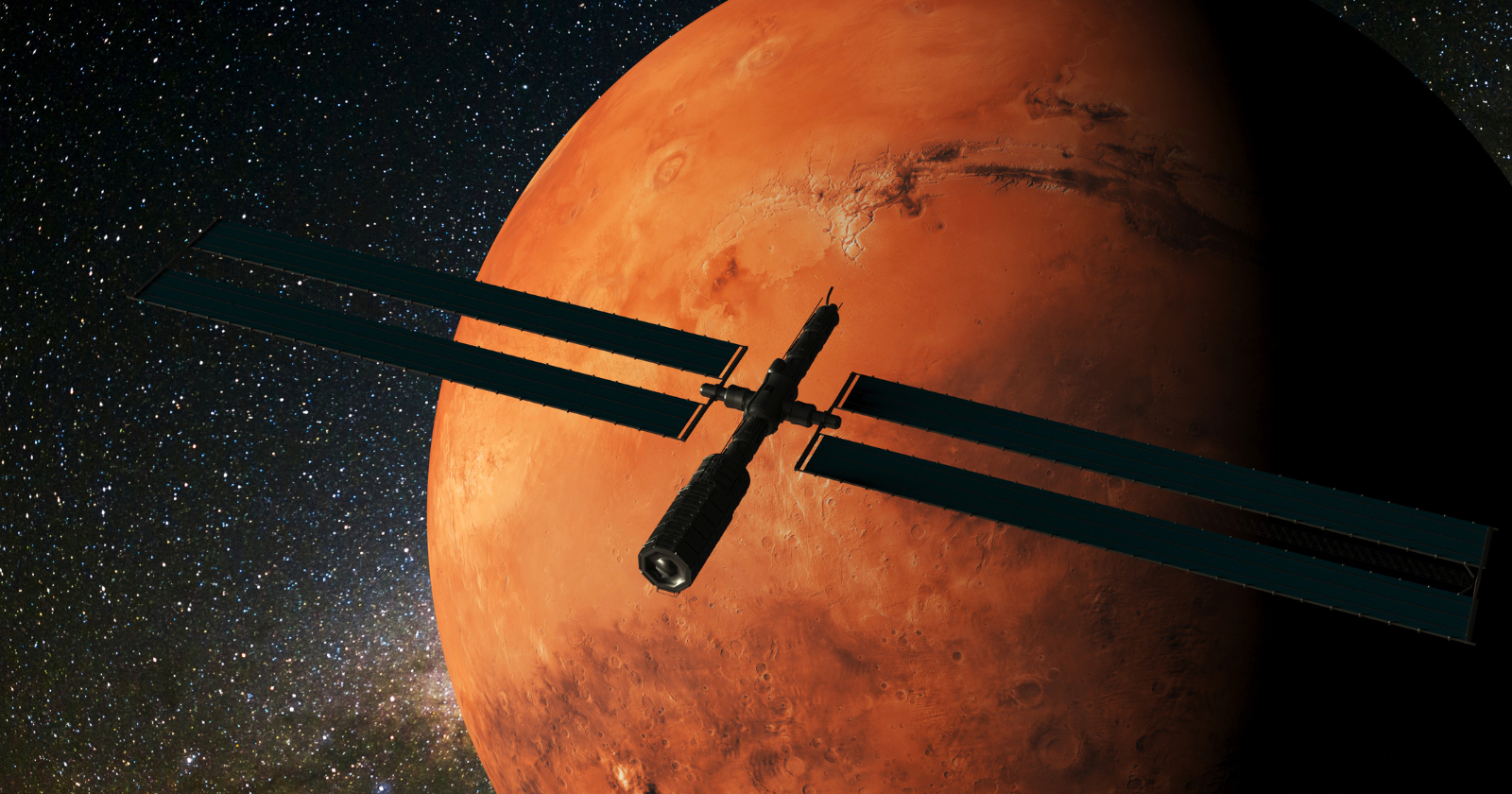
Relativity Space has reached orbit exactly zero times. Its only rocket flew once, in March 2023, climbed cleanly through the hardest part of the atmosphere, and then a second-stage engine quit and the vehicle fell into the Atlantic a few minutes after liftoff. On June 17, 2026, that same company announced it would build and fly a science orbiter to Mars in 2028 anyway.
The mission is the first under a newly created Interplanetary Sciences Program, run under CEO Eric Schmidt. It would carry a NASA instrument suite, double as a communications relay for whatever is operating on the Martian surface, and be paid for not by the agency but by a philanthropic backer Relativity has declined to name.

The rocket that flew once
Relativity flew its 3D-printed Terran 1 a single time, on March 23, 2023. The rocket passed max-q, the point of peak aerodynamic stress, then lost its upper stage and never made orbit. A month later the company retired the small launcher to concentrate on the larger, reusable Terran R.
Terran R is a medium-class rocket roughly in the Falcon 9 weight class, with a first flight Relativity has slated for late 2026 from Cape Canaveral. Industry sources expect that to slip to 2027, a delay consistent with the development pace of nearly every new orbital-class launcher of the past decade.
The Mars orbiter would be Terran R’s interplanetary debut. If the rocket flies close to schedule, the 2028 transfer window to Mars is reachable. If it slips, the mission slips with it. There is no version of this where the orbiter beats the rocket to the pad.
What the orbiter would carry
The science payload comes from NASA’s Ames Research Center, which will design, build, and integrate it. The centerpiece is an atmospheric suite NASA calls Aeolus — four instruments meant to deliver the first integrated, daily, global picture of Martian winds, temperatures, dust, and clouds. A radar instrument would map subsurface ice and geology, the kind of water-resource data future crewed missions would lean on.
NASA says it will operate the instruments for at least one Martian year and build the pipeline that turns raw readings into usable science, under what it describes as its first six-year reimbursable Space Act Agreement. Relativity builds, owns, and flies the spacecraft; NASA supplies the instruments and the data processing.
Then there is the relay. The orbiter is being pitched to carry high-bandwidth laser and radio links back to Earth plus radio communications with surface assets. That matters because NASA’s working Mars relay fleet — the Mars Reconnaissance Orbiter, MAVEN, and Odyssey — is aging, with no committed replacement for the data backhaul every Mars rover depends on. A privately built relay arriving in the late 2020s would fill a hole the agency has openly worried about.
Relativity has said all of the mission’s scientific data will be released publicly. The control questions are harder. Who sets the relay schedule when multiple surface assets compete for the same downlink? What happens to a publicly funded rover if a privately owned orbiter becomes the only way to hear from it? Those answers are not in the announcement.
The Schmidt factor
The mission is inseparable from Eric Schmidt. The former Google chief executive took a controlling stake and became CEO of a cash-strained Relativity in March 2025, succeeding co-founder Tim Ellis. He arrived with money and with a network of science philanthropists.
Schmidt has framed the company’s goal as making access to space routine and pushing science beyond Earth, describing the Interplanetary Sciences Program as a step built on the Terran R platform. The orbiter is meant as a proof of concept; Relativity has not detailed the missions that would follow.
It is also not the only Schmidt-adjacent payload on Terran R’s manifest. Schmidt Sciences, the philanthropic vehicle Schmidt founded with his wife Wendy, announced in January 2026 the Eric and Wendy Schmidt Observatory System. That suite includes Lazuli, a space telescope with a primary mirror larger than Hubble’s, also targeting a launch as soon as 2028 on Terran R.
Two flagship science missions, one unflown rocket, one fortune behind much of both. Whether Schmidt Sciences is the Mars orbiter’s specific backer is unconfirmed; the company will only say the funder is philanthropic.
A privately funded mission to Mars
Privately backed science is not new in itself. The Breakthrough Initiatives funded ground-based SETI work. Jared Isaacman — now NASA’s administrator — bankrolled human spaceflight before taking the job. What is new in the Relativity model is the scale of capital a Mars orbiter requires, the presence of NASA instruments aboard a privately owned spacecraft, and the folding of commercial communications into what has historically been sovereign infrastructure.
This is also not Relativity’s first private Mars plan. In 2022 the company and Impulse Space announced a Mars lander to fly on Terran R, originally targeting the 2024 window; a 2023 update pushed it to as soon as 2026, and neither company has said much about it since.
The 2028 window is getting crowded regardless. SpaceX continues to pitch Starship cargo flights to Mars in roughly the same period, without firm payload commitments. More privately developed hardware may be pointed at the planet in 2028 than at any prior window. Whether all of it actually flies is a separate question, and Mars schedules are famously elastic.
The credibility test
Relativity’s announcement lands at an awkward point in its own story. It still has to prove Terran R can reach orbit. It has to prove the rocket can be reused on a useful cadence. And it has to show a launch company can build, integrate, and operate a deep-space science platform — a different engineering discipline entirely.
Plenty of launch startups have promised spacecraft alongside their rockets; few delivered both. The ones that came closest — SpaceX with Dragon, Rocket Lab with its Photon bus — got there through years of incremental flight experience Relativity does not yet have. The Mars orbiter would compress that curve dramatically, or expose how steep it still is.
The schedule offers no slack. If the program slips by a single Mars window, 26 months, the orbiter becomes a 2030 or 2031 mission, and the case for it shifts with it.
For now the orbiter is instrument designs at Ames, tank hardware in a Long Beach factory, and a 2028 launch window that, like every Mars window, opens and closes on the planet’s schedule rather than anyone’s. The rocket meant to carry it has still never left the pad. Both have to work, roughly two years apart, and Mars does not hold the window open.