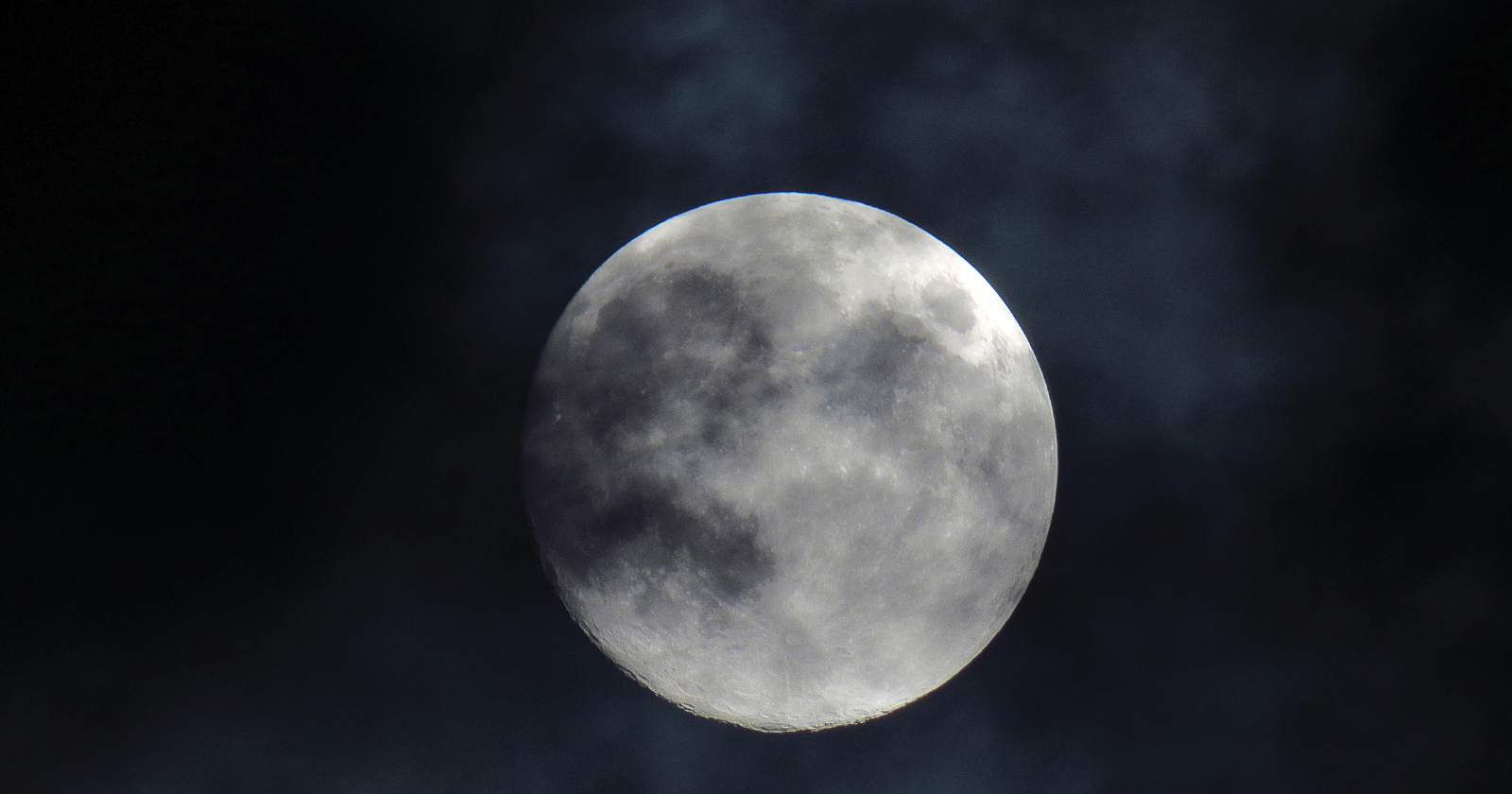
There is a particular kind of sentence that means nothing the first time you read it, and then, years later, on an ordinary afternoon, means almost everything. I came across this one online, buried in a thread I have long since lost, with no name attached: “Maybe the moon is only beautiful because it is so far away.” The first time, you nod and scroll past. The second time, usually just after you have finally got close to something you spent years wanting, it stops you where you stand.
Because it might be true. And if it is true of the moon, it is quietly true of a great many other things you have arranged your whole life around.
What the astronauts actually found
The poets handed us a dependable moon. Silver, serene, faintly sad, hung up there to be longed at from a safe distance. Then a dozen men got close enough to put their boots in it, and the reports that came back read rather differently.
The moon up close is grey. Not romantic grey. The grey of a car park in February. The dust gets into everything, clings to the suits, jams the seals, and on the first mission the spray kicked up by the departing lander cooked one of the experiments NASA had just finished setting down. And it has a smell. Nearly every astronaut who tracked it back into the cabin and lifted his helmet described the same thing, more or less: spent gunpowder, or fireplace ash with a little water thrown over it.
Buzz Aldrin, standing in the middle of all that, called the scene “magnificent desolation.” Hold onto that pairing, because everything after this depends on it.
The thing I wanted from four thousand miles away
For a long stretch of my thirties I ran restaurants in London, and the moon I personally longed at was somewhere warm and slow and far. I never pinned it down precisely. A blurry version of it showed up in my head during every wet February stocktake. Somewhere I could move at half speed. Somewhere the year did not have a grey lid bolted over it for five straight months. Somewhere I was not the man solving a broken walk-in fridge at one in the morning.
When I sold the business, I moved to Bangkok, which was about as far as the fantasy could physically stretch.
And the fantasy did not survive the landing. Real Bangkok has traffic that can visibly age you. It has heat that is a daily negotiation rather than a holiday. It has visa runs, paperwork, and the exact universal tedium of a wet Tuesday, which it turns out is manufactured at every latitude on Earth. The slow golden somewhere had been, like the moon, mostly a trick of distance.
Why distance flatters
Distance does something very specific, and it is not magic. It deletes detail. And detail is precisely where disappointment keeps its address.
From far enough away, the moon is a smooth disc. Up close it is dust and dead craters. From far enough away, the city you are dreaming of is a feeling. Up close it is a queue at an immigration counter. Longing works by sanding off everything inconvenient until only the glow remains, and then we fall for the glow and call it the thing itself.
You can catch this happening in plain sight. The fat orange moon that stops people on the pavement, sitting low on the horizon, owes most of its drama to the air it is shining through. The light cuts a longer, shallower slant across the atmosphere, the blue gets scattered out of it, and you are left holding the warm colour. It looks enormous too, though it is no bigger than the small pale one overhead. That is your own eye misjudging it against the rooftops. The part of that moon you find beautiful is, to a real degree, the distance and the air. The stuff between you and it is doing the work, and the moon gets the credit.
Magnificent desolation
Now back to Aldrin’s two words, because they are the actual answer.
He got nearer to it than almost anyone in history. The silver coin of the poems vanished the instant his boots came down, swapped for a dead grey field that smelled of struck matches. He did not call it disappointing. He called it magnificent. A different magnificent. Not the flattering sort that distance gives you for nothing, but the harder, stranger sort you only earn by standing in the real place, in the real dust, looking at a horizon that has not shifted in a billion years.
That is the half the aphorism leaves out, and it is the half worth keeping. Some things really are only beautiful far away, and the wise move is to leave them out there and stop trying to land. But some things trade their easy beauty for a sturdier one the moment you arrive.
Bangkok did that for me. I lost the golden fantasy and got the actual city, dust and admin and disappointing Tuesdays and all, and I would not trade back. The version I longed at was prettier. The version I live in is mine. Only one of those was ever worth getting close to.
The moon is leaving anyway
The astronomers will give you one last detail, almost as a footnote. The moon is drifting away from us, by close to four centimetres every year. Slowly, permanently, the gap is widening.
Which means, by the cold logic of that sentence, it is growing more beautiful all the time. Lovelier in exact proportion to how far it slips beyond our reach. Depending on the afternoon, that is either the most romantic fact in the sky or a very quiet warning.
I take it as the warning. The silver moon hanging perfect and far will go on being perfect precisely because no one I know will ever have to stand in it. The grey one, the one that ruins equipment and smells of gunpowder and lets you down on close inspection, is the only one anybody ever actually got to love.