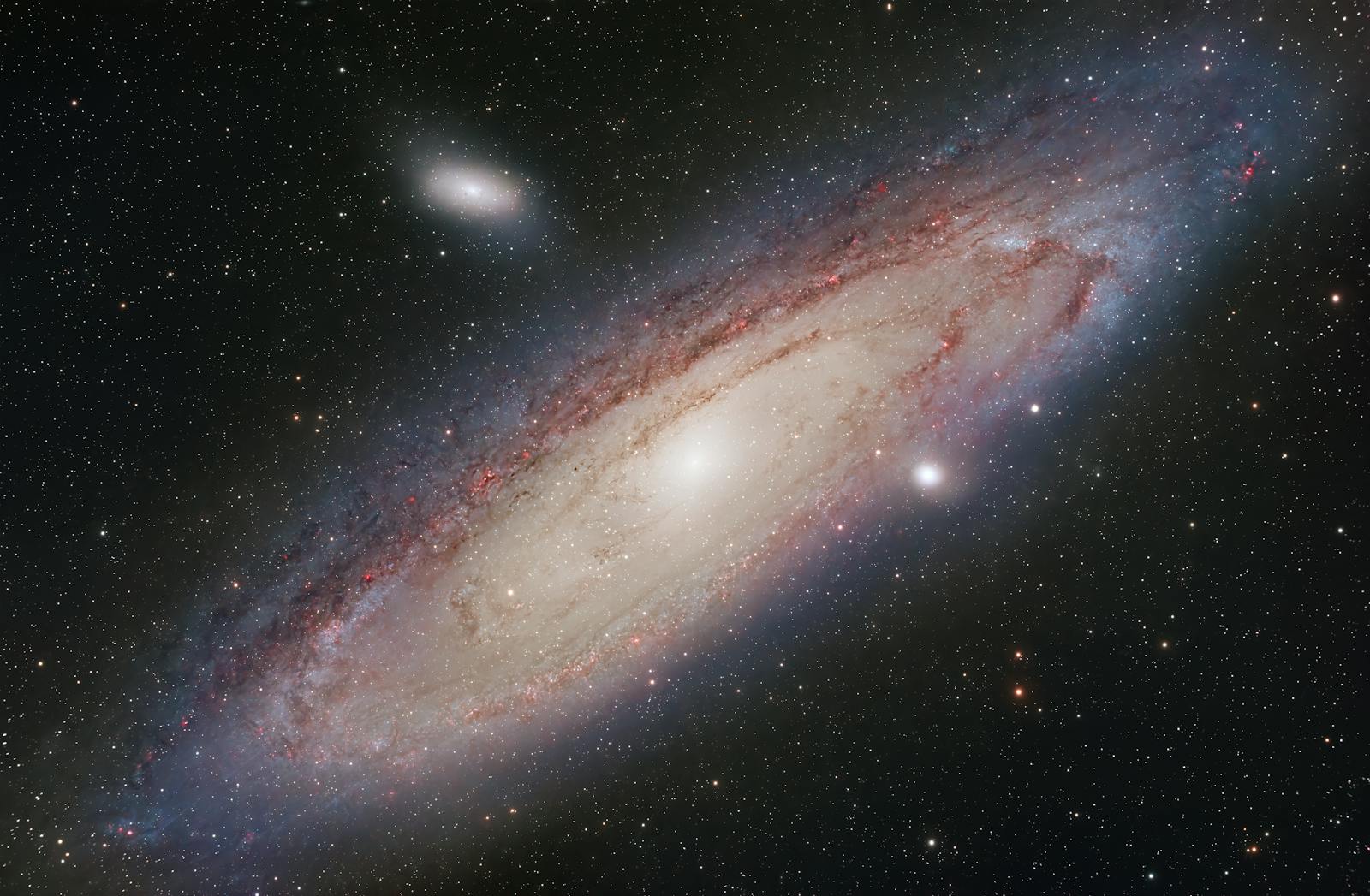
Brian Cox used this line in the “Messengers” episode of the BBC series Wonders of the Universe (2011), with the particular quiet confidence he tends to deliver these kinds of lines with. The line has, since, taken on the standard half-life of a science aphorism. It appears on motivational posters. It is quoted at the bottom of social media posts featuring photographs of galaxies. It is, by now, structurally hard to receive as anything other than a piece of cultural furniture rather than as the claim it actually is.
The claim, when one strips away the standard absorption, is more interesting than the standard absorption suggests. The claim is that life, on this planet and presumably elsewhere, is not, in any structural sense, separate from the universe in which it occurs. The claim is, more specifically, that life is the configuration the universe has, by some combination of physical law and accumulated time, produced in order to perform the operation of understanding itself. The universe is, in this framing, not an object that contains conscious beings. The universe is, more accurately, the substance from which the conscious beings have been built, and the conscious beings are the mechanism by which the substance now examines itself.
This is, on close examination, a slightly vertiginous claim. The vertigo is what the cultural absorption tends to flatten. The flattening allows the line to be quoted without the listener having to actually engage with what it would mean for the line to be true.
What the line is, in fact, asserting
The line is asserting a particular structural fact about the relationship between the conscious beings and the substance they have been built from. The fact is that the atoms in your body are, on close examination, the same atoms that were assembled in the cores of stars several billion years ago and were distributed through the local region of the galaxy by the deaths of those stars. The atoms have, in some real way, been around for considerably longer than you have. The atoms have been, for most of their existence, doing other things. The atoms have, for the last seventy or eighty years of their existence, been doing the particular configuration that is currently you.
This is, on the available evidence from physics and chemistry, simply factually correct. The atoms in your hand are not, in any deep sense, your atoms. They are atoms that are, for the moment, participating in the configuration that you are. They will, after you stop being the configuration you are, participate in other configurations. The participation is the activity. The activity does not, in any meaningful sense, belong to you. The activity has been ongoing for billions of years and will continue for billions more, with or without your particular configuration in the picture.
What Cox is observing, in the line, is that one of the configurations the activity has produced is the configuration that can, in turn, examine the activity. The configuration is you. The configuration is also, presumably, every other conscious being on the planet and, on the available statistical evidence, probably a non-trivial number of conscious beings elsewhere in the universe. These configurations are not, in any structural sense, the universe’s exception. The configurations are, more accurately, what the universe has produced when given enough time and the right local conditions. The producing of consciousness is, on the available evidence, what the universe does in places where the conditions permit it.
Why this is hard to actually sit with
The line is hard to sit with, on close examination, because it requires the conscious being to occupy two positions simultaneously that the standard cultural framing keeps separate.
The first position is the position of being a particular individual, with a particular history, particular preferences, particular relationships, particular concerns. The first position is the position from which most of adult life is lived. The first position treats the individual as the basic unit of experience and the universe as the wider context in which the individual happens to operate.
The second position is the position the line is gesturing at, which is the position of being one of the universe’s many local configurations for self-examination. The second position treats the universe as the basic unit and the individual as the temporary local arrangement through which the universe is, at this moment, looking at itself. The individual, in this framing, is not the protagonist. The universe is the protagonist. The individual is, more accurately, a brief instrument the universe is currently using.
Both positions are, on close examination, accurate to different features of the same situation. The first position is accurate to the lived experience of being a particular person. The second position is accurate to the structural facts about what the particular person is, in some real way, made of and continuous with. The wider culture tends to operate almost entirely from the first position and to treat the second position as a piece of poetic embellishment that does not require any actual structural revision of how one understands one’s own life.
Cox’s line is, in some real way, the small invitation to take the second position seriously. The taking-seriously is what produces the vertigo. The vertigo is what the standard cultural absorption is calibrated to defuse.
What changes, if one does take it seriously
I want to be honest about what taking this seriously has, in my own case, actually changed. The changes have not been dramatic. The changes have, more modestly, been a particular kind of quiet recalibration of how I relate to certain features of my own daily life.
The first change is that the small daily concerns of being a particular adult, the ones that occupy most of any given Tuesday, become, in some real way, slightly less heavy than they used to be. The concerns are still real. The concerns are still mine to address. The concerns are, however, no longer the entire field of view. The wider field of view contains the recognition that the configuration currently addressing the concerns is a temporary local arrangement of materials that have been doing other things for several billion years and will, in due course, return to doing other things again. The temporariness is not, on close examination, depressing. The temporariness is, more accurately, the structural fact that allows the small daily concerns to be held with slightly less grip than the first-position framing would require.
The second change is that certain experiences acquire, in some real way, slightly more weight than they previously had. The walk in nature where the light is particularly good. The conversation with someone in which both participants are, briefly, fully present. The moment of seeing something that, in some structural sense, the universe has not previously gotten to see through one’s particular instrument. These experiences register, in the second-position framing, as the universe doing what it has, in some real way, produced this whole configuration in order to do. The experiences are not just one’s personal pleasures. The experiences are, more accurately, the universe’s brief and partial moments of self-observation, conducted through one’s particular instrument. The framing makes the experiences feel slightly more substantial than the first-position framing would have made them feel.
The third change is that mortality becomes, in some real way, slightly easier to sit with. The first-position framing treats mortality as the ending of the protagonist’s story. The second-position framing treats mortality as the dispersal of one particular configuration back into the larger pool from which other configurations will, in due course, also be assembled. The configuration is temporary. The substance is not. The substance, having done the configuration that was you, will continue to do other configurations. The other configurations will, presumably, also do some local version of the self-examination that the universe has been doing through you. The continuity is not, in any sense, personal. The continuity is structural. The structural continuity is, in some real way, a different kind of comfort than the personal continuity the wider cultural framing keeps trying to construct.
The honest acknowledgment
I want to acknowledge that I do not, on most days, operate from the second position. I operate, like almost everyone else, from the first position, with all of its small daily concerns and particular preoccupations. The first position is, in some real way, where adult life is conducted. The second position is, more modestly, a perspective available occasionally, in selected moments, when one is willing to step back from the first position for long enough to remember that it is, in some structural sense, not the whole of what is going on.
The remembering is small. The remembering does not, by itself, solve any of the actual problems of being a particular conscious configuration in 2026. The remembering does, however, produce a particular kind of quiet recalibration that the first position, operating alone, does not quite have access to. The recalibration is what Cox’s line is, in my honest accounting, actually offering. The line is not an inspirational sentiment. The line is the small structural reminder that the configuration currently reading this is, in some real way, the cosmos doing what the cosmos does in places where the conditions permit it.
The cosmos is, through me and through you, looking at itself. The looking is not, in any deep sense, our personal achievement. The looking is, more accurately, what the cosmos produces when it has had enough time. We are the means. The means is the activity. The activity is what we are, in some real way, here to do. The here is, on close examination, also the everywhere. The doing is, on close examination, also the being. The two are, in this framing, not separate. The not-separateness is the part that takes some sitting with. The sitting with is, in some real way, the most useful piece of cosmological work most of us can do in any given day. It does not require any equipment. It requires, more modestly, the willingness to occasionally occupy the second position long enough to remember that the first one is, in some structural sense, not the whole picture.
Quote source: Brian Cox, Wonders of the Universe, episode “Messengers” (2011).