I have, by now, lost count of the number of times I have stepped out of an airport into a city that I had previously only encountered in films and felt, for the first hour or so, slightly dislocated in time. The dislocation is real. The cities are not, by any honest accounting, the future. They are the present, as built by particular combinations of capital, ambition, and aesthetic conviction. The fact that they look like the future is, on close examination, a feature of how the wider culture’s visual vocabulary for “the future” has been calibrated by a century of speculative fiction. The cities have not arrived from the future. They have, more accurately, been built to match the future that the films told us was coming.
One quick note before the list. Tokyo is the obvious entry that I have deliberately left off, because Tokyo, on close examination, is not the future. Tokyo is the 1980s version of the future, perfectly preserved. The neon-saturated Shinjuku that the Blade Runner films were modeled on is still there, but the actual leading edge of urban configuration has, in the last twenty years, moved elsewhere.
This list is about the cities the actual leading edge is currently being built in, not about the ones that were the leading edge forty years ago.
Your list will be different. Mine is mine.
1. Shenzhen
Shenzhen is what happens when a city is built, more or less from scratch, in the last forty years, on the assumption that the digital layer is the primary layer. The result is not, on close examination, pleasant to walk around. The result is also unmistakably the actual future, in a way that almost no other city manages. The drone deliveries. The autonomous vehicles. The QR-code-mediated everything. The particular kind of glass-and-steel density that has none of the historical residue most older cities still carry. Shenzhen is the closest thing I have ever experienced to standing inside the cover of a science fiction novel from 2010 about the world of 2040. The novel turned out to be set in 2026, and the setting is Shenzhen.
2. Dubai
Dubai is the strangest entry on this list. The strangeness is that Dubai does not feel, on the ground, like a city in the older sense. Dubai feels, more accurately, like a particular kind of climate-controlled experience-environment that happens to involve buildings. The buildings are enormous. The buildings are arranged on a desert that did not, until very recently, have any of these particular buildings on it. The whole place feels like the set of a film about a future in which the wealthy have built themselves a separate civilization in a place that was previously not habitable. The film is currently being made by the city itself, in real time, around you, while you eat dinner at the top of a skyscraper that is taller than anything you have ever been inside.
3. Seoul
Seoul is what Shenzhen wants to be when it grows up. The integration of digital infrastructure, real-time public transit, ambient retail, and what I can only describe as post-physical interface culture is, on close examination, more sophisticated in Seoul than anywhere else I have been. The neon is still there. The neon is no longer doing the work it used to do. The work is being done in the layer one cannot see. The city operates with a particular kind of quiet competence that has the texture of a future that arrived without any fanfare and is currently waiting for the rest of the world to catch up. Seoul is, in my honest accounting, the actual leading edge of the urban future, even though it does not photograph as dramatically as the more aggressive entries on this list.
4. Singapore
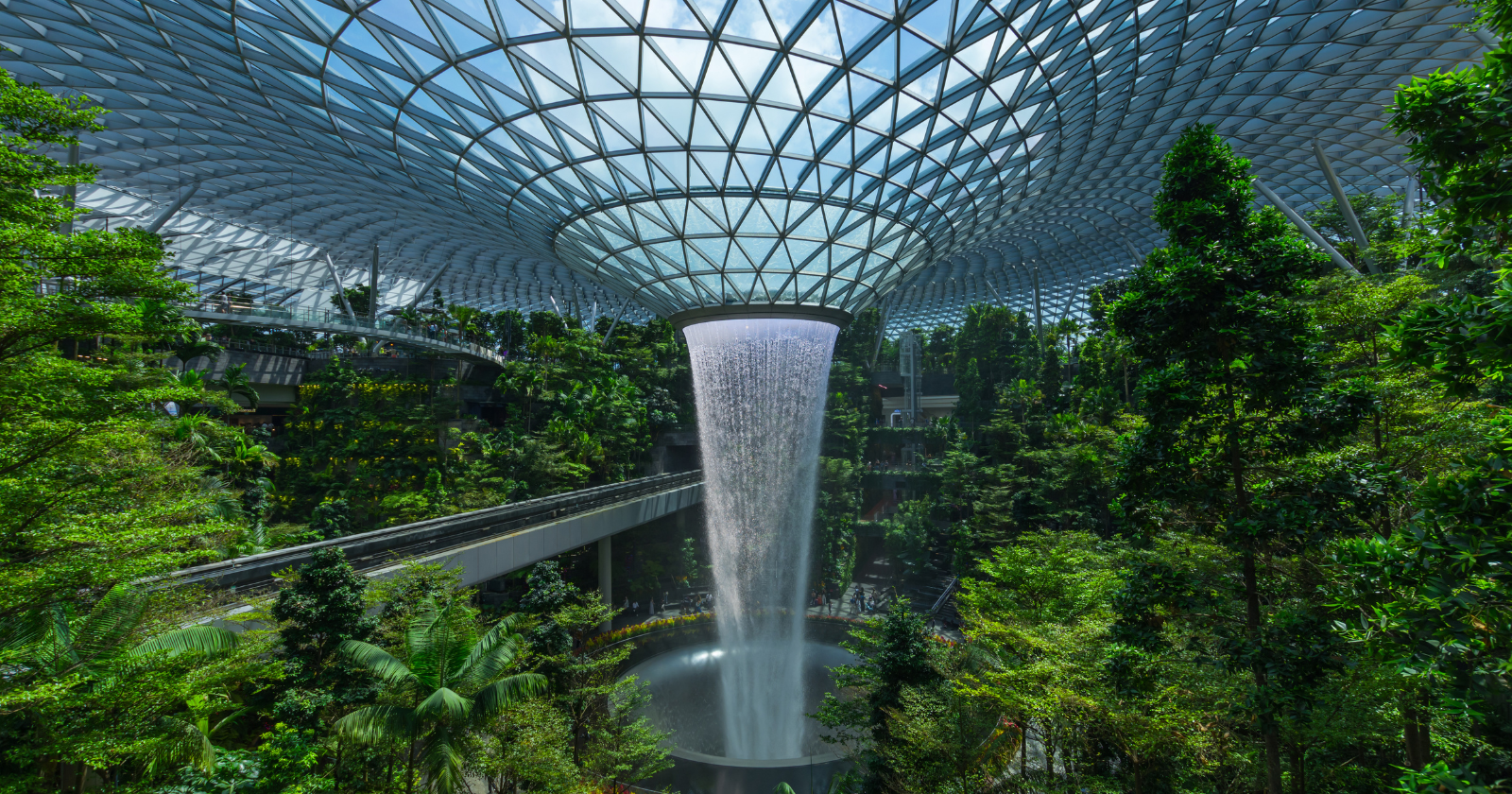
Singapore is the future as imagined by a particular kind of efficient, slightly authoritarian, intensely landscaped urban planner. The Supertree Grove at Gardens by the Bay, lit up at night, with the cooled conservatories visible behind it, is the most visually arresting deliberate piece of “this is what the future looks like” architecture I have ever stood inside. The trees are not trees. The trees are vertical gardens shaped like trees, with solar panels, and they light up. The whole city has been built with this kind of attention. Singapore is the future as it would look if the people building it had, in fact, read the science fiction and decided to skip directly to the good parts.
5. Chongqing
Chongqing is the entry on this list that almost nobody outside China has visited and that almost everybody, when they see footage of it, assumes is a CGI rendering. The city is built on a series of steep hills above the confluence of two major rivers. The result is that the urban geometry is, in some real way, three-dimensional in a way no other city I have been to manages. Trains go through buildings. Highways run on the seventh floor of residential blocks. The light at night, reflecting off the rivers and the towers, produces a visual configuration that is, on close examination, almost entirely indistinguishable from the matte paintings in the Blade Runner sequels. Chongqing is what happens when a city of thirty-two million people is built on terrain that should not, by any reasonable accounting, support a city at all.
6. Hong Kong
Hong Kong remains, despite everything, one of the great science fiction cities. The vertical density of Mid-Levels and Causeway Bay. The way the city stacks itself up the sides of mountains. The mid-air walkways. The lights of Central reflecting off the harbor at night, with the peak rising behind them. The aesthetic that Ghost in the Shell, in its 1995 animated version, lifted more or less directly. Hong Kong is, in some real way, the older sibling of the visual language Shenzhen is currently extending. The difference is that Hong Kong has the historical texture that Shenzhen has had to build itself without. The two cities, looking at each other across the bay, represent two adjacent versions of the future arriving from slightly different directions.
7. Doha
Doha is the lesser-known Gulf entry that, in my experience, produces an even stronger version of the future vertigo than Dubai. The corniche at sunset, with the West Bay skyline rising out of the water in a particular kind of unified architectural confidence, has the quality of a render rather than a photograph. The skyline was, until about fifteen years ago, almost entirely not there. The buildings have been added on a timeline that, by ordinary urban standards, is not a real timeline. Doha is what happens when the deciding to build the future does not, in the deciding entity’s accounting, need to wait for the future to arrive. The future is built immediately. The future is currently catching up to Doha.
8. Shanghai
The view from the Bund across the Huangpu River to Pudong, particularly at night, is one of the great visual achievements of the twenty-first century. The Oriental Pearl Tower. The Shanghai Tower. The Jin Mao. The Shanghai World Financial Center. All of these are visible at once, lit up in coordinated patterns, reflected in the river, against a skyline that, in 1990, did not exist. The not-existing of the skyline in 1990 is the part that produces the future vertigo. The skyline is approximately thirty-five years old. The skyline looks like the future of 2080 as imagined by a science fiction writer in 1985. The visual disjunction between the historical Bund on one side of the river and the future-Pudong on the other is, in some real way, the most compressed version of the wider Chinese twentieth-century telescope I have ever seen.
9. Hangzhou
Hangzhou is the entry that surprises most visitors, because it is, in the Western imagination, primarily known as the city of the West Lake, which is one of the oldest and most carefully preserved scenic areas in China. What the West Lake postcard does not convey is that, a few miles away from it, Hangzhou is one of the most aggressively built-out tech cities in the world. The Alibaba headquarters. The autonomous vehicle pilots. The particular kind of seamless mobile payment integration that operates more smoothly here than almost anywhere else, including Shenzhen. Hangzhou is the future as it looks when the future is being built underneath a historical site rather than on top of one. The contrast between the lake at dawn and the tech district at night is, in some real way, the most compressed version of the actual contemporary Chinese urban configuration available in any one place.
10. Reykjavik
This one is on the list for a different reason than the others. Reykjavik does not look like the future of dense urban capital. Reykjavik looks like the future of a different kind of speculative fiction, the kind set on a sparsely populated terraformed colony in which a small human settlement has been carefully fitted into an indifferent alien landscape. The volcanic terrain, the geothermal infrastructure, the sparse population, the long winter darkness lit by particular kinds of low warm interior lighting, all of these produce the texture of a settlement rather than a city. The settlement is on Earth. The settlement also has the visual quality of being not quite on Earth. Reykjavik is the future as imagined by Ursula K. Le Guin rather than by Ridley Scott. The future is, on close examination, capacious enough to contain both versions.
The honest acknowledgment
The thing all ten of these cities have in common is that they are, in fact, the present. The future-vertigo they produce is a feature of how the wider culture’s visual vocabulary has been calibrated, not of any actual temporal anomaly. The cities have not arrived from the future. The films, more accurately, were anticipating what the present would eventually look like. The films were correct. The cities, when you walk into them, are simply confirming the accuracy of the prediction. The vertigo is the small cognitive lag while one’s apparatus catches up to the fact that the predicted future is, by now, the actual furniture of the world we are all currently living in.
The cities will, in another twenty years, look quaint. The next generation’s “ten cities that look like sci-fi sets” list will not include most of mine. The future, on close examination, keeps moving. The keeping-moving is, in some real way, the most reliable feature of the future the films have been describing all along.