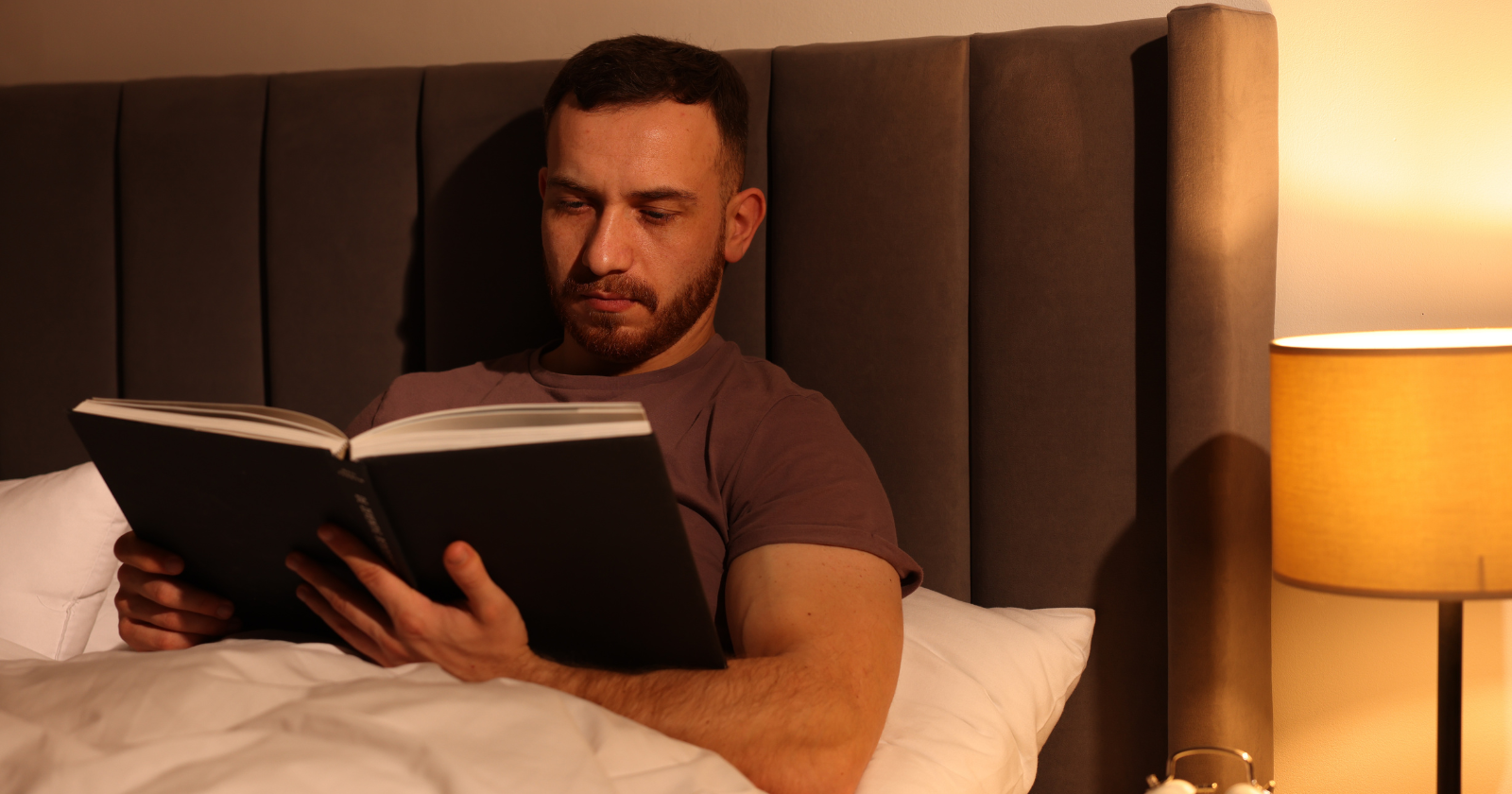
The way my evening looks these days: by nine or ten, the overhead lights in the living room are off, replaced by a single warm-toned lamp in the corner. The phone sits in the kitchen, deliberately too far to reach for from the sofa. By the time I’m in bed, the only light I’m using is a small clip-on reading light fixed to whatever book I’m working through (currently Yuval Noah Harari’s Nexus). Lights out, on a reasonably consistent basis, around eleven.
It took me a while to put this routine together, and even longer to realize that almost all of it had been quietly worked out, in a much more sophisticated form, by NASA. The agency has spent decades trying to keep astronauts sleeping well while orbiting a planet that, from their position, dawns and sets sixteen times a day.
The practices it has built around that problem turn out to be uncomfortably applicable to the rest of us, who have only one sun to manage and still seem unable to manage it.
Rule #1: Lower the light long before I go to bed
The single change that has done the most for my sleep is also the most unglamorous. Roughly two hours before I want to be asleep, I stop using overhead lights. The room gets noticeably dimmer. The light I do use is warm-toned — yellow rather than blue-white — and is positioned low rather than overhead. It is the lighting equivalent of telling the body the sun is going down, because, biologically, that is what it is.
The body’s machinery for this is exactly as straightforward as it sounds. Space Center Houston explains it in plain terms: “When there is less light – like at night – our internal clock tells our brain to make more melatonin, which makes us drowsy.” Bright overhead light, especially in the blue end of the spectrum, sends the opposite signal. Harvard Health Publishing notes that even quite modest brightness — around eight lux, less than most table lamps — is enough to interfere with melatonin secretion.
The ISS uses a designed version of this principle. Before bedtime, the cabin lights drop to a lower intensity with less blue content, mimicking the dusk signal the body has evolved to read. This isn’t wellness fashion; it’s operational hygiene — what NASA does to keep its most critical people sleeping in an environment that, left to itself, wouldn’t let them.
My version is a twenty-dollar warm lamp in the living room, an unwillingness to flick on the kitchen overhead after nine, and the slow realization that the rooms I used to need bright white light in were not actually rooms in which I needed to be doing anything that required bright white light.
Rule #2: Get the phone out of the wind-down
The harder rule, and the one I would not have believed worked if I had not done it for a few weeks, is putting the phone somewhere I cannot easily reach for it in the hour before bed.
The reason this works is partly cognitive — phones keep the brain in a stimulated state — but it is also, very literally, a lighting problem. A phone screen held at face distance is the kind of light source the circadian system reads as daytime: short-wavelength, bright, and right at the eye. Harvard Health summarizes the relevant research bluntly: while any light at night suppresses melatonin, blue light “does so more powerfully,” and the effect can shift the body’s clock by hours rather than minutes. The exact thing NASA spends so much effort blocking on the ISS is, more or less, the exact thing most adults voluntarily hold in front of their face for an hour before they try to sleep.
The broadest practical implication, in the words of the Space Center Houston piece: “limited exposure to light, especially blue light, before bedtime and during sleep can help you get a better night’s sleep.” It is also the rule the phone makes hardest to follow.
I am not perfect at this. There are nights I check the phone late. The pattern I have noticed is that those nights take longer for me to fall asleep, and the next morning is harder, in a way that is just consistent enough that I no longer pretend it is coincidence.
Rule #3: Replace the screen with something analog
If the phone is the problem, the question is what replaces it. The wind-down hour has to be filled with something, or the brain will fill it with the phone again.
For me the answer has become a paper book and a small clip-on reading light that attaches to the cover. The clip-light points downward, illuminates only the page, and emits the smallest amount of warm light I need to read by. The rest of the bedroom stays dark. The book — Harari’s Nexus at the moment — gives the brain something with a story arc and a slow rhythm to wind down with, rather than a feed designed to keep it scrolling.
The choice of medium turns out to matter more than I would have expected. A Harvard Medical School study compared people reading printed books to people reading on a light-emitting e-reader in the hours before bed. Here’s what they found:
“Participants reading an LE-eBook took longer to fall asleep and had reduced evening sleepiness, reduced melatonin secretion, later timing of their circadian clock and reduced next-morning alertness than when reading a printed book, ”
This is, in a sense, my home-built version of the ISS environment. The astronauts have engineered light environments costing serious money. I have a five-dollar clip-light and a hardcover. The principle is the same: minimum light, low blue content.
The trickiest part is the social and psychological work of agreeing with yourself that the phone is genuinely not coming with you to bed. After that, the routine mostly takes care of itself.
What actually changed
The headline change is the obvious one: I sleep better, fall asleep faster, and wake up feeling more like a person than a thing being dragged out of bed by an alarm. That is the part the wellness industry sells, and it is real.
The less expected change is what happened to my mornings. After a properly dark, properly quiet night of sleep, the first hour reads differently — sharper, more decisive, less reactive. I think the version of me at 9am is the version of me who, a year ago, would not have shown up until afternoon, if at all.
The astronaut framing for all of this is not a gimmick. NASA cares about these rules because the consequences of getting them wrong are not a sluggish morning but a failed reentry or a missed instrument reading. The science that backs the rules is the same science whether you are in low Earth orbit or in a small apartment putting the overhead light off for the evening. Most of us have just been ignoring it.
None of this is a substitute for medical advice, and a routine cannot reach every condition that affects sleep. If your sleep stays poor for weeks despite the lamp, the phone-banishing and the book — or if you snore heavily, wake gasping, or feel exhausted regardless of how long you spend in bed — that’s worth a conversation with a GP. Sleep disorders are common, treatable, and not something a clip-on reading light is going to fix.