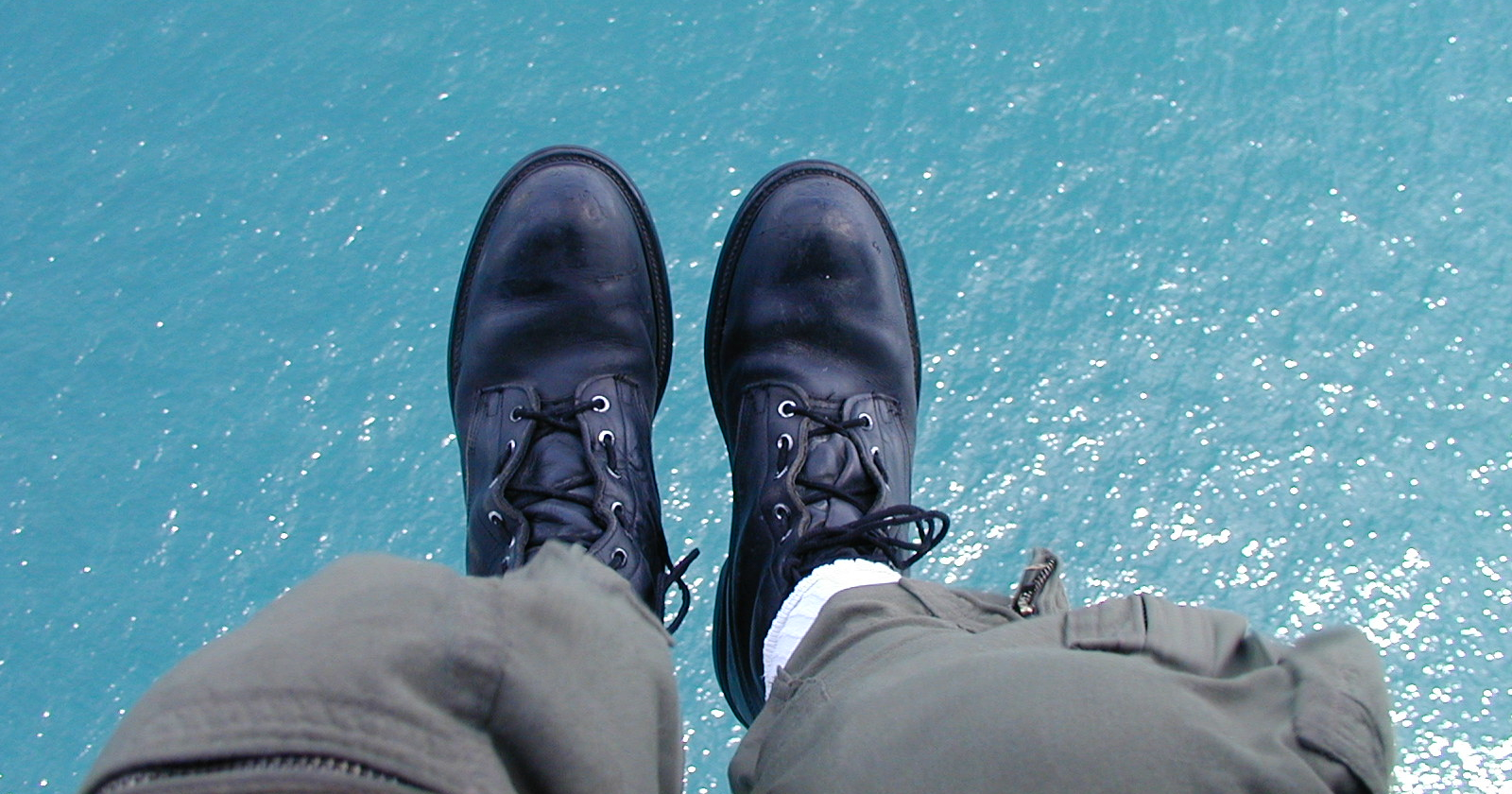
Bangkok, seventy-eight floors up, and I was gripping the railing of an observation deck like it owed me something.
I had spent three weeks in Thailand barely thinking about anything. Scooters, heat, midnight noodles, the specific looseness that comes from not having a plan. I had climbed temples, wandered night markets, gotten on the wrong bus and decided it was fine. Nothing in me had been afraid.
Then I stepped out onto that deck and felt something I had no language for. My legs didn’t shake. I didn’t spiral. What happened was subtler and stranger: a sudden, unwanted pull toward the edge, and a fierce, immediate resistance to it. Like two parts of me were disagreeing about something urgent, without consulting my thoughts.
I stepped back inside. I told myself it was the heat.
It took an astronaut, of all people, to finally give me better language for it.
What Reid Wiseman said from orbit
Reid Wiseman is the commander of NASA’s Artemis II mission — the first crewed lunar journey in more than fifty years. Before commanding that mission, he spent 164 days aboard the International Space Station in 2014, during which he went on two spacewalks. Afterward, he posted something that has stayed with me since I first read it: “While spacewalking I realized something: I used to think I was scared of heights but now I know I was just scared of gravity.”
One sentence. And it reframed something I had been misreading about myself for years.
Because what Wiseman named is not a quirk of astronaut psychology. It is a precise description of what the body actually responds to when it says it’s afraid of heights. Not the height. Not the distance to the ground. The force that makes the ground dangerous.
Gravity is what turns a ledge into a threat. Gravity is what the nervous system is calculating in that split second of cold alertness. Height is just the context. Gravity is the content.
I’ve read enough psychology to know that therapists typically approach fear of heights as a specific phobia — something to be named, exposed to gradually, desensitized. That framework is clinically sound, and for people whose lives are genuinely disrupted by it, it works. But it doesn’t ask the deeper question. It treats the fear as a problem to manage rather than a signal worth understanding.
Wiseman’s one line did something most clinical language doesn’t: it pointed at the thing underneath. Not heights as the trigger, but gravity as the actual subject. That distinction sounds small. It isn’t.
The fear that was there before you were
What makes this reframe more than semantic is the biology underneath it.
Most fears are learned. The nervous system encounters something harmful, encodes it, and generalizes the caution forward. But fear of heights is different. Research published in the Journal of Neuroscience found that fear of heights appears to be innate — associative learning isn’t required for it to develop. In classic visual cliff experiments, human infants and newborn animals already show reluctance to cross a glass floor with a visible drop below, before they have ever fallen, before they have been warned, before life has given them any reason to be afraid.
The fear predates the experience.
Evolutionary psychologists describe this as a non-associative fear — one of the very few that seem hardwired rather than acquired. The ancestors who instinctively pulled back from ledges were more likely to survive and reproduce. That caution was passed forward. What you feel at a great height isn’t a personal malfunction. It is an evolutionary adaptation to the risks of falling, encoded in the body long before your particular life began.
What Bangkok revealed in me wasn’t a new weakness. It was an old biological logic, finally finding its trigger.
Why some people feel it more than others
If the fear is innate, why hadn’t I felt it before? Why do some people stand on observation decks taking selfies while others go quiet at the railing?
The answer is partly perceptual. Research on acrophobia points to something called visual field dependence — the degree to which your sense of balance relies on what your eyes are telling you, rather than what your inner ear and body are sensing. At height, visual signals become destabilizing rather than grounding. The ground is too far away to anchor you. The space is too open to orient you. Studies have found that visual field dependence, postural control, and space and motion discomfort are more significant predictors of height fear than prior traumatic experience.
So the fear isn’t irrational. It is your body noticing that its usual tools for staying safe are not working the way they should. The system is functioning. It is doing exactly what it was designed to do.
What becomes clinical acrophobia — affecting roughly six percent of the population — is when that adaptive caution amplifies beyond context. The biological mechanism meant to keep you cautious near cliffs starts firing in glass-walled elevators, on footbridges, in the middle of the night.
The pull no one warns you about
Here is the part that disturbed me most, standing on that deck.
What I felt wasn’t only fear. It was also something that resembled an urge. A strange, directionless pull toward the edge I was simultaneously desperate to avoid. Like two signals running at once, one that said danger and one that said look how close you could get to it.
This has a name: the high place phenomenon, sometimes called l’appel du vide, the call of the void. Clinical psychologist Jennifer Hames and colleagues at the University of Notre Dame found that more than half of people who had never experienced suicidal ideation reported feeling this urge at heights at some point in their lives. It has nothing to do with wanting to die. Researchers believe it may be a misfire in the threat-detection system: the mind notices the danger of the edge, generates the thought what if I jumped as part of its risk simulation, and the conscious brain misreads that safety check as a desire.
The pull isn’t toward death. It’s your nervous system running a vivid rehearsal of the worst case, to make sure you choose otherwise.
Knowing this didn’t make me less unsettled by the memory. But it changed what I thought the memory meant.
What the deck was really measuring
Standing seventy-eight floors above Bangkok, I thought I was discovering something new about myself. A fear I’d somehow missed. A flaw that had been hiding.
But I think what I was actually discovering was how much the previous three weeks had stripped away.
In Thailand, in the heat and motion and beautiful absence of a plan, I had been very much in my body. Not analyzing. Not managing. Just moving through things. And then I stepped onto that deck and was confronted with something my body recognized before my mind did. The calculation was immediate and ancient: gravity, edge, no ground in reach.
The fear wasn’t new. The conditions that let me finally feel it were.
Wiseman’s insight from orbit holds something worth staying with. He had to leave Earth’s gravitational field entirely to understand what he had actually been afraid of all along. Sometimes it takes that kind of distance — from ground level, from routine, from the ordinary noise of a life being managed — to finally hear what the body has been saying.
A different kind of looking down
When people discover a fear they didn’t know they had, the instinct is to call it irrational. Something to overcome, reframe, correct. And for the clinical end of the spectrum, where fear disrupts daily functioning, that framing has its place.
But for most of us, what gets labeled irrational is usually just biological. It is an old system speaking a language the modern world doesn’t leave much room for. Fear of heights is one of the few things your body already knew before your life gave it any reason to know it. It came with you. It was written into the nervous system by every ancestor who stood near an edge, felt that same pull, and stepped back.
Wiseman named it from two hundred miles above Earth. I found it seventy-eight floors above Bangkok. The height was different. The gravity was the same.
And maybe that’s the question worth carrying down from the observation deck: not what are you afraid of, but what force, underneath the fear, have you been misreading all this time?