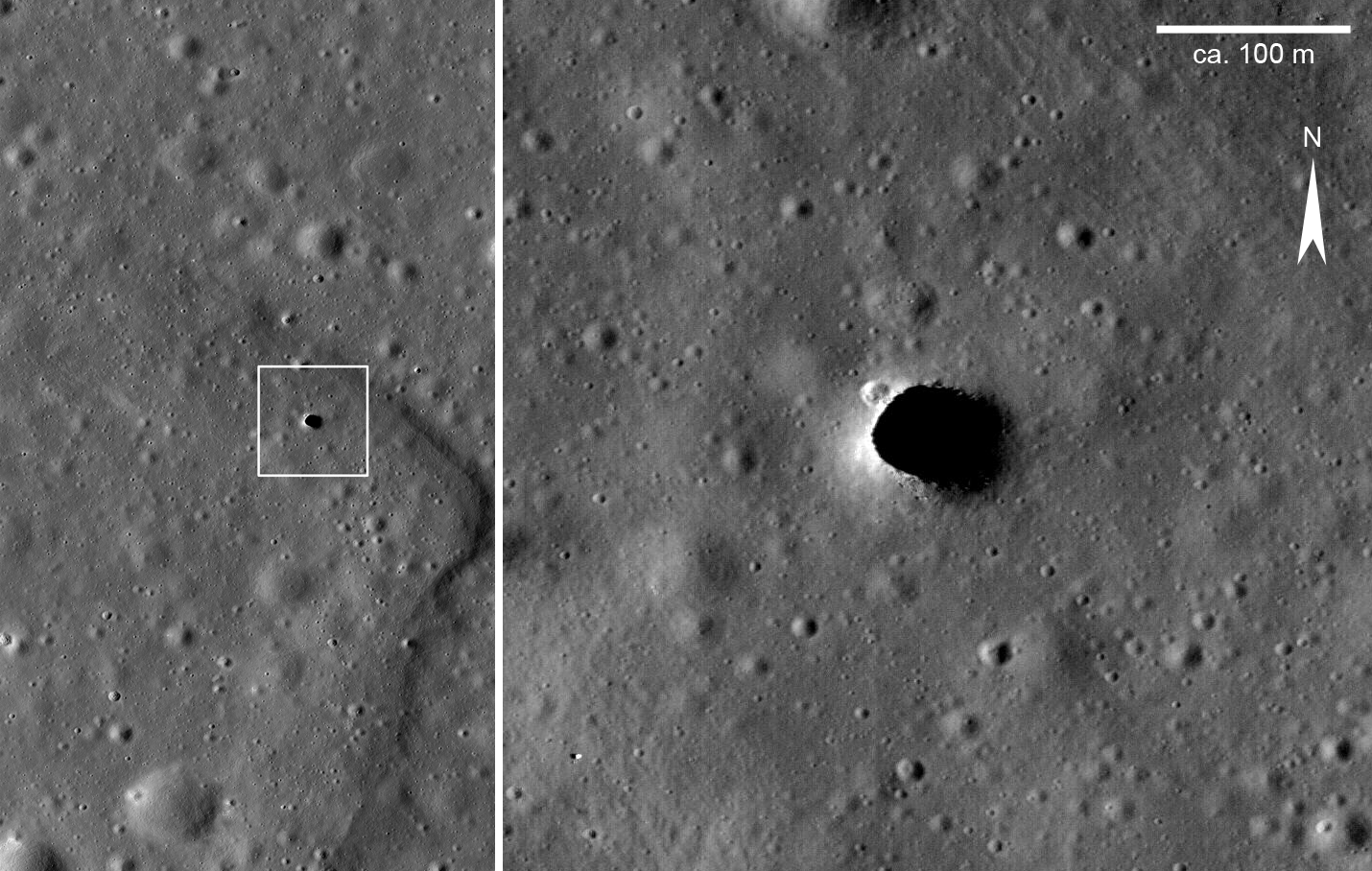
WASHINGTON, NASA has selected a radar, seismic, gravity and camera suite called GIMLI to be deployed at the Marius Hills Pit and test from the surface whether the pit opens into a lava tube.
The agency named GIMLI on 30 September 2026 as one of three payload suites chosen under its PRISM programme for the Moon Base effort, to fly on a commercial lander under the Commercial Lunar Payload Services scheme. No launch date and no lander vendor have been named. The principal investigator is Nathaniel Putzig of the Planetary Science Institute.
The pit lies in the Marius Hills, an ancient volcanic region. In 2017 a team using the Lunar Radar Sounder on Japan’s Kaguya spacecraft reported echoes near the pit that it interpreted as an intact lava tube, and candidate tube sites line up with mass deficits in gravity maps from the GRAIL spacecraft, the Japanese space agency said. None of that has shown whether the hole leads anywhere.
“Readers should not conclude that the pit is an opening to a lava tube,” Gareth Morgan, GIMLI’s deputy principal investigator at the institute, told Space Daily in an email on 19 October 2026.
High-resolution images from NASA’s Lunar Reconnaissance Orbiter show the pit walls “form an overhang above a subsurface void space that is wider than the diameter of the pit itself”, Morgan said. The size of that void is unknown, and so is whether it is an isolated cavity or part of a larger cave system.
Similar pits exist in volcanic terrain on Earth, Morgan said. “Sometimes they are skylights into lava tubes, but in other cases they are isolated shafts/cavities caused by volcanic-tectonic activity,” he said. “GIMLI has been designed to differentiate between the two scenarios.”
“It has long been speculated that lava tubes, which on Earth are remnants of drained lava flows, exist on the Moon, but this has never been definitively confirmed,” Morgan said. “GIMLI will enable us to address this for the first time.”
“Confirming these void spaces now could shift future habitat planning, offering natural, ready-made shelters that provide crucial thermal stability and shielding from deadly ionizing radiation and micrometeoroid bombardment,” the agency said in its 30 September 2026 release.
GIMLI’s ground-penetrating radar is supplied by the Norwegian Space Agency, according to the institute. Honeybee Robotics, a Blue Origin company, is building the active-source seismic system, the gravimeter and the cameras, and is managing the project.
Each instrument should respond to a tunnel in its own way, Putzig told Space Daily in an email on 19 October 2026. “With the ground-penetrating radar, we would expect a strong reflection from the top of the lava tube back to the antenna, due to the high dielectric contrast between rock and the vacuum within the lava tube,” he said.
“For the active-source seismic, we would expect strong reflected and refracted acoustic waves from the perimeter of the lava tube, but the acoustic waves will not pass through the void space,” Putzig said. “For the gravimeter, we would expect to see a strong, negative gravity anomaly when passing over the lava tube, as it represents a locally reduced mass in what is otherwise dense rock.”
“If we see all of these effects, it will represent very strong evidence that the pit does in fact represent a collapse feature into a much more extensive lava tube,” he said.
Elevator and sealed walls
Published figures for the pit’s depth disagree. NASA’s description of the orbiter’s images puts the pit at about 34 metres deep. The Lunar Reconnaissance Orbiter Camera team gives 40 metres in a 2017 update. Putzig put the drop at about 60 metres.
“There’s a sharp drop of about 60 m between the pit rim and the floor of the pit, so while first explorations could be done by flying or rappelling into the pit, it may become necessary to install an elevator to move people and equipment in and out of a shelter,” Putzig said.
“Creating a shelter would require walling off either end of a portion of the lava tube and pressurizing the interior, but cross-cutting fractures could make it necessary to seal off the tube walls as well to avoid leaks,” he said.
In July 2022 NASA reported that Diviner data from the orbiter and computer modelling showed shaded locations within some lunar pits “always hover around a comfortable 63 F (about 17 C)”. Radiation shielding inside the Marius Hills Pit has not been measured on site.
Morgan said a null result would still be useful. “If we don’t find evidence of a cave system at our Marius Hills landing site, our measurements will still allow us to test alternative hypotheses for lunar pit formation, which in turn will provide new insights into volcanic activity, such as localized volcanic-tectonic processes,” he said.
The pit walls also expose layers of rock. The suite’s camera mast “will be used to inspect these outcrops (from a safe distance) to measure the number, thickness and origin of the layers”, Morgan said, with the results compared against the geophysical surveys to reconstruct the site’s sequence of eruptions.
Sources:
- https://www.nasa.gov/news-release/nasa-adds-new-science-investigations-for-moon-base/
- https://www.psi.edu/blog/psi-led-team-selected-for-nasa-prism-program/
- https://www.isas.jaxa.jp/en/topics/001159.html
- https://lroc.im-ldi.com/image_tags/Pits
- https://lroc.im-ldi.com/images/202
- https://www.nasa.gov/solar-system/nasas-lro-finds-lunar-pits-harbor-comfortable-temperatures/
- https://www.esa.int/ESA_Multimedia/Images/2020/02/Marius_Hills_pit