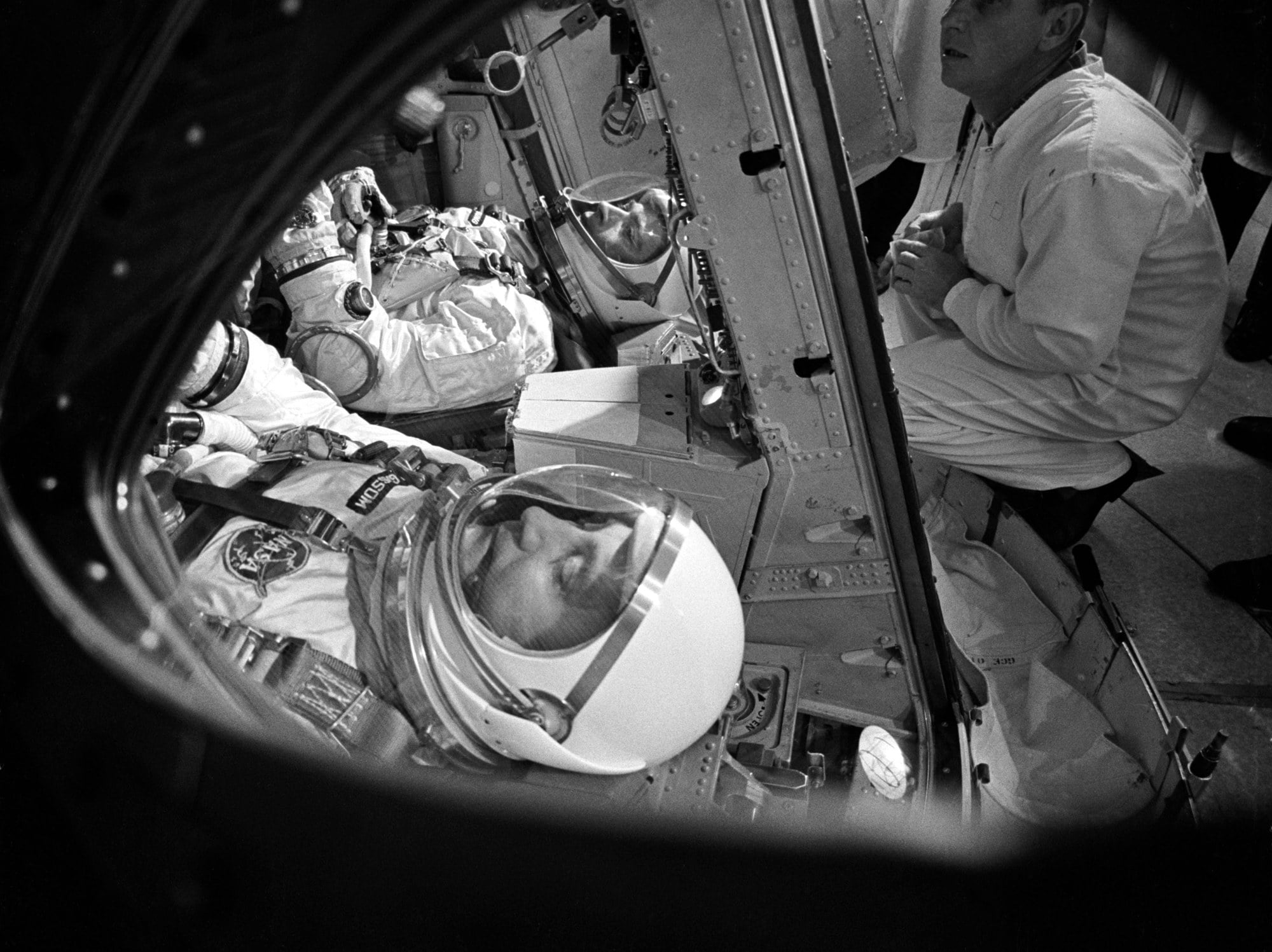
NASA Administrator James Webb pressed Manned Spacecraft Center director Robert Gilruth for a report on whether John Young should be disciplined for smuggling a corned beef sandwich onto Gemini III, NASA’s History Office says.
Young had fellow astronaut Walter “Wally” Schirra, the backup command pilot, buy the sandwich, then pocketed it in his pressure suit as he headed to the launchpad on March 23, 1965, Jennifer Ross-Nazzal, NASA’s human spaceflight historian, wrote in the History Office essay on March 20, 2025.
Nearly two hours into a flight of almost five hours, Young offered it to commander Gus Grissom, historian James Anderson wrote in a NASA Ames essay published on March 17, 2022. Grissom took a bite, found the rye crumbling, and put the sandwich in his own suit pocket.
The whole exchange lasted less than a minute. Congress raised the matter with NASA leadership at hearings on the agency’s 1966 budget, Ross-Nazzal wrote.
Webb told the committee that “this is the United States of America’s space program and, as a matter of policy, we are not going to permit individuals to superimpose their judgment as to what is going to be taken on these flights.”
He added: “I think it is fine for Dr. Gilruth to take a very strong position with respect to the individuality of these men, but from those of us who have to look at the totality of the matter, this was not an adequate performance by an astronaut.”
Representative George E. Shipley likened the Gemini cabin to a “surgeon’s operating room” and called Young’s antics “foolish”. Crumbs behind an instrument panel could interfere with flight equipment and cost the mission and its crew.
George Mueller, associate administrator for Manned Space Flight, told the committee that NASA did not “approve [of] unauthorized objects such as sandwiches going on board the spacecraft.” He said the agency had “taken steps, obviously, to prevent recurrence of corned beef sandwiches in future flights.”
Mueller also said: “There was no detriment to the experimental program that was carried on, nor was there any detriment to the actual carrying out of the mission because of the ingestion of the sandwich.”
Gilruth defended the crew. Such antics, he told the committee, helped crews “break up the strain” of spaceflight.
Gilruth said he hesitated “to be too strict in the future by laying down a lot of rules for men who have this responsibility and who, in all the flights so far, have done such good jobs.”
Webb read the incident as a sign that Gilruth was too lax with his astronauts, Ross-Nazzal wrote, and pressed him for a report to determine whether Young should be disciplined or at the very least reprimanded. Young never received a formal reprimand.
The sea urchin experiment
Near the approved food box beside Grissom sat a canister of sea urchin eggs, Arbacia punctulata, Anderson wrote. It was NASA’s first fundamental space biology experiment in orbit.
The canister held eight identical chambers. Turning its handle was meant to start fertilization in specific chambers, with a fixative halting cell division at different stages through the flight.
The handle broke when Grissom turned it, and the experiment’s objectives were not achieved. NASA redesigned the canister, substituted frog eggs, and flew it on Gemini VIII and Gemini XII.
By the end of the program, cell division had been shown to occur in microgravity without detrimental effects attributable to lower gravity.
Gemini III had none of the strict diet controls that other Gemini experiments on astronauts often required, so a few bites of the sandwich “would not have disrupted any of the planned experiments,” Anderson wrote.
Young hatched the idea during training, when Grissom grew “bored” with the dehydrated food, Ross-Nazzal wrote. Bringing a sandwich “seemed like a fun idea at the time” to Young.
One goal of the flight was to test NASA’s food packaging and its waste disposal procedures. Young called the chicken bites “barely edible” in his post-flight debriefing.
On the air-to-ground recordings, Grissom asked, “Where did that come from?” Young said: “I brought it with me.” He added: “Let’s see how it tastes.” Then: “Smells, doesn’t it?”
Two days after the flight, reporter Bill Hines asked at the postflight press conference what became of the sandwich. “How did you find out about that?” Young said, then laughed and said Grissom “ate the sandwich.”
Starting with Gemini IV, crews had to submit a list of items they planned to carry. Sandwiches were prohibited, along with bulky, heavy or metal objects that could affect spacecraft equipment.
The incident did not harm Young’s career. He became the first astronaut to fly to space six times, on two Gemini, two Apollo and two space shuttle missions. He also served as chief of the Astronaut Office for 13 years.
Sources:
- NASA History Office, Jennifer Ross-Nazzal, “Fallout from the Unauthorized Gemini III Space Sandwich”: https://www.nasa.gov/history/fallout-from-the-unauthorized-gemini-iii-space-sandwich/
- NASA Ames, James Anderson, “Contraband Corned Beef and the Early Days of Space Biology: the Gemini III Mission”: https://www.nasa.gov/centers-and-facilities/ames/contraband-corned-beef-and-the-early-days-of-space-biology-the-gemini-iii-mission/