

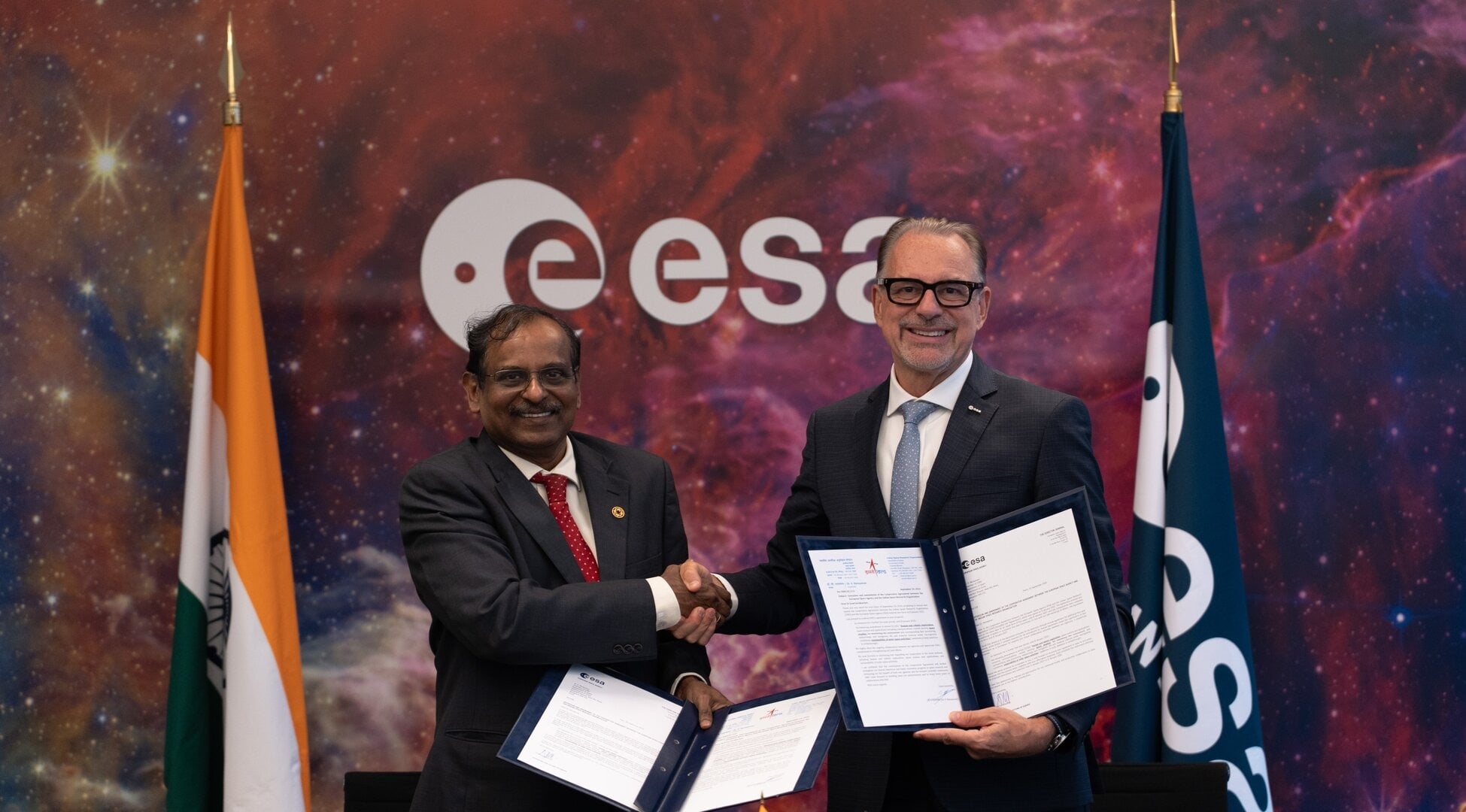
The European Space Agency and the Indian Space Research Organisation have extended their Cooperative Agreement by a further five years, to 8 January 2032, through an exchange of letters signed in Paris on 10 September 2026 on the margins of the International Space Summit. The amendment keeps the existing framework intact while widening it to cover space weather, human and robotic exploration, and the sustainability of outer space activities, according to ESA’s announcement of the extension.
Paris exchange of letters and the 2032 horizon
The instrument used here matters as much as the content. An exchange of letters is the lightest available mechanism for amending an agreement already in force: rather than negotiating a replacement text, the two agencies confirm in correspondence that the existing agreement continues, that its expiry date moves, and that specified new fields fall within its scope. The underlying Cooperative Agreement has been in force since January 2002, and the new end date of 8 January 2032 follows the five-year cadence that has carried it through more than two decades.
Signature took place in Paris during the International Space Summit, with ESA Director General Josef Aschbacher and ISRO Chairman Dr V. Narayanan both present. In ESA’s account of the signing, Aschbacher pointed to the length and continuity of the relationship with India and to the value of widening it into new fields, while Narayanan welcomed the extension as a basis for deeper technical work between the two agencies. Neither agency announced a new programme, a budget line or a mission commitment alongside the letters; the document is an enabling framework, not a project decision.
The extension had been prepared through ESA’s own governance. The agency’s Council met for its 347th session at ESA Headquarters in Paris in June 2026, and the published outcomes of that meeting record the approvals taken by delegations from ESA Member States ahead of the September signature. That sequence — Council approval in June, signature in September — is the standard path for amendments to ESA’s bilateral agreements with non-Member State partners, and it means the broadened scope carries the endorsement of ESA’s governing body rather than resting on an executive decision alone.
New scope: space weather, exploration, sustainability
The three added fields each map onto work already under way on both sides. Space weather is the most operationally immediate. ESA runs space weather services through its Space Safety programme, and India operates its own solar observation and ionospheric monitoring capability; the physical phenomena involved — coronal mass ejections, geomagnetic storms, ionospheric disturbance affecting navigation signals — do not respect regional boundaries, and forecasting depends on data exchange between widely separated ground stations and spacecraft. Bringing space weather inside the Cooperative Agreement gives both agencies a legal basis for that exchange without negotiating a separate instrument each time.
Human and robotic exploration is the second addition, and the broader of the two. It covers the ground where ESA’s human spaceflight and exploration directorate and ISRO’s crewed programme work overlap: crew training, life support and habitation technologies, lunar robotic missions, and the operational support that either agency can offer the other. Listing it in the agreement does not create a joint mission, but it removes a procedural obstacle to negotiating one.
Sustainability of outer space activities is the third. The term covers space debris mitigation, collision avoidance, end-of-life disposal practices, conjunction data sharing and the standards work carried out in multilateral forums including the UN Committee on the Peaceful Uses of Outer Space. Both ESA and ISRO track objects in orbit and both operate spacecraft in the congested low Earth and geostationary regimes, and both have positions to coordinate in international standard-setting. Putting the subject inside a bilateral agreement is a way of aligning technical practice and, where the two agencies agree, of presenting common positions.
Continuity since 2002 and the human-exploration statement of intent
What the extension preserves is as significant as what it adds. The existing areas of cooperation — Earth observation, satellite navigation, space science and mission operations support — continue unchanged. Those four fields describe most of the practical traffic between the two agencies since 2002. Earth observation covers the exchange of data from environmental and climate-monitoring satellites. Satellite navigation touches the interoperability questions raised by Europe’s Galileo and India’s regional navigation system. Space science covers instrument contributions, joint participation in science missions and the sharing of results. Mission operations support is the least visible and among the most used: ESA’s ESTRACK ground station network and ISRO’s tracking facilities have supported each other’s spacecraft during launch and early orbit phases and at points in cruise where a station in the right hemisphere is the only option available.
The 2026 letters also build on a more specific step taken the previous year. ESA and ISRO signed a Joint Statement of Intent on human exploration in 2025, setting out shared interest in crewed spaceflight activity. A statement of intent has no binding force; it records a direction of travel and gives technical teams on both sides a mandate to explore options. Folding human and robotic exploration into the Cooperative Agreement gives that earlier statement a legal frame to sit within, so that any activity arising from it — an astronaut training exchange, a payload contribution, a shared analysis of habitation hardware — can proceed under an agreement already ratified and in force rather than waiting on a fresh negotiation.
For both agencies the arrangement now runs to the start of 2032, covering a period in which India’s crewed programme and Europe’s exploration commitments are both scheduled to advance. The letters signed in Paris do not commit either side to a specific flight, payload or facility. They establish that when either agency wishes to propose one, the paperwork is already in place.