

Benjamin Franklin had a habit that made him a great scientist and a slightly eccentric houseguest: he could not stop poking at things nobody else thought were questions.
For years he had heard sailors’ lore that oil calms rough water, and he refused to leave it alone. So one windy day around 1770, at Mount Pond on Clapham Common south of London, the portly American statesman walked down to the water’s edge with a small cruet of oil to settle the matter himself.
The looking-glass trick
He poured on, by his own account, “not more than a tea spoonful.”
What happened next he described with obvious delight. The oil “spread itself with surprising swiftness,” and where it reached, the wind-chopped water fell instantly still — the calm patch spreading and spreading across the pond until it made “all that quarter of the pond, perhaps half an acre, as smooth as a looking-glass.”
A teaspoon of oil. Half an acre of glass. Franklin repeated it until he was sure it was real, and he had a showman’s flair for the effect — he later took to carrying oil in the hollow of a bamboo walking cane, so he could quiet a pond on command and mystify onlookers. He wrote the experiment up in a 1773 letter to the British scientist William Brownrigg; it was read to the Royal Society and published in its journal in 1774, under the wonderfully plain title Of the Stilling of Waves by Means of Oil.
Then he moved on, having no idea he had just performed one of the most important measurements in the history of physics — and left the actual measuring for someone else.
The number Franklin didn’t take
Here is the thing Franklin missed, and it is the whole point.
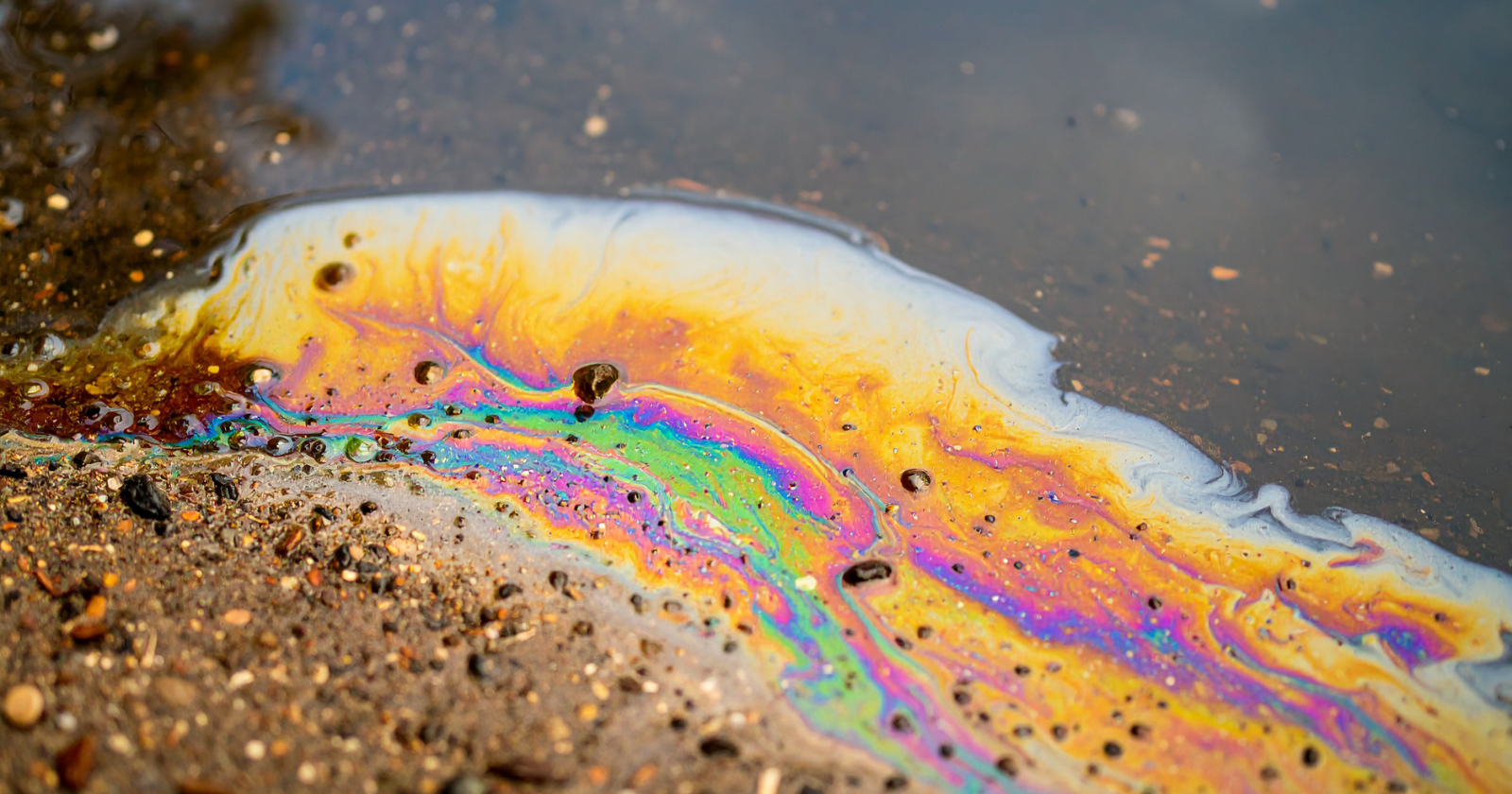
He had spread a fixed volume of oil over a measured area, and the oil had stopped spreading. It didn’t thin forever into nothing; it reached a limit and held. That limit is a clue about the smallest possible thickness of oil — and the arithmetic is something a schoolchild can do. Take the volume of the oil, divide by the area it covered, and the answer is the thickness of the film.
A teaspoon is about 5 cubic centimeters. Half an acre is about 2,000 square meters. Divide one by the other and the oil layer comes out around two nanometers thick — two millionths of a millimeter.
That number matters enormously, because a puddle of oil cannot be thinner than a single one of its own molecules. If the film has thinned until it can thin no more, its thickness is roughly the height of one molecule lying on the water. Franklin, without knowing it, had trapped the size of a molecule inside a party trick — and never ran the division.
The kitchen bench and the knighthood
It took just over a century for anyone to take the number seriously, and when they did, it came from two directions at once.
In the 1880s, Lord Rayleigh — a titan of British physics — did the calculation Franklin hadn’t, spreading oil on water in the lab and reasoning from volume and area to a film thickness of about 1.6 nanometers, which he understood to be near the size of a single molecule. At almost the same moment, an untrained German woman named Agnes Pockels was doing better experiments at her own kitchen sink, having been kept out of university because she was a woman. Measuring surface films with barriers and buttons in a basin of water, she pinned the thickness at about 1.3 nanometers.
Pockels sent her results to Rayleigh in a letter. To his great credit, he recognized their quality immediately and arranged for them to be published in Nature — and the field of surface science effectively begins with the two of them, an English lord and a self-taught woman at a sink, both refining the number Franklin had left sitting on a pond.
Modern values put an oil molecule’s length right where they landed: on the order of one to two nanometers.
The moral in the teaspoon
The Franklin oil experiment is a favourite of physics teachers for a reason that outlives its charm: it shows that a fundamental constant of nature was lying in plain sight, inside an amount of oil small enough to swallow, waiting on nothing but the nerve to divide one number by another.
Franklin had the curiosity to run the experiment and the honesty to report it in full, but he stopped at the wonder — the looking-glass pond, the delighted onlookers — and didn’t push through to the meaning. It’s a very human failure, and an instructive one. He was standing on the first credible measurement of the molecular world and saw only a good trick. The molecule was in the teaspoon the whole time. All anyone had to do was ask how thin the oil had become before it stopped — and it took a hundred years, a lord and a woman at a kitchen sink to finally ask it.
