

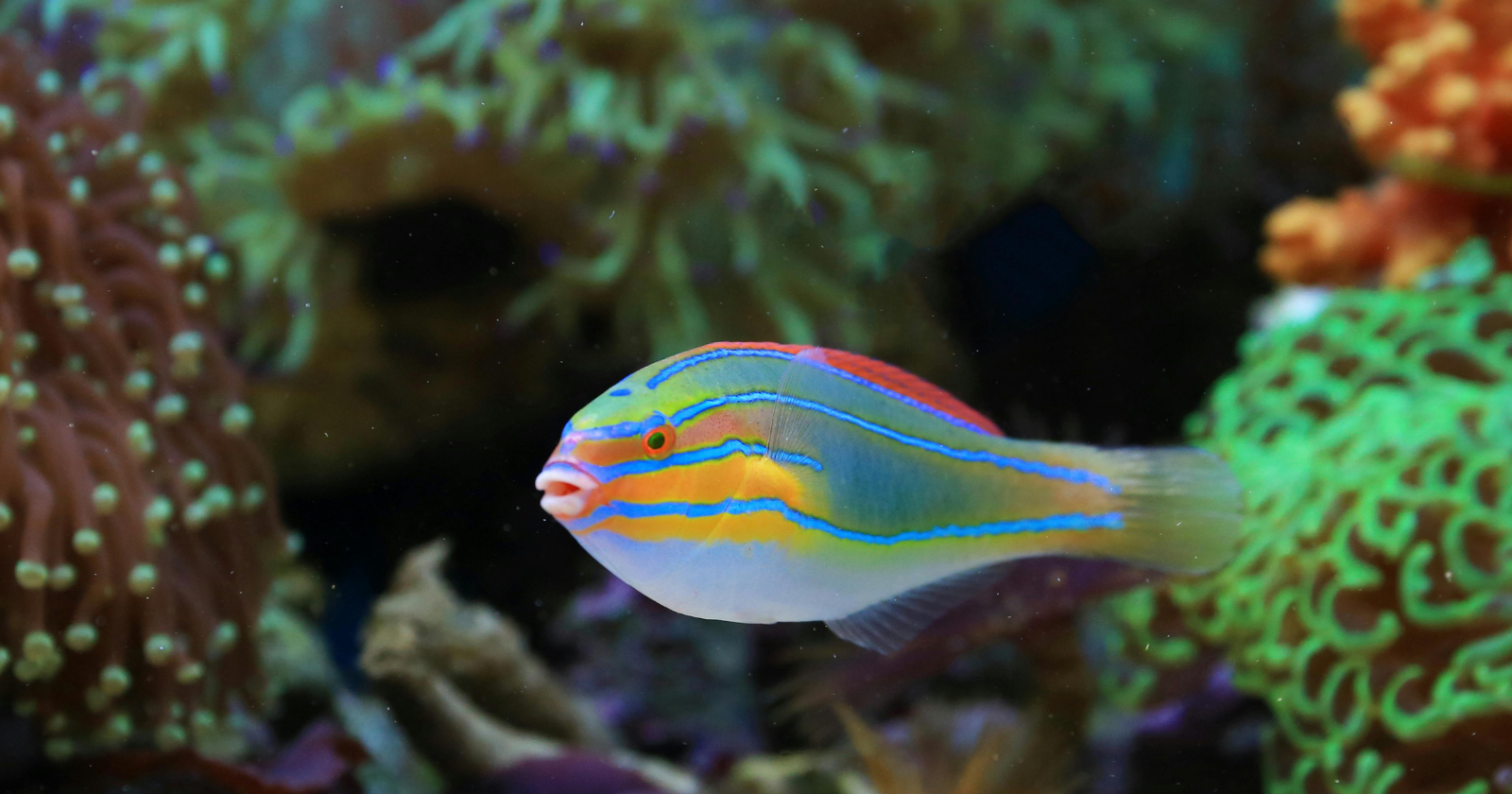
Marine biologists have documented five species of wrasse in the western Atlantic using rocks, coral rubble and shells as makeshift anvils to crack open crabs, mollusks and other armored prey — a foraging technique already documented in fish from the Indo-Pacific but never before filmed in the Atlantic. A study published in Coral Reefs in March 2025 provides the first evidence of anvil use in three of the five species and the first video documentation of the behavior in the other two.
The wrasses behind the discovery
The research, led by Dr. Juliette Tariel-Adam of the Fish Lab at Macquarie University’s School of Natural Sciences in Sydney, focused on New World wrasses in the genus Halichoeres: the slippery dick (H. bivittatus), the Brazilian wrasse (H. brasiliensis), the yellowhead wrasse (H. garnoti), the black-ear wrasse (H. poeyi), and the puddingwife wrasse (H. radiatus), documented at Fernando de Noronha Island off Brazil’s northeast coast.
The paper lists co-authors Jaqueline G. Toledo, C. E. O’Brien, Sergio R. Floeter and Professor Culum Brown alongside Tariel-Adam. Anvil use in fish is not new to science. Since it was first documented in an orange-dotted tuskfish roughly fifteen years ago, researchers have logged the behavior in roughly two dozen of the more than 550 known wrasse species, almost all of them in the Indo-Pacific and Indian Ocean. What sets this study apart is geography and scale: it is the first systematic documentation of anvil use among wrasses native to the western Atlantic, and it draws on the largest video dataset yet assembled for the behavior in this ocean basin.
The team built that dataset by turning to citizen scientists. Divers, snorkelers and underwater photographers working across the Caribbean, the Caicos Islands and Brazil submitted footage and written accounts through a public call for observations, contributing 16 new records to the study. Combined with existing records, the dataset gave researchers close, repeated looks at details of the behavior that had previously been described only impressionistically.
How the fish crack their prey
Fish in the study grabbed a hard-shelled item — in most cases a crab, mollusk, sea urchin or hermit crab — and swam it to a chosen surface before repeatedly slamming it against that surface to crack it open. Successful cracking attempts required an average of six or more strikes and took at least a minute to complete, and prey was successfully accessed and consumed in 12 of the 19 documented events, according to the published paper. One of the study’s more striking findings involves anvil choice.
The wrasses used a range of materials as anvils — rock outcrops, coral rubble, reef platforms and shells — without sticking to a single preferred striking surface, switching anvils mid-attempt in 53 percent of observed strikes.
Researchers interpreted this flexibility as a sign the fish are actively assessing which surface will most efficiently break a given prey item rather than relying on a classic bite-and-swim mechanism regardless of the target.
Researchers make the case for fish cognition
Tariel-Adam framed the findings as part of a broader case for taking fish cognition seriously. “Tool use is typically associated with humans, but this behaviour is proof that fish are far cleverer than they get credit for,” she said, in comments reported by Phys.org. Senior author Culum Brown, who has spent much of his career studying fish behavior and welfare, added that the wrasses “demonstrate flexible and dexterous tool use, expanding our understanding of tool use evolution in the animal kingdom.”
The paper situates the discovery within debates over how and why tool use evolves. Because anvil use has now turned up independently in wrasse lineages on opposite sides of the globe, the behavior increasingly looks like a foraging strategy that several unrelated reef fish lineages have independently evolved — one that is easily missed by divers not specifically watching for it, which is part of why the researchers built their dataset largely around community-contributed footage, supplemented by only a handful of controlled observations.
Coverage of the paper by Scimex and Oceanographic magazine both note that the research team is continuing to solicit new footage from divers and underwater photographers, on the expectation that further observations will clarify how widespread the behavior is among western Atlantic reef fish and whether other genera beyond Halichoeres practice it as well.
Further detail on the study is available via the Macquarie University research profile and additional reporting from ZME Science.