

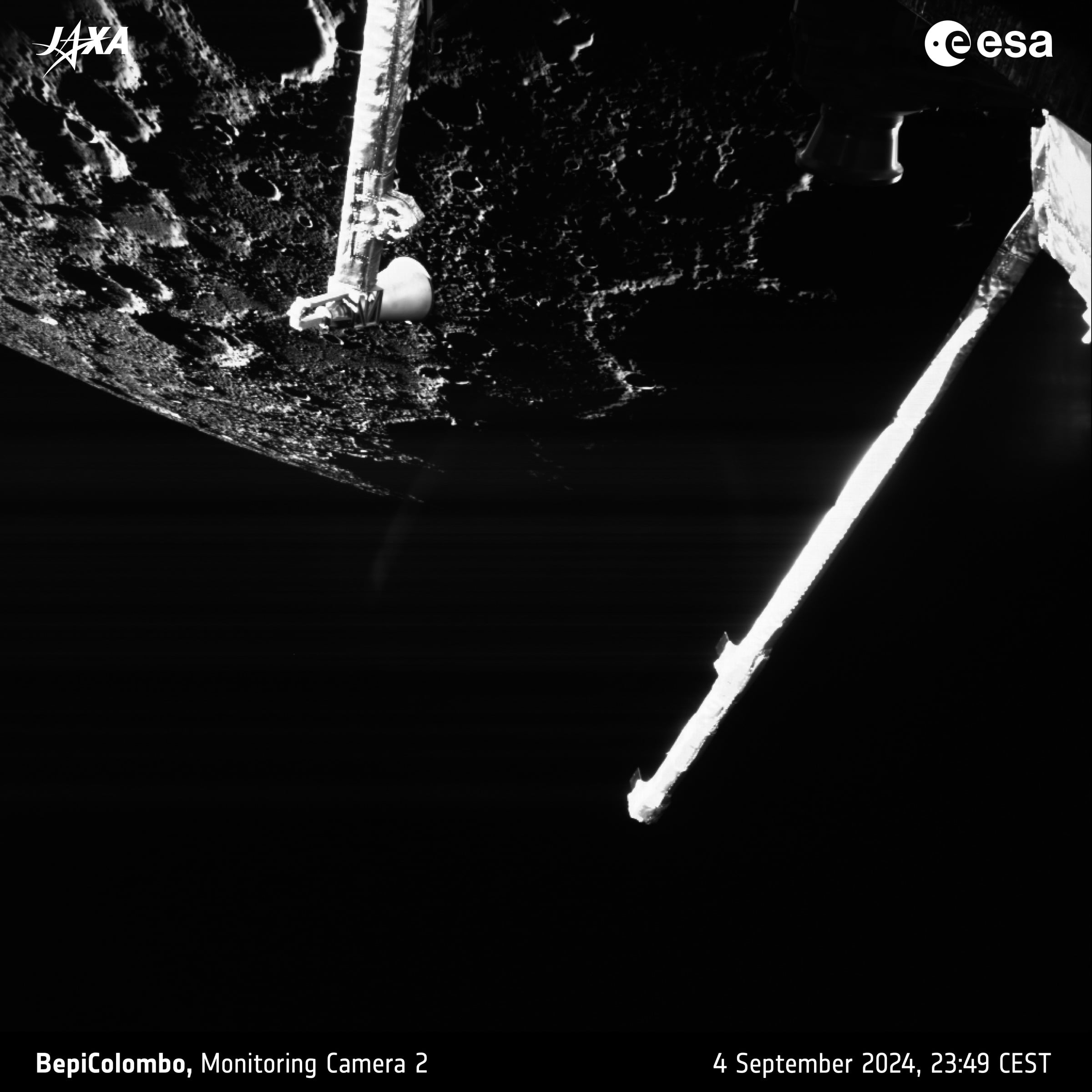
On 8 September 2026, Nature Astronomy published the first Mercury results from a Finnish-built particle and X-ray detector riding on BepiColombo, drawn from a pass that took the spacecraft to within 165 kilometres of the planet’s surface on 4 September 2024. During that fourth Mercury flyby, the Solar Intensity X-Ray and Particle Spectrometer, known as SIXS, recorded solar electrons and protons penetrating Mercury’s magnetosphere and precipitating onto the airless surface, while the planet itself carved structure into the particle population streaming past. The measurement was a matter of timing as much as trajectory: Mercury happened to be immersed in enhanced solar energetic particles when the ESA/JAXA spacecraft swung by, and an instrument designed largely to watch the Sun found itself sampling what the Sun does to a rocky world with almost no protection.
A 165-kilometre pass, and a Sun that was already active
Flybys are a currency of interplanetary navigation. BepiColombo has spent years shedding orbital energy against the gravity of Earth, Venus and Mercury itself, and each Mercury encounter has been a few minutes of close-range science bracketed by long stretches of cruise. The fourth of those encounters, on 4 September 2024, brought the stack to a closest approach of 165 kilometres above the surface, low enough that the spacecraft threaded the inner region where Mercury’s weak intrinsic magnetic field, the solar wind and the planetary body all interact within a very small volume.
What made the pass scientifically unusual was the space weather. As the University of Turku described in announcing the results on 10 September 2026, Mercury was bathed in elevated solar energetic particle fluxes at the time, so SIXS was not sampling a quiet background but an active one. Energetic protons and electrons from the Sun were arriving in quantity, and the instrument could track how that population changed as the spacecraft moved through the magnetosphere and past the planetary limb.
SIXS was built in Finland and flies on the Mercury Planetary Orbiter, one of the two science spacecraft in the BepiColombo stack. Its primary role is to measure solar X-rays and high-energy solar particles, largely so that the orbiter’s X-ray imaging spectrometer can interpret the fluorescence that those X-rays excite in Mercury’s crust. A detector built to watch the illuminating source turns out to be a capable monitor of the particle environment itself, and the new paper is the first published Mercury science from it.
Shadows, loss cones and a surface that absorbs
The signal in the data is largely a signal of absence. According to the Nature Astronomy analysis, protons vanished from the SIXS record in a way the authors relate to magnetic shadowing by the planet: the solid body of Mercury sits in the path of particle gyration and drift, and where a field line intersects the surface, the particles that would have populated it have already been swallowed. The planet writes its own silhouette into the energetic particle population, and the shape of that silhouette depends on where the spacecraft sits relative to the field geometry.
Electrons showed dropouts too, and the paper attributes these to a wide magnetic loss cone. In a strongly magnetised world such as Earth, particles spiralling along field lines are typically mirrored back before they reach the atmosphere, and only those with a narrow enough range of pitch angles are lost. Mercury’s field is weak and its planetary radius large relative to that field’s extent, so the range of angles that lead directly to impact is broad. The consequence is blunt: a large fraction of the arriving particles do not bounce, they land.
That is the core of the result. The authors present the flyby data as evidence of both planetary shielding and surface precipitation at a weakly magnetised planet close to its star. Mercury does deflect and structure the incoming population, so the magnetosphere is not irrelevant, but it also delivers a substantial share of that population onto bare rock. There is no atmosphere to intercept the flux, only a tenuous exosphere, so precipitating electrons and protons reach the regolith directly, where they can drive chemistry, contribute to the sputtering and release processes that keep the exosphere supplied, and excite X-ray emission of their own.
From October 2018 to an orbit at last
BepiColombo launched on 20 October 2018, a joint ESA and JAXA mission carrying two orbiters to the innermost planet: Europe’s first mission to Mercury, and the third spacecraft campaign there after NASA’s Mariner 10 in the 1970s and MESSENGER in the following decade. The cruise has been long by design, with flybys of Earth, Venus and Mercury used to slow the stack against the Sun’s gravity well, and the flybys have doubled as rehearsals, brief windows in which instruments still partly obstructed by the transfer module could be exercised on a real target.
That phase is ending. Orbit insertion at Mercury is planned for November 2026, with the two orbiters separating in December to begin their independent missions, according to the Finnish institutional coverage of the mission’s approach to orbit. From orbit, SIXS will be able to monitor the particle and X-ray environment continuously rather than in flyby snapshots, across changing solar activity and across the full range of magnetospheric geometry that a single 165-kilometre pass could only sample once.
The published result stands as a marker of what that continuous record should build on: during an episode of enhanced solar energetic particles, with the spacecraft 165 kilometres above the surface on 4 September 2024, SIXS registered proton disappearance consistent with magnetic shadowing by the planet and electron dropouts consistent with a wide magnetic loss cone, evidence of both shielding and precipitation onto an airless world. The orbital phase, and the long-duration version of that measurement, begins within weeks.